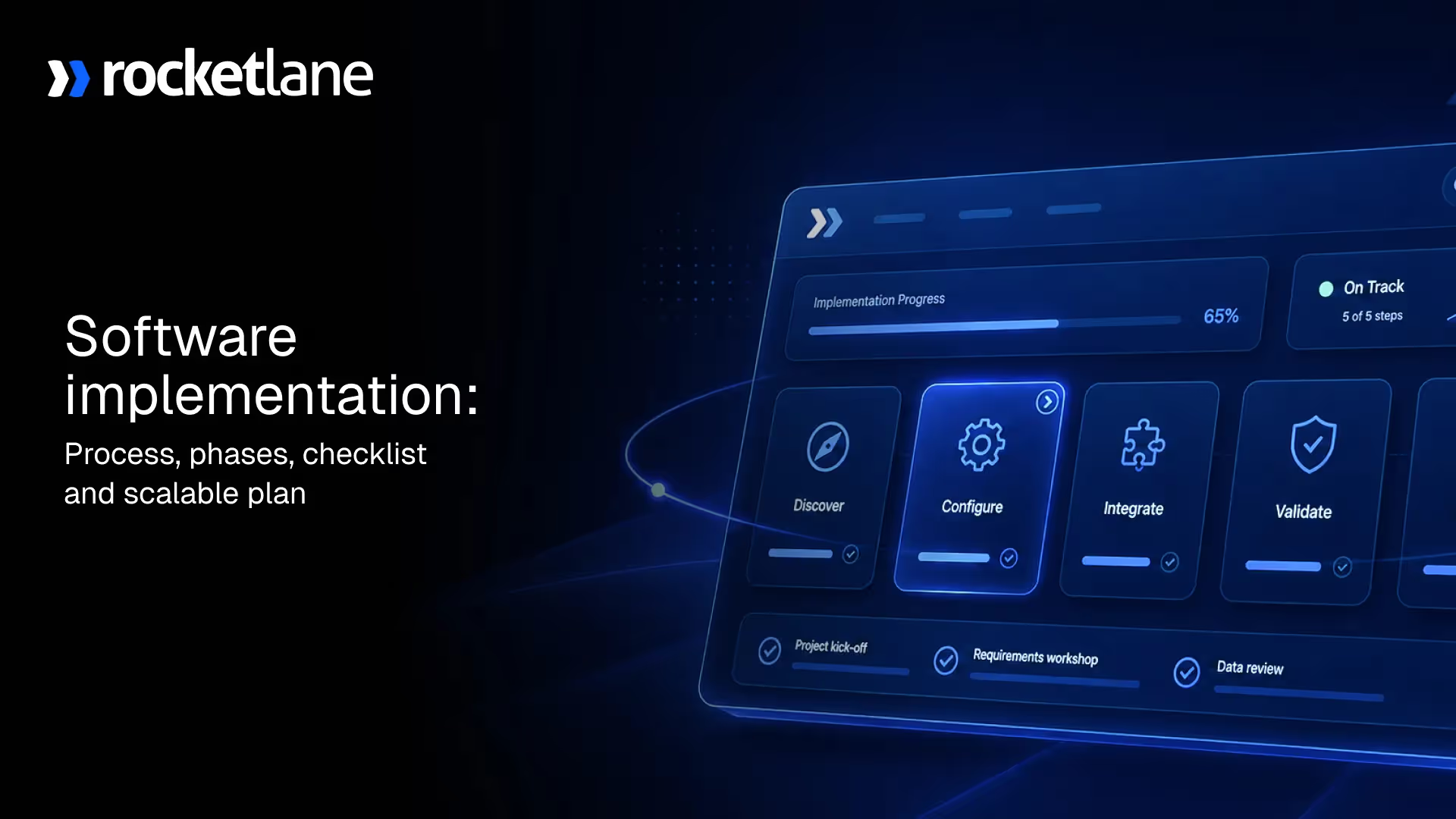
Software implementation: A complete guide for PS leaders in 2026

•
•
Summarize blog with






Most teams think the deal is the finish line. In reality, it is the starting point of risk.
Software implementation is where delivery performance directly shapes revenue outcomes. A contract only creates potential. Value is realized when the new software is configured, adopted, and used inside real business operations.
This is where margin evaporates. Where scope becomes a negotiation. Where your fastest rep's deal becomes your slowest delivery project.
Teams run implementation across spreadsheets, emails, and disconnected software systems. There is no single source of truth. Dependencies slip. Customers lose clarity. Internal teams spend more time coordinating than executing.
As volume increases, the cracks widen:
- Time to value keeps slipping
- Delivery costs increase due to rework
- Customer confidence drops during onboarding
- Forecasting becomes unreliable
High-performing teams don't run implementation projects.
They run implementation systems — repeatable, measurable, and scalable. That is what enables predictable delivery, better customer experience, and scalable growth.
Most teams think implementation starts after the contract is signed. It doesn't. It starts the moment a delivery team inherits a deal they didn't scope.
It includes:
- Defining scope and success criteria
- Gathering requirements
- Configuring and customizing the system
- Managing data migration and validation
- Testing workflows
- Running a comprehensive training program for users
- Launching the new software
- Providing ongoing support after go live
This process connects product capability to real business operations and determines how quickly and effectively value is realized.
What is software implementation?

Most teams think implementation starts after the contract is signed. It doesn't. It starts the moment a delivery team inherits a deal they didn't scope.
It includes:
- Defining scope and success criteria
- Gathering requirements
- Configuring and customizing the system
- Managing data migration and validation
- Testing workflows
- Running a comprehensive training program for users
- Launching the new software
- Providing ongoing support after go-live
This process connects product capability to real business operations and determines how quickly and effectively value is realized.
Implementation decides if the sale turns into revenue or regret. A signed contract only creates potential; value shows up when the system is live, configured, and actually used.
It is the point where strategy meets execution. A product can be well designed, but without a structured software implementation process, it fails to deliver value in real business operations.
Software implementation: Meaning in practice
Implementation turns product capabilities into working systems people actually use. That means configured workflows, clean data, and users who know what they're doing.
This includes aligning the new software with existing systems, configuring it, handling data migration, and ensuring teams know how to use it effectively.
Software implementation vs software development
Software development creates the product. Software implementation makes that product usable in a real context.
Development focuses on building software features and capabilities. Implementation focuses on applying those capabilities within a company’s business operations to produce measurable outcomes.
Software implementation vs integration vs adoption
Each plays a different role. Implementation sets up the system, integration connects it with other new software systems, and adoption ensures teams actually use it to generate value.
ICP pain
Teams struggle when software implementation is treated as a basic setup instead of a structured execution. Work becomes fragmented, ownership is unclear, and delays become the norm.
Business impact
A clear understanding of implementation improves planning accuracy, reduces rework, and accelerates time to value across projects.
Transition
Once the role of software implementation is clearly defined, its impact on revenue, customer experience, and scalability becomes impossible to ignore.
Why software implementation matters now

Implementation is no longer a post-sale handoff. It's a revenue function. A slow implementation delays revenue recognition. A broken one kills retention before the first renewal conversation.
In most SaaS and technology businesses, revenue does not truly begin at contract signing. It begins when the new software is implemented, used, and embedded into daily business operations.
This makes the software implementation process a critical lever for growth, retention, and margin control.
Time to value determines retention
Time to value is one of the strongest predictors of customer retention. When customers see results early, they build trust in both the product and the team delivering it.
Slow implementations kill retention before the first renewal meeting. Customers disengage. Internal champions lose credibility.
By the time you realize it, churn is already inevitable. A structured software implementation plan ensures that milestones are clear, progress is visible, and value is delivered within expected timelines.
Implementation shapes first product experience
For most customers, implementation is their first real experience with the product after purchase. It sets the tone for everything that follows.
If the implementation process is smooth, predictable, and well communicated, customers see the product as reliable and easy to work with. If it is fragmented and reactive, confidence drops quickly.
This is where factors like data migration, training program quality, and clarity of ownership matter. A poorly executed onboarding experience can outweigh even a strong product, while a well-executed implementation can strengthen long-term adoption and expansion.
Scale exposes process weaknesses
Spreadsheets work for three projects. At ten, they break. At fifty, they become the bottleneck. As teams handle more implementations, manual coordination becomes a bottleneck.
Without a defined system implementation process, teams rely on meetings, emails, and spreadsheets to track progress. Dependencies get missed. Customer tasks slip. Internal teams spend more time chasing updates than executing work.
This leads to longer timelines, inconsistent outcomes, and higher delivery costs. A standardized software implementation life cycle with clear phases and defined ownership allows teams to scale without adding unnecessary complexity.
Urgency
- Delayed implementation delays revenue recognition
- Inefficient execution increases the cost per project
- Inconsistent onboarding reduces customer satisfaction
Business impact
- Improved implementation reduces churn risk
- Faster delivery accelerates revenue realization
- Standardized execution improves scalability
Transition
To improve software implementation outcomes, teams need to clearly separate execution from adjacent functions like integration and adoption, and treat implementation as a structured system rather than a one-time setup.
Software implementation vs integration vs adoption

Software implementation, integration, and adoption are often treated as the same thing.
They are not. Each plays a distinct role in turning new software into real business value, and confusion between them is one of the biggest reasons implementations fail.
The difference comes down to responsibility, focus, and how success is measured.
Delivery teams' own implementation. That means they own the margin, the timeline, and the customer's first real experience with the product. The goal is to take the product and make it work inside the customer’s environment.
This includes configuration, data migration, workflow setup, and coordination across stakeholders. Success is measured by how quickly the customer reaches value.
Integration is handled by technical teams. Its focus is on connectivity between software systems.
This includes APIs, data syncing, and ensuring that systems communicate without errors. A system can be implemented correctly but still fail if integrations are unreliable. That is why data reliability is the key metric here.
Adoption sits with customer success teams. It focuses on usage and long-term value realization. Even a well-implemented system can fail if users do not engage with it. This is where training employees' programs, onboarding support, and continuous enablement come into play. Usage rate becomes the signal of success.
The biggest implementation failures don't come from bad execution. They stem from blurred ownership among the delivery, CS, and technical teams. Implementation teams get pulled into adoption issues. Technical teams fix execution gaps.
Customer success teams try to compensate for a poor setup. This creates confusion, delays, and inconsistent outcomes.
Clear separation ensures accountability. It allows each team to focus on what they do best while working toward a shared goal. When implementation, integration, and adoption are aligned but not mixed, teams reduce execution gaps, improve delivery speed, and create a smoother path from purchase to value.
Software implementation process in 7 phases
Without a defined process, every implementation becomes a one-off negotiation. Standardization turns delivery into a margin center rather than a cost center. Without defined phases, teams rely on reactive coordination, which leads to delays, rework, and inconsistent outcomes.
The most effective teams follow a clear, repeatable system implementation process that standardizes execution while allowing flexibility where needed.
Phases at a glance
The 7 phases of software implementation are: planning, discovery, configuration, migration, testing, deployment, and hypercare.
Each phase plays a specific role in moving from intent to execution.
Planning sets the foundation. Teams define scope, align stakeholders, and create a detailed implementation plan. Without this, everything downstream becomes reactive.
Discovery ensures clarity. Requirements are captured, dependencies are identified, and expectations are documented. This phase directly impacts the accuracy of timelines and the effort required.
Configuration translates requirements into a working system. This includes setting up workflows, permissions, and system behavior aligned to business operations.
Migration handles data transfer from existing systems into the new software. Clean, validated data is critical. Poor data migration leads to downstream issues that are hard to fix later.
Testing validates the system before launch. Teams check workflows, integrations, and data accuracy to ensure the system performs as expected.
Deployment is the go-live moment. The system is released into a live environment and made available to users.
Hypercare focuses on stabilization. Teams monitor usage, resolve issues, and support adoption through training programs and ongoing support.
Operator decision points
These decisions determine how well the implementation holds under pressure.
For example, an unclear scope leads to scope creep. Undefined ownership causes delays in customer tasks.
Poor timeline planning results in missed dependencies. Lack of defined KPIs makes it difficult to measure success.
Unstructured execution leads to unpredictable timelines, repeated delays, and constant firefighting. Teams spend more time coordinating than delivering.
A defined software implementation life cycle improves delivery speed, consistency, and forecasting accuracy. It enables teams to scale implementations without increasing operational chaos.
Software implementation plan template
A structured software implementation plan is the foundation of predictable delivery. Without it, teams rely on fragmented updates, unclear ownership, and reactive decision-making.
A well-defined system implementation plan brings clarity to execution and keeps both internal teams and customers aligned.
The goal of a software implementation plan is simple. It translates strategy into execution. It defines what needs to be done, who owns it, when it happens, and how success will be measured.
Implementation plan structure
A strong software implementation plan template includes the following sections:
Each section plays a specific role in driving clarity of execution.
Objectives define why the implementation exists. They connect the project to business operations and expected outcomes. Without clear objectives, teams lose direction and prioritize incorrectly.
Scope sets boundaries. It defines what is included in the software implementation project plan and what is not. This prevents scope creep and keeps timelines realistic.
Timeline maps the entire software implementation process across phases. It includes milestones, dependencies, and key checkpoints.
A well-structured timeline reduces delays and improves forecasting accuracy. Tasks break down execution into actionable steps. This is where high-level planning turns into day-to-day work.
Ownership ensures accountability. It clearly defines internal responsibilities and customer responsibilities. Most delays in implementing new software come from unclear ownership, especially on the customer side.
Risks identify potential issues early. These include data migration challenges, dependency delays, and integration gaps. Having mitigation plans in place reduces last-minute escalation.
Metrics define success. KPIs such as time to value, completion rate, and adoption signals help teams measure whether the implementation is on track.
Operator insight
A strong implementation plan serves as the single source of truth for delivery teams, customers, and leadership. It reduces reliance on meetings and manual updates by making progress visible and trackable.
Business impact
A well-structured software implementation plan improves alignment, reduces rework, and accelerates execution across projects.
Software implementation checklist

A software implementation checklist ensures that each phase of the implementation process is completed with clarity and consistency.
It acts as a control layer over execution, helping teams avoid missed steps, hidden risks, and incomplete handoffs.
A checklist isn't a to-do list. It's a forcing function. It stops teams from marking a phase complete before it's actually validated.
Tasks get marked complete without validation, and issues surface later during testing or after going live. A structured checklist prevents this by defining clear exit criteria for every phase.
Each phase must meet its checklist conditions before moving forward.
In the planning phase, the scope must be clearly defined and all stakeholders aligned. This includes internal teams and customer stakeholders. Misalignment at this stage leads to downstream delays.
During discovery, requirements should be validated rather than assumed. This reduces rework during configuration. Configuration is complete only when the system reflects agreed workflows and business operations.
Migration requires careful validation. Data migration issues are among the most common causes of failure when implementing new software.
Testing must include user acceptance testing. UAT approval confirms that the system works as expected in real scenarios. Deployment readiness ensures that all dependencies are resolved before going live.
Hypercare focuses on adoption tracking, training program effectiveness, and ongoing support to stabilize usage.
Operator rule
A phase is complete only when all checklist conditions are validated. Skipping validation leads to compounding errors that are harder to fix later.
Software implementation examples
Software implementation varies significantly based on business size, system complexity, and the number of existing systems involved. Not all implementations require the same level of effort, and treating them equally leads to poor planning and unmet expectations.
In an SMB SaaS onboarding scenario, implementation is usually straightforward. The focus is on configuring the system, basic data migration, and running a simple training program. Timelines are shorter, and fewer stakeholders are involved.
Mid-market implementations introduce more complexity. Multiple workflows need to be configured, dependencies increase, and coordination across teams becomes more important.
Here, a structured software implementation plan is critical for managing timelines and ownership.
Enterprise deployments are the most complex. They involve multiple software systems, large-scale data migration, and deep integration requirements. These projects require detailed planning, strong governance, and continuous monitoring to avoid delays and cost overruns.
Different levels of complexity demand different resource allocation, timelines, and execution strategies.
Software implementation methodologies

Choosing the right software implementation methodology depends on the clarity of scope, customer involvement, and risk tolerance.
There is no single approach that works for every implementation. The goal is to match the methodology to the project's level of uncertainty and complexity.
Waterfall works best when requirements are clearly defined upfront. The software implementation process follows a linear sequence, with each phase completed before the next begins. This reduces ambiguity but limits flexibility when requirements change.
Agile is suited for projects where requirements evolve. Teams work in iterations, allowing continuous feedback and adjustments. This approach improves adaptability but requires strong coordination and disciplined execution.
Phased rollout focuses on risk control. Instead of launching everything at once, teams implement the system in stages. This reduces the impact if issues arise and allows gradual stabilization.
Pilot first approaches are used for validation. A smaller group or use case is implemented first to test assumptions before scaling. This is common when implementing new software in an organization with high uncertainty.
Hybrid models combine elements of these approaches. They provide structure where needed and flexibility where required.
Operator insight
Hybrid models are widely used because they balance predictability with adaptability, making them effective for most modern software implementation scenarios.
Software implementation timeline
SMB implementations take weeks. Enterprise ones take months. The difference isn't effort—it's coordination overhead.
While benchmarks help set expectations, actual timelines depend on how well the software implementation process is structured and executed.
For SMB implementations, timelines are shorter because the scope is limited. Fewer stakeholders are involved, integrations are minimal, and data migration is relatively simple. With a clear software implementation plan, teams can move quickly from setup to go live.
Mid-market implementations introduce more variables. Multiple workflows need to be configured, dependencies increase, and coordination across teams becomes critical. Delays often occur when ownership is unclear or when customer inputs are not delivered on time.
Enterprise implementations take the longest due to scale and complexity. These projects involve multiple existing systems, large datasets, and deeper integration requirements.
Data migration alone can extend timelines if validation is not handled properly. In addition, approvals, compliance checks, and stakeholder alignment add layers of coordination.
Timeline accuracy depends less on effort and more on execution discipline. Poor planning, unclear scope, and reactive communication can easily double expected timelines.
A well-defined system implementation process with clear phases, milestones, and accountability reduces this risk. It ensures that dependencies are tracked, decisions are made early, and progress is measurable.
The fastest teams don't work faster. They remove coordination overhead. That's what cuts timelines in half.
Software implementation risks

Software implementation risks are not random. They follow predictable patterns and show early signals long before they become major issues.
Teams that recognize these signals early can prevent delays, cost overruns, and poor outcomes.
Scope creep is one of the most common risks in a software implementation project. It starts with small, unplanned requests that seem harmless but quickly expand the scope. Without proper change control, timelines stretch, and priorities shift.
Data issues often surface during migration. Inconsistent formats, missing fields, or incorrect mappings lead to errors that require rework. Strong data migration validation significantly reduces this risk.
Customer delays are another major factor. Implementation depends on inputs, approvals, and actions from the customer side. When ownership is unclear, tasks get missed, and timelines slip. Clear accountability and visibility are critical here.
Integration failures occur when systems do not communicate as expected. API errors, mismatched data structures, or missing dependencies can block progress. Thorough testing before deployment is the only reliable way to prevent this.
Most risks are avoidable. They become critical only when they are identified too late. A strong software implementation plan, combined with clear checkpoints across the implementation process, helps teams detect and resolve issues early.
Why most software implementations fail

Most implementations fail before go-live. Not because the product is bad. Because the handoff from sales to delivery was never structured.
Even strong teams struggle when the software implementation process is not structured. Work becomes reactive, ownership blurs, and issues surface too late to fix without causing impact.
These failures are predictable and often repeat across projects.
Handoff gaps
One of the earliest failure points is the transition from sales to delivery.
Critical context is often lost during this stage. Requirements discussed during sales are not fully documented. Customer expectations are not clearly transferred. Delivery teams start with incomplete information and make assumptions to move forward.
This creates misalignment from day one. Teams end up revisiting decisions, reworking configurations, and adjusting scope mid execution. A weak handoff directly increases delays and delivery costs.
Customer dependency mismanagement
Software implementation depends heavily on customer participation.
Customers are responsible for providing data, validating requirements, and approving milestones. When these dependencies are not tracked or enforced, progress slows down. Tasks remain pending without clear accountability.
Most teams assume customer inputs will come on time. In reality, they need structured follow-up, visibility, and ownership. Without this, timelines slip even when internal execution is strong.
Lack of visibility
Visibility is one of the most overlooked factors in implementation success.
Leadership often relies on meetings or manual updates to understand project status. There is no real-time view of progress, risks, or delays. By the time issues are visible, they have already impacted timelines.
A lack of visibility leads to reactive decision-making. Teams spend time explaining problems instead of solving them. This slows down the entire software implementation project.
Over-reliance on manual coordination
Many teams still manage implementation using emails, spreadsheets, and status calls.
This creates a heavy coordination layer. Delivery teams spend a large portion of their time updating stakeholders, manually tracking tasks, and chasing down inputs. Execution takes a back seat.
Manual coordination also increases the risk of errors. Tasks get missed, dependencies are overlooked, and communication becomes inconsistent across stakeholders.
Trigger signals
- Repeated timeline changes
- Constant escalation meetings
- Unclear ownership
Business impact
Failure in software implementation increases delivery costs, delays revenue realization, and raises the risk of churn. It also reduces team capacity, as more effort is spent on fixing issues rather than delivering new projects.
The pattern is clear. When execution is not structured, failure is not an exception. It becomes the default outcome.
What best-in-class teams do differently
The gap between average and high-performing teams in software implementation is not effort. It is how execution is structured and managed. Best-in-class teams do not rely on individual effort to drive outcomes. They build systems that make execution consistent and scalable.
Traditional teams operate across multiple tools. Information is scattered across spreadsheets, emails, and project tools. This creates visibility gaps and forces teams to spend time coordinating rather than executing.
Best-in-class teams work from unified platforms where all implementation data lives in one place. This creates a single source of truth and reduces dependency on manual updates.
Execution style also differs. Traditional teams react to issues as they arise. Delays are identified after they happen. Best-in-class teams monitor progress proactively. They track risks, dependencies, and milestones in real time, which allows early intervention.
Manual processes are another major differentiator. Traditional teams depend on status calls and manual reporting. Best-in-class teams automate workflows wherever possible. This reduces administrative effort and frees up time for actual delivery work.
Communication is often siloed in traditional setups. Different stakeholders have different versions of the truth. The best delivery teams don't send weekly status emails. They give customers a live view into progress, so they never have to ask. Everyone sees the same data, which improves alignment and decision-making.
Business impact:
This shift improves delivery speed, consistency, and scalability. Customer relationship management can handle more software implementation projects without increasing headcount, while maintaining quality and predictability.
Software implementation best practices
The difference between average and successful software implementation is not effort. It is consistency in execution. Best practices create that consistency and make outcomes predictable across projects.
- Define business outcomes before execution: Start with clear objectives tied to business operations. Define what success looks like before building the software implementation plan. This keeps teams aligned and avoids unnecessary work during execution.
- Standardize core workflows: Not every part of the software implementation process needs to be custom. Standardizing repeatable steps across projects reduces variability and improves delivery speed. It also makes scaling easier as volume increases.
- Enforce customer accountability: Customers play a critical role in implementation. Their inputs, approvals, and validations directly impact timelines. Clearly define customer responsibilities and track them as you would internal tasks. This reduces delays when implementing new software.
- Track meaningful KPIs: Focus on metrics that reflect execution quality. Time to value, milestone completion rate, and escalation frequency provide a clear view of progress. Tracking these KPIs helps teams identify issues early and take corrective action.
- Limit early customization: Over-customization in early phases increases complexity and slows down delivery. Focus on core functionality first, then expand based on actual needs. This approach reduces risk and speeds up the software implementation timeline.
- Reduce manual coordination through automation: Manual updates and constant follow-ups consume a large part of the delivery effort. Automating status tracking, reporting, and communication improves visibility and frees teams to focus on execution.
Consistency enables scalability. Teams that follow structured best practices deliver faster, reduce rework, and handle higher implementation volumes without losing control.
Software implementation KPIs
Software implementation KPIs help teams measure execution quality, identify risks early, and improve consistency across projects. Without clear metrics, progress becomes subjective, and issues surface too late.
The most effective teams track a small set of KPIs that directly reflect delivery performance and business impact.
Time to value is the most important KPI in any software implementation process. It measures how quickly the customer begins to see real outcomes from the new software. Faster time to value improves retention and builds trust early.
On-time completion reflects predictability. It shows how consistently teams deliver projects within planned timelines. Frequent delays indicate issues in planning, ownership, or execution.
CSAT measures customer experience during implementation. A smooth onboarding experience leads to higher satisfaction and better long-term adoption.
Utilization tracks how effectively resources are used. Low utilization signals inefficiency, while very high utilization may indicate overload and risk of burnout.
Escalation rate highlights risk. Frequent escalations often point to deeper issues such as unclear scope, poor visibility, or dependency gaps.
Tracking these KPIs together gives a complete view of software implementation performance. It helps teams move from reactive problem-solving to proactive management.
Why your current tools break at scale
Most teams start software implementation with tools that work for a few projects. As volume increases, those same tools begin to fail. The problem is not the team. It is the mismatch between tools and execution needs.
Spreadsheets are often used as the backbone of implementation tracking. They are flexible but highly manual. As projects grow, maintaining accuracy becomes difficult. Data gets outdated, dependencies are missed, and version control becomes a constant issue.
Project management tools improve task tracking but fall short on collaboration and real-time visibility. They are built for internal teams, not for managing customer-facing implementation workflows. This creates gaps between what teams see internally and what customers experience.
CRM systems are designed for sales and pipeline tracking. They are not built to handle the complexity of a software implementation process. Trying to manage execution inside a CRM leads to fragmented workflows and limited visibility into actual progress.
As implementation scales, these limitations become more visible.
Trigger signals
- Excessive status meetings
- Unclear project health
- Manual reporting overhead
Teams spend more time updating stakeholders than executing work. Information is scattered, and decision-making becomes slower. Scaling software implementation requires tools that are built for execution, not just tracking.
Why Rocketlane fits modern implementation teams

Modern software implementation demands more than task tracking. Teams need execution systems that reduce manual work, improve visibility, and scale with project volume.
That's the problem Rocketlane solves. Not task tracking—execution systems. A unified platform that removes coordination overhead, makes progress visible, and lets delivery teams scale without adding headcount. It connects planning, execution, and reporting into a single system, helping teams run a more structured and predictable software implementation process.
Problem to solution mapping
Fragmented tools are one of the biggest barriers to execution. Teams rely on spreadsheets, emails, and multiple systems to manage implementation. This creates visibility gaps and forces teams to spend time coordinating rather than delivering. A unified platform removes these gaps by bringing all implementation data into a single source of truth.
Customer confusion is another common issue. When customers lack clear visibility into progress, timelines, or responsibilities, delays increase. A dedicated customer portal improves transparency. It allows customers to track progress, understand their responsibilities, and stay aligned with delivery teams.
Enterprise resource planning is often based on assumptions. Teams lack a clear view of capacity, leading to over-allocation or underutilization. Content management system capabilities provide better visibility into team capacity, helping teams assign work more effectively and avoid bottlenecks.
Manual reporting consumes a significant amount of time during implementation. Teams spend hours creating status updates, tracking progress, and sharing information across stakeholders. Dashboards replace this effort with real-time visibility, reducing administrative work and improving decision-making.
The value of this approach is not in individual features, but in how they work together. When planning, execution, and reporting are connected, teams reduce friction across the entire software implementation life cycle.
Business impact
Faster implementations through reduced coordination overhead
- Improved visibility across projects and stakeholders
- Better resource utilization across teams
- Reduced administrative burden, allowing teams to focus on execution
Modern implementation teams are moving away from fragmented setups toward unified, system-driven execution. This shift is what enables scale without sacrificing quality.
How Nitro transforms implementation workflows
Software implementation breaks down when execution depends on manual effort. Documentation, tracking, and coordination consume time that should be spent on delivery.
Nitro changes this by shifting teams from manual workflows to AI-assisted execution.
Workflow transformation:
Handoff is often inconsistent. Teams rely on meeting notes and scattered documents to capture requirements. This leads to gaps and misalignment. With Nitro, documentation is generated automatically from calls and inputs, creating a more reliable starting point for implementation.
Execution in most teams is reactive. Issues are addressed only after they surface. This delays progress and increases effort. Signal-driven execution helps teams detect risks early, using real-time inputs from across projects and customer interactions.
Reporting is another major bottleneck. Teams spend hours creating updates, compiling data, and sharing progress. AI-generated insights replace this manual effort by pulling data directly from the system and presenting it in a usable format.
Communication also becomes more efficient. Instead of constant follow-ups and status meetings, automated updates keep stakeholders informed. This reduces coordination overhead and improves clarity across teams and customers.
Operator rule
Automation reduces friction and improves consistency across the software implementation process.
Business impact
- Faster execution due to reduced manual work
- Lower operational overhead across teams
- Improved outcomes through better visibility and early risk detection
The future of software implementation

Software implementation is shifting from coordination-heavy execution to AI-driven systems. Teams are moving away from managing tasks toward systems that execute, monitor, and optimize work in real time.
This shift is not optional. As implementation volume grows and customer expectations rise, manual workflows cannot keep up. Spreadsheets work for three projects. At ten, they break. At fifty, they become the bottleneck. Delivery teams spend more time updating status than executing work.
AI is changing how implementation work gets done. It reduces manual effort in documentation, data migration, reporting, and communication. It also improves decision-making by providing real-time signals on risks, progress, and performance. Instead of reacting to problems, teams can act early and prevent them.
What this means
- Increased automation across the software implementation process
- Improved efficiency with less manual coordination
- Higher customer expectations for speed, clarity, and outcomes
Customers now expect what they were promised in the demo—fast, visible progress and outcomes in weeks, not quarters. Miss that window, and the deal feels like a mistake. They expect systems to work without delays and teams to operate with precision.
Teams that adopt structured workflows supported by automation and AI will deliver more consistent results. They will handle higher project volumes without increasing overhead. They will also create better customer experiences by reducing friction across the implementation journey.
The future belongs to teams that treat implementation as a repeatable system: defined handoffs, enforced accountability, and real-time visibility—not heroic project managers keeping it all in their heads.
Conclusion
Software implementation determines how quickly software turns into real business value. It is the bridge between a signed deal and actual outcomes inside business operations.
Teams that rely on fragmented tools, manual tracking, and reactive coordination struggle to scale. Delays become common, costs increase, and customer confidence drops during onboarding. These issues are not caused by effort. They are caused by the lack of a structured software implementation process.
Teams that adopt a clear implementation plan, define ownership, and standardize workflows operate differently. They reduce uncertainty, improve visibility, and deliver more predictable outcomes. When automation and AI are layered on top, the impact becomes even stronger. Manual work is reduced, execution becomes faster, and teams can handle more projects without increasing headcount.
The gap between average and high-performing teams is no longer about working harder. It is about building systems that execute consistently.
Resource constraints and coordination challenges do not show up early. They appear when timelines are already at risk. Rocketlane helps teams run software implementation at scale with better visibility, faster time to value, and lower delivery effort.
Blog Summary
Table of Contents

Regsiter for the live webinar


Great consultants didn't join your team to spend Fridays writing documentation.
Table of contents
18 of Forbes Cloud 100 chose Rocketlane. The best PS teams aren't waiting around.
FAQs
What is software implementation?
Software implementation is the process of deploying, configuring, testing, and launching software so it works within real business operations and delivers measurable value. It connects product capabilities to actual workflows, data, and users, ensuring the system is usable, adopted, and aligned with business goals from day one.
What are the phases of software implementation?
The phases of software implementation include planning, discovery, configuration, migration, testing, deployment, and post-launch support. Each phase has a clear objective and output, helping teams move from scope definition to a stable, fully functional system with validated workflows and active user adoption.
What should a software implementation plan include?
A software implementation plan should include objectives, scope, timeline, tasks, ownership, risks, and success metrics. It serves as a single source of truth, aligning delivery teams and customers, reducing confusion, and ensuring execution remains structured, trackable, and aligned with business outcomes.
Why do software implementations fail?
Software implementations fail due to poor visibility, unclear ownership, unmanaged customer dependencies, and reliance on manual processes. These issues lead to delays, rework, and misalignment, increasing delivery costs and reducing the likelihood of successful implementation and long-term value realization.
How long does implementation take?
Software implementation timelines vary based on complexity. SMB projects may take a few weeks, while enterprise implementations can take several months. Timelines depend on scope, data migration effort, integrations, and stakeholder involvement, with a structured installation process helping reduce delays.













Copyright © 2026 Rocketlane Corp. All rights reserved.



















.webp)