Project management methodologies: A complete guide with examples, frameworks, and how to choose the right one in 2026
•
•
Summarize blog with






Introduction
Projects rarely fail in a single moment. The early signs are much quieter.
Plans still exist, but they need constant clarification. Coordination takes more effort than expected.
Decisions that once felt straightforward begin to stall. Progress becomes something teams explain, not something that’s obvious from the work itself.
These signals show up long before deadlines slip or budgets are questioned. They point to a delivery system under strain.
As teams scale, timelines compress, and dependencies multiply, the way work is structured starts to matter as much as how well individuals execute.
In modern delivery environments, success depends on how decisions are made under uncertainty, how work is coordinated across roles and systems, and how risk is managed before it turns into rework.
This is where project management methodologies come into focus.
They define how projects move from intent to outcome. They shape when decisions are made, how change is handled, what progress means, and how accountability is shared across teams and stakeholders.
When methodologies are applied with intent, they reduce ambiguity. Roles become clearer. Communication becomes more predictable.
Trade-offs are made consciously rather than reactively. Over time, delivery variance narrows and confidence increases, even as complexity grows.
This guide takes an execution-first view of project management methodologies. It examines how commonly used approaches actually behave under real delivery pressure.
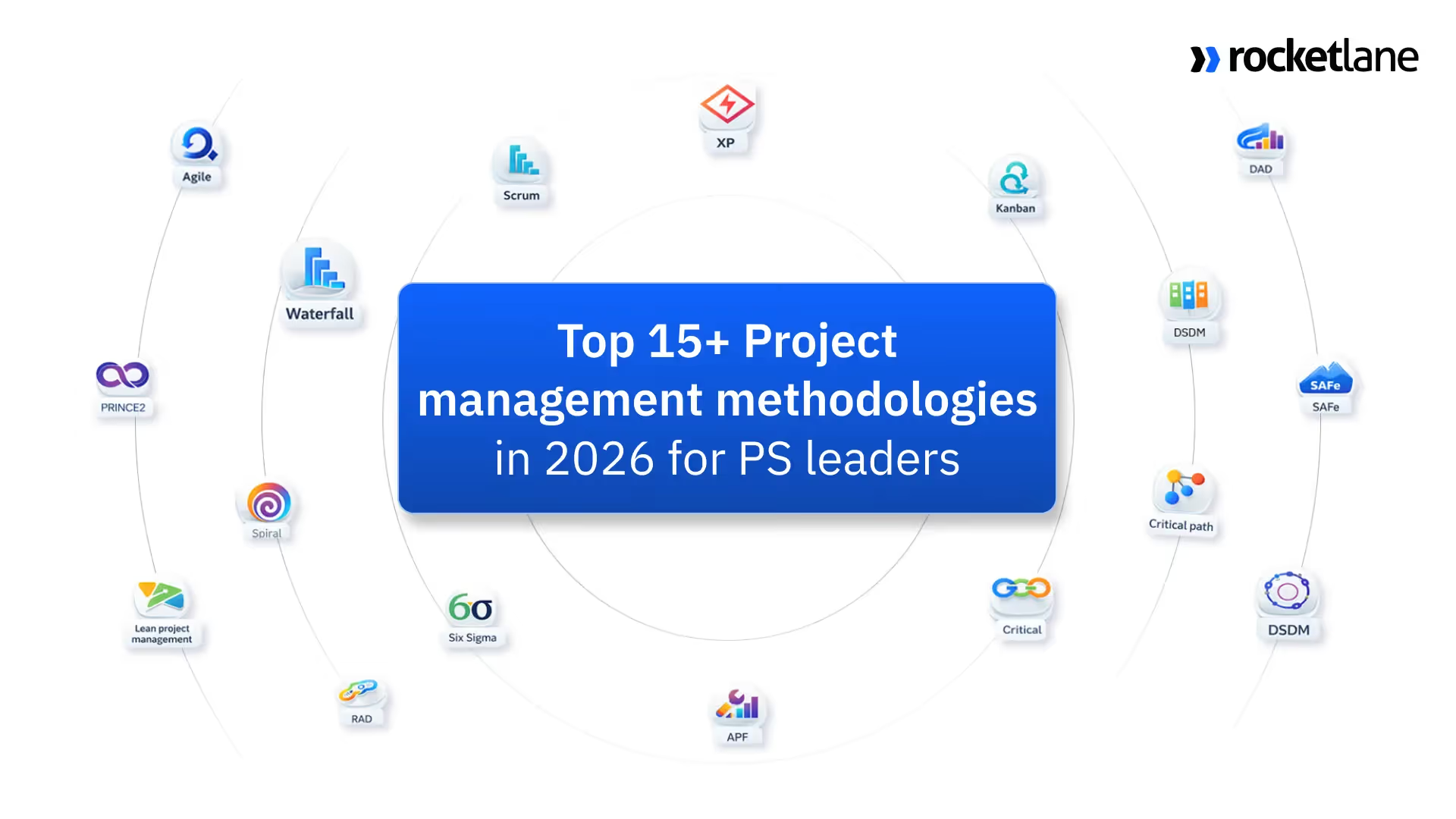
It explores methodologies and frameworks such as Waterfall, Agile, Scrum, Kanban, Lean, Six Sigma, and modern hybrid models, and compares how they handle scope volatility, dependency complexity, customer involvement, and risk.
It also examines how execution visibility, tooling, and AI-driven delivery systems are increasingly helping teams make deliberate methodology choices that support predictable execution and sustainable delivery.
What is a project management methodology?
A project management methodology is a structured, end-to-end system for organizing work under constraints.
It defines how a project moves from intent to outcome, how uncertainty is handled at different stages, and how coordination happens across people, time, and dependencies.
Each methodology is built on a set of core principles that guide how projects are structured, managed, and delivered.
At its core, a methodology answers four questions:
- How much do you need to know before we start a project?
- How do you organize work as conditions change?
- How do you measure progress in a way that reflects real value?
- How do you make trade-offs when constraints collide?
Projects differ from routine operations because they introduce new combinations of people, tools, scope, and expectations. Methodologies help establish boundaries around project scope, clarify roles and responsibilities, and align stakeholders around shared objectives.
Identifying project stakeholders and managing their stakeholder expectations throughout the project lifecycle is essential to ensure successful delivery and minimize misunderstandings.
In more mature organizations, methodologies also play a governance role. They standardize how decisions are escalated, how risks are identified and tracked, and how delivery performance is evaluated across portfolios.
This allows leadership to compare projects on meaningful dimensions and intervene early when patterns of risk or delay begin to emerge.
Project management methodologies: Common defaults vs how they are meant to work
Key differences between project methodologies, frameworks, processes, and techniques
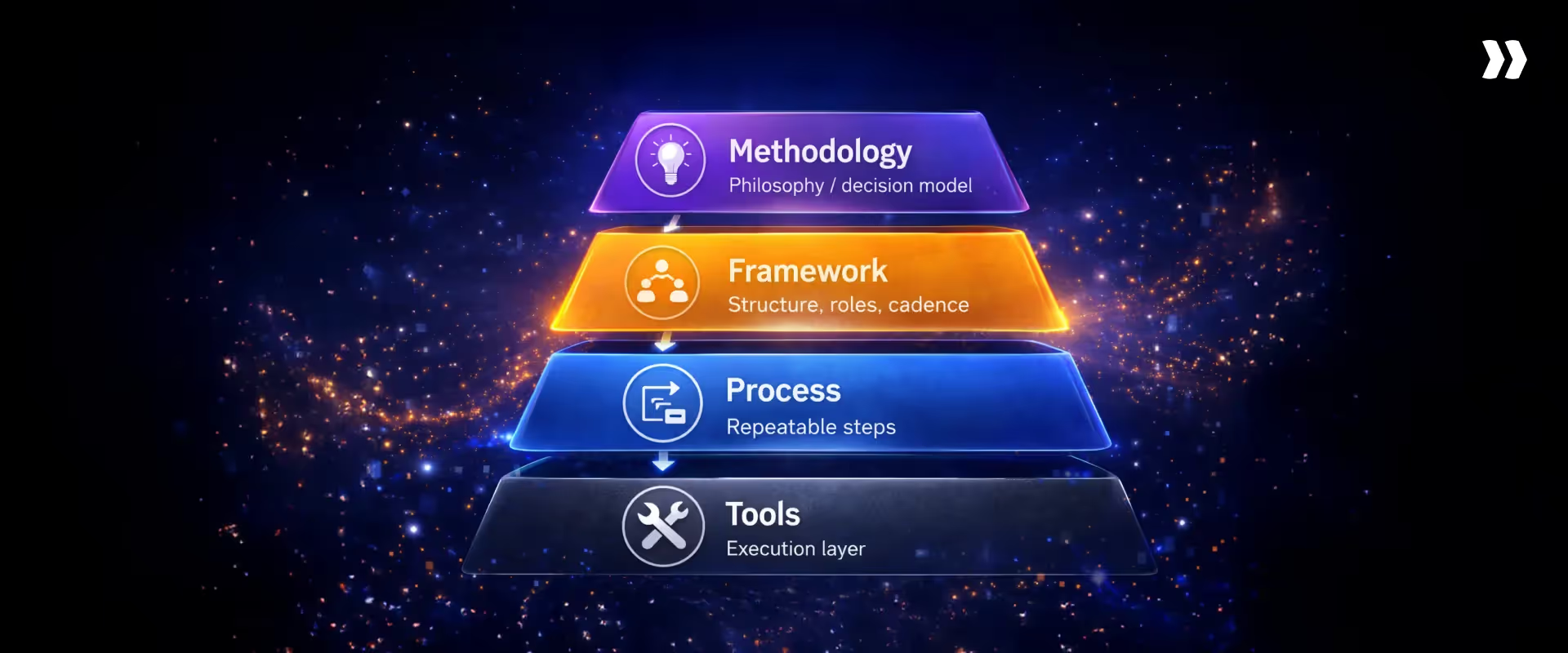
On one hand, the concepts of project methodologies, frameworks, processes, and techniques are often used interchangeably, but they operate at different levels of abstraction.
At a high level, each layer answers a different question about how work gets done, from overall philosophy to day-to-day execution.
Project management methods, on the other hand, refer to the overarching approaches that guide the selection and application of specific methodologies, frameworks, and processes.
Project management methodology
A project management methodology is the highest-order construct that defines the mental model of delivery by clarifying assumptions about uncertainty, complexity, and coordination.
It shapes how much planning is appropriate, how control mechanisms are applied, and how adaptable the system should be as conditions change.
Methodologies also establish governance expectations. They define who makes which decisions, when escalation is required, and how success is evaluated. In this sense, a methodology expresses the organization’s underlying philosophy about delivery.
Traditional project management methodologies typically follow linear, plan-driven processes, in contrast to more adaptive approaches that allow for iterative change.
Project management framework
A framework provides a structured way to apply a methodology in practice. It defines roles, events, artifacts, and workflows that teams use to coordinate work while leaving room for contextual adaptation.
For instance, Scrum and SAFe are examples of frameworks that sit within broader methodological thinking rather than replacing it.
Agile teams frequently use these frameworks to coordinate work, manage backlogs, and adapt to changing requirements.
Frameworks translate intent into operating structure, but they do not define the intent itself.
Project management process
A process is a repeatable sequence of steps designed to execute specific types of work consistently. Project management processes emphasize reliability and efficiency.
They are often embedded within frameworks to standardize recurring activities such as approvals, change management, testing, or handoffs.
Project management technique
A project management (PM) technique is a focused method used to solve a specific delivery problem.
Examples include estimation models, prioritization methods, dependency mapping, and risk analysis tools.
Techniques are portable and can be reused across methodologies, frameworks, and processes.
Why alignment matters
Strong delivery environments align all four layers so that intent, structure, execution, and problem-solving reinforce one another. Weaker environments mix these layers arbitrarily.
The result is tool-driven behavior, inconsistent execution, and surface-level adoption of practices without shared intent.
How methodologies, frameworks, processes, and tools differ in intent, structure, and execution
Benefits of using the right project management methodology
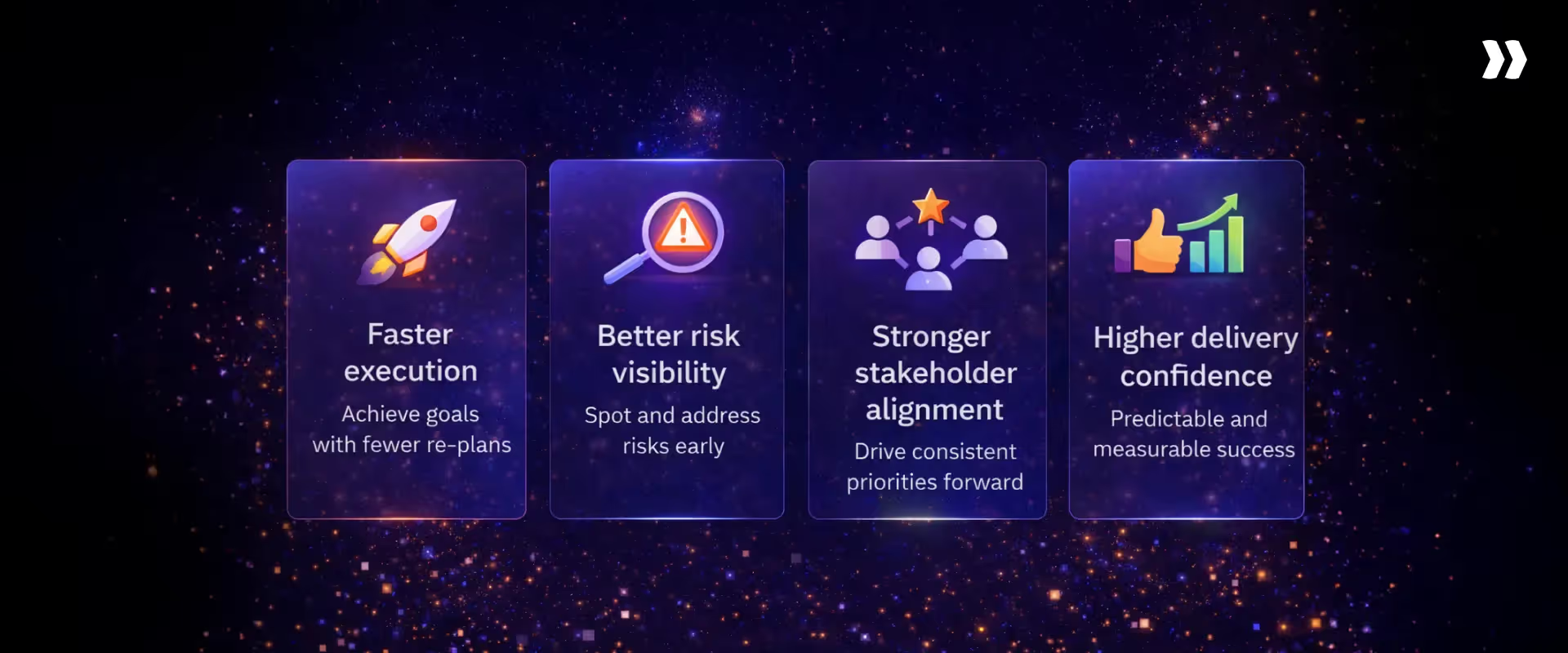
Using the right methodology does not make teams faster by default. What it does is reduce avoidable friction.
It aligns how decisions are made, how uncertainty is handled, and how coordination happens across people and time.
Choosing the appropriate project methodology ensures that these benefits are maximized by providing a structured set of principles and processes tailored to the project's needs.
The benefits compound across the lifecycle of a project and become most visible under pressure.
A well-matched methodology aligns three things that are otherwise easy to misalign:
- How decisions are made,
- How uncertainty is handled, and
- How coordination happens across people, tools, and time.
Methodologies also align stakeholders around shared objectives.
Clearly defining project objectives and project deliverables at the outset is essential for guiding planning and execution, ensuring everyone understands the tangible outputs expected and the goals to be achieved.
When those elements are aligned, your teams stop fighting the system they are working inside, and you get:
- Less wasted effort
- Fewer surprises
- More predictable delivery
- Higher morale
Selecting the right methodology increases the likelihood of project success by ensuring alignment, effective risk management, and the delivery of intended project objectives and project deliverables.
Faster execution with fewer re-plans
Methodologies influence speed indirectly, by reducing how often teams have to stop, rewind, and reset.
The right methodology matches planning depth to uncertainty. This means that
- Predictive methodologies concentrate decisions early, which works when assumptions are stable, and change is costly.
- Adaptive methodologies delay commitment, which works when information improves through execution.
When this match is correct, teams avoid two common failure modes:
- Over-planning in inherently volatile environments
- Under-planning in environments where constraints are real and unforgiving.
The result is forward motion with teams spending less time revisiting fundamental assumptions and more time making incremental, informed decisions.
Better risk visibility
Every methodology encodes assumptions about when risk should appear and how it should be handled.
Some surface risk early through analysis and validation.
Others distribute risk discovery across delivery cycles. Some make risk reduction the organizing principle of execution.
The right methodology ensures that risks surface while they are still manageable, by ensuring that:
- Risks appear as patterns and trends, not surprises.
- Activity is less likely to be mistaken for progress.
- Issues tied to scope, feasibility, resourcing, or stakeholder readiness emerge through structured checkpoints (rather than informal escalation).
Over time, teams develop a shared language that distinguishes acceptable uncertainty from preventable exposure.
Stronger stakeholder alignment
Beyond guiding teams, methodologies shape stakeholder behavior, often implicitly.
A clear methodology sets expectations around:
- When stakeholders are involved
- What kind of input is required, and
- How changes will be evaluated.
Project managers are responsible for ensuring that stakeholder and customer expectations are managed throughout the project lifecycle.
Stakeholders know whether they are shaping direction continuously, validating outcomes at milestones, or approving formal transitions. Teams know where authority sits and how decisions move.
Alignment here is about shared understanding of constraints, trade-offs, and success criteria throughout delivery.
Higher delivery confidence
Delivery confidence is, at its core, trust in the system. Teams gain confidence when they understand:
- How progress will be measured
- How issues will be escalated, and
- How change will be absorbed without destabilizing delivery
At an organizational level, this confidence compounds with forecasts becoming more credible, lessons persisting across projects, and confidence becoming structural rather than situational.
How and why project management methodologies shape planning, execution, and outcomes
Once a methodology is in place, it shows up in how teams plan, how they respond when reality diverges from expectations, and how outcomes are ultimately judged.
Selecting the appropriate methodology is essential to effectively manage projects of varying complexity and uncertainty.
How methodologies shape planning
Methodologies define how much certainty teams are expected to achieve before execution begins.
Some approaches emphasize early commitment and detailed definition, while others intentionally allow ambiguity to persist until learning improves.
In practice, this shapes project planning behavior in several ways:
- Teams develop shared expectations about which decisions must be locked early and which can remain fluid.
- Assumptions are treated differently, either as commitments to defend or hypotheses to test.
- Estimates carry different weight, depending on how reversible early decisions are assumed to be.
- Planning effort either compounds value or becomes rework, depending on how closely it matches uncertainty.
How methodologies shape execution
During execution, methodologies influence how work is coordinated and how frequently decisions are revisited.
They define whether teams operate in fixed cycles, continuous flow, or staged handoffs, and they shape how dependencies are surfaced and resolved.
This shows up in execution patterns such as:
- How often teams synchronize and realign priorities
- Whether dependencies are managed proactively or discovered through delay
- How ownership is distributed across roles and teams
- How quickly teams can respond when work does not proceed as expected
How methodologies shape tracking and control
Methodologies also define what signals matter during delivery.
They determine whether progress is interpreted through milestone completion, documentation, working outputs, flow metrics, or customer impact.
Methodologies provide structured approaches to measuring and visualizing project progress, enabling teams to monitor advancement and make informed adjustments.
This affects tracking and control in concrete ways, such as when:
- Teams optimize for the metrics that define progress, even when those metrics are imperfect proxies for value.
- Risks surface either early through frequent feedback or late through formal reviews.
- Control mechanisms rely on either escalation and approval or inspection and adjustment.
How methodologies shape outcomes over time
Across multiple projects, methodologies leave a lasting imprint on organizational behavior.
Teams internalize what is rewarded, what is tolerated, and what triggers escalation.
Over time, this leads to patterns such as:
- Increased or reduced willingness to surface risk early.
- Greater reliance on process or on judgment.
- Consistent delivery confidence or persistent uncertainty across portfolios.
This is why methodology choice has long-term implications. It shapes how organizations learn from delivery, not just how individual projects are run.
The 6 core phases common to most project management methodologies
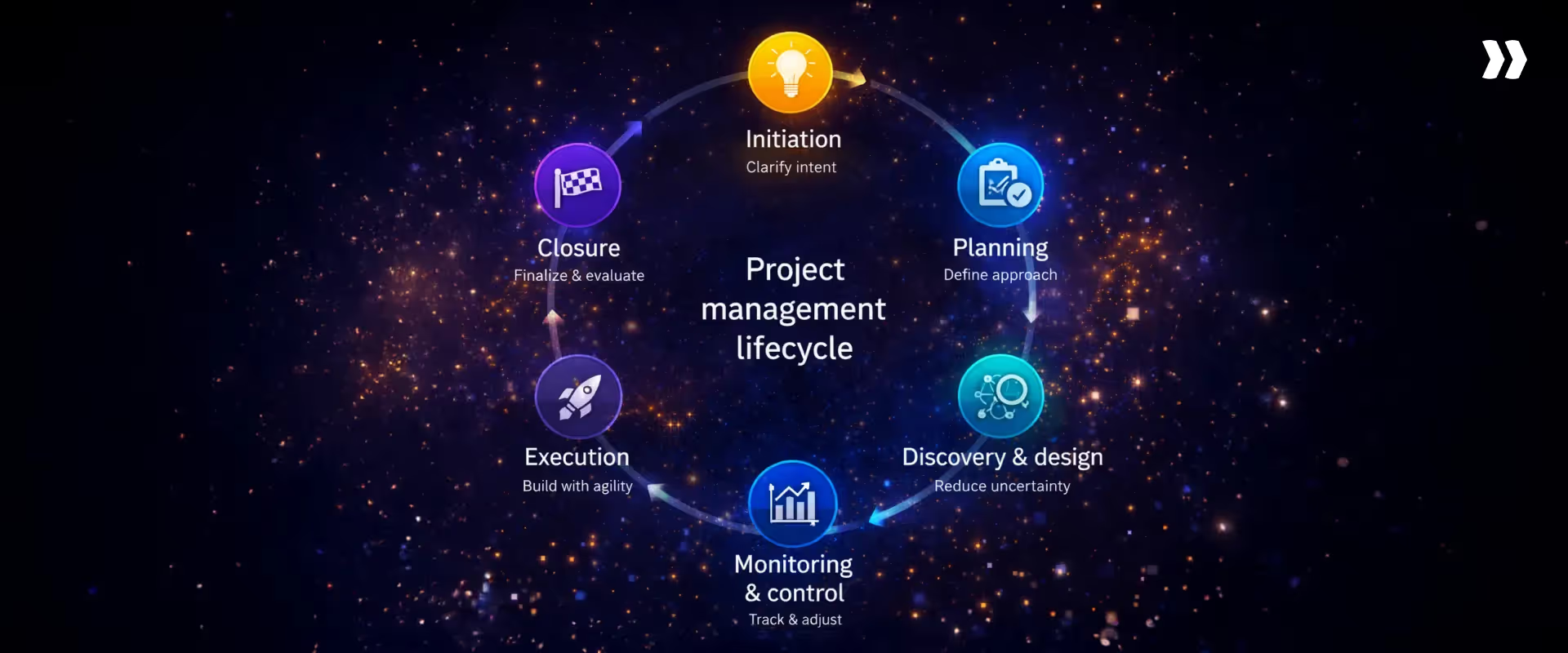
Although methodologies differ in how they handle uncertainty, control, and change, most are organized around a shared lifecycle.
These phases are less about strict sequencing and more about recognizing what kind of thinking and coordination is required at different points in delivery.
The 6 core phases will closely mirror the software development life cycle used in software engineering projects.
Understanding these phases helps teams see where structure adds leverage and where it can introduce friction.
1. Initiation
Initiation establishes why the project exists and under what conditions it should move forward.
This phase anchors delivery work to strategic intent rather than treating execution as an isolated activity.
In practice, initiation brings clarity around a few critical elements, such as:
- The outcome the project is meant to deliver and why it matters
- The stakeholders involved, along with their decision authority
- The constraints that shape delivery, including time, project budgets, and regulatory limits
- The risks that could fundamentally undermine the project if left unaddressed
In some project management methodologies, project initiation is a formal process that sets up roles, processes, and organizational structure at the outset to ensure successful project delivery and management.
2. Planning
Planning converts intent into coordinated action. It defines how scope, timelines, resources, and dependencies fit together into a workable delivery model.
Effective planning does not eliminate uncertainty. It makes assumptions explicit and tests whether commitments are appropriate given the cost of change. Planning effort typically focuses on:
- Clarifying scope boundaries and what is intentionally out of scope
- Sequencing work to respect dependencies and constraints
- Allocating resources while acknowledging competing priorities
- Establishing communication and decision-making cadence
3. Discovery and design
Discovery and design deepen understanding before commitments harden. This phase focuses on clarifying requirements, validating assumptions, and aligning stakeholders on solution direction.
In practical terms, discovery and design help teams:
- Surface technical, operational, or user-related unknowns
- Explore solution options and trade-offs
- Reduce downstream rework by testing assumptions early
In predictive methodologies, this phase is concentrated early. In adaptive methodologies, it is distributed across iterations.
In both cases, its purpose is risk reduction through learning.
4. Execution
Execution is where plans encounter reality. Work is carried out, dependencies become visible, and trade-offs must be resolved in real time.
Execution quality is shaped by:
- How clearly ownership and accountability are defined
- How quickly decisions are made when constraints collide
- How effectively teams coordinate across roles and dependencies
Strong execution systems absorb change without losing direction. Weak systems rely on individual effort to compensate for structural gaps.
5. Monitoring and control
Monitoring and control run alongside execution.
This phase provides visibility into progress, quality, cost, and risk so teams can adjust course deliberately rather than reactively.
Effective monitoring typically emphasizes:
- Early signals of delay or risk rather than retrospective status
- Meaningful indicators of value delivery, not just activity
- Decision-enabling project insights instead of exhaustive reporting
Control mechanisms vary by methodology, but their purpose remains the same: enable timely intervention without stalling execution.
6. Closure
Closure formalizes completion and enables learning. It confirms outcomes, captures lessons, and transitions ownership from project teams to operational teams.
Although often treated as administrative, closure is where organizations consolidate delivery insight. When it is skipped or rushed, teams lose the opportunity to improve future execution and repeat avoidable mistakes.
The most widely used project management methodologies
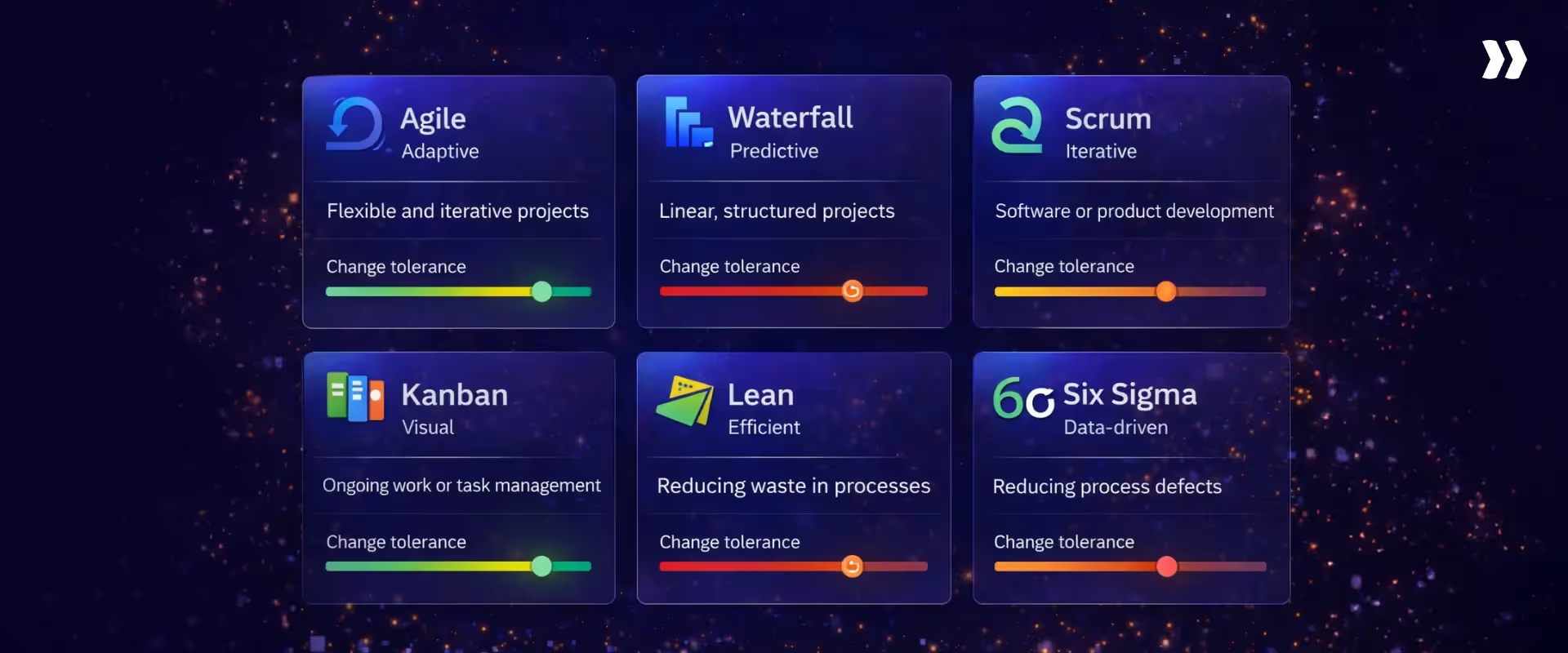
Each methodology encodes assumptions about how predictable the work is, how tightly tasks are coupled, how decisions should be staged, and how expensive it is to change direction once execution begins.
The sections below examine widely used methodologies using a consistent lens: what it is, why it exists, how it works in practice, and when it fits best.
These are considered some of the most popular project management methodologies across industries due to their proven effectiveness.
1. Agile
Agile is a family of project management methodologies designed for environments where requirements evolve, and certainty emerges through execution rather than upfront analysis.
Agile treats plans as hypotheses and delivery as a learning mechanism.
Agile is grounded in agile principles such as flexibility, iterative development, and adaptive planning, which enable teams to respond quickly to change and continuously improve their processes.
Why it exists
Agile emerged in response to repeated failures of predictive planning in knowledge-heavy work.
Teams found that locking decisions early created brittle delivery systems that collapsed when assumptions proved wrong.
Agile exists to reduce the cost of uncertainty by allowing teams to adapt before commitments harden.
How it works
Agile organizes work into small, incrementally valuable units delivered in short cycles.
Planning happens continuously, priorities are revisited frequently, and progress is evaluated through working outcomes and stakeholder feedback.
Decision-making authority is intentionally pushed closer to execution, where information is freshest.
Over time, this changes delivery behavior. Teams learn to treat change as input rather than disruption, and success is defined by value realized rather than plans followed.
When it works best
Agile works best when requirements are expected to change, when stakeholders are available throughout delivery, and when work can be decomposed into independently valuable increments.
It is particularly effective where discovery and execution overlap and where learning drives direction.
Example
Applications for Agile include software implementation, product development, digital platforms, internal tools built for evolving user needs, and innovation initiatives where early usage informs prioritization and scope.
2. Waterfall
What it is
Waterfall is a predictive project management methodology that structures work into sequential phases, with each phase completed and approved before the next begins.
It assumes that sufficient certainty can be achieved upfront to justify early commitment.
Why it exists
Waterfall exists to provide predictability, traceability, and control in environments where deviation is costly or risky.
It was designed for delivery contexts where rework carries significant financial, operational, or safety consequences.
How it works
Waterfall relies on detailed upfront planning and formal documentation.
Requirements are defined early, design follows, and execution proceeds through controlled handoffs.
Progress is tracked through milestones and approvals, and changes are managed through structured change control.
This approach prioritizes stability over adaptability. Decisions are made early and protected through due process.
When it works best
Waterfall works best when requirements are stable, dependencies are tightly coupled, and regulatory, contractual, or audit requirements demand clear documentation and sign-off. It is most effective when discovery can be completed before execution begins.
Example
Examples for Waterfall project management include construction projects, infrastructure delivery, regulated system implementations, and large contract-bound programs with fixed acceptance criteria.
3. Scrum
Scrum is a structured framework within Agile project management methodologies.
It provides a concrete execution model through defined roles, ceremonies, and artifacts that support transparency and adaptation.
Scrum methodology is widely adopted for its focus on short work cycles, defined roles, and iterative delivery.
Why it exists
Scrum exists to help teams manage complexity without requiring long-term certainty. It introduces a predictable cadence of planning, review, and reflection so teams can adapt frequently without losing accountability.
How it works
Work is delivered in fixed-length sprints. Teams commit to short-term goals, deliver potentially usable output, review progress with stakeholders, and reflect on execution quality. This creates regular decision points while preserving flexibility within each cycle.
Scrum’s structure reduces ambiguity around roles and expectations, which helps teams focus on delivery rather than coordination overhead.
When it works best
Scrum works best for small to mid-sized, stable teams working on complex problems where frequent feedback improves outcomes.
It assumes active product ownership and the ability to complete meaningful work within sprint boundaries.
Example
SaaS feature development, modernization initiatives, and cross-functional teams delivering evolving capabilities on a regular cadence.
4. Kanban
Kanban is a flow-based project management methodology focused on visualizing work, limiting work in progress, and optimizing throughput rather than enforcing time-boxed delivery.
Kanban boards are used to visualize workflows, manage task progress, and enhance team communication and collaboration, especially among agile teams.
Why it exists
Kanban exists to address inefficiency caused by overloading teams with too much concurrent work.
It aims to improve delivery speed and quality by reducing bottlenecks and managing flow explicitly.
How it works
Work items move continuously through defined stages on a visual board. Teams limit how much work can be in progress at any time, monitor flow metrics, and reprioritize dynamically as conditions change.
Kanban emphasizes evolutionary change rather than transformation. Teams improve delivery by adjusting flow rather than restructuring planning cycles.
When it works best
Kanban works best in environments with continuous demand and variable intake, such as operational, service-oriented, or support-heavy contexts where work cannot be easily grouped into fixed planning intervals.
Example
Customer support operations, DevOps pipelines, internal service teams, and maintenance-heavy product environments.
5. Lean methodology
Lean project management applies principles of value optimization and waste reduction to delivery systems. It treats projects as interconnected workflows rather than isolated task sequences.
Lean methodology originated from the Toyota Production System, which focused on waste reduction and process optimization.
Why it exists
Lean exists to address inefficiency that accumulates over time in complex delivery environments. It focuses on improving flow and eliminating non-value-adding work rather than accelerating execution blindly.
How it works
Lean emphasizes value stream mapping, root-cause analysis, and continuous improvement. Decisions are guided by throughput, cycle time, and customer value rather than task completion or resource utilization metrics.
Lean changes how teams think about success by shifting attention from activity to outcomes.
When it works best
Lean works best in environments with repeatable workflows and leadership commitment to sustained improvement. It is particularly effective where incremental gains compound over time.
Example
Operational efficiency initiatives, service delivery optimization programs, and internal workflow standardization efforts.
6. Six Sigma
Six Sigma is a data-driven project management methodology focused on reducing defects and process variation through structured analysis and control.
Why it exists
Six Sigma exists to improve quality and predictability in systems where variation has a measurable cost. It prioritizes consistency and control over speed or experimentation.
How it works
Projects follow structured improvement cycles that measure current performance, analyze root causes, implement targeted improvements, and control outcomes over time.
Decisions are grounded in statistical evidence rather than intuition.
When it works best
Six Sigma works best in stable environments where processes are repeatable and outcomes can be measured reliably, such as manufacturing and large-scale operations.
Example
Project management methodologies examples for Six Sigma include manufacturing optimization, service quality improvement initiatives, and large operational efficiency programs.
6 leading project management methodologies at a glance
Additional project management methodologies and frameworks
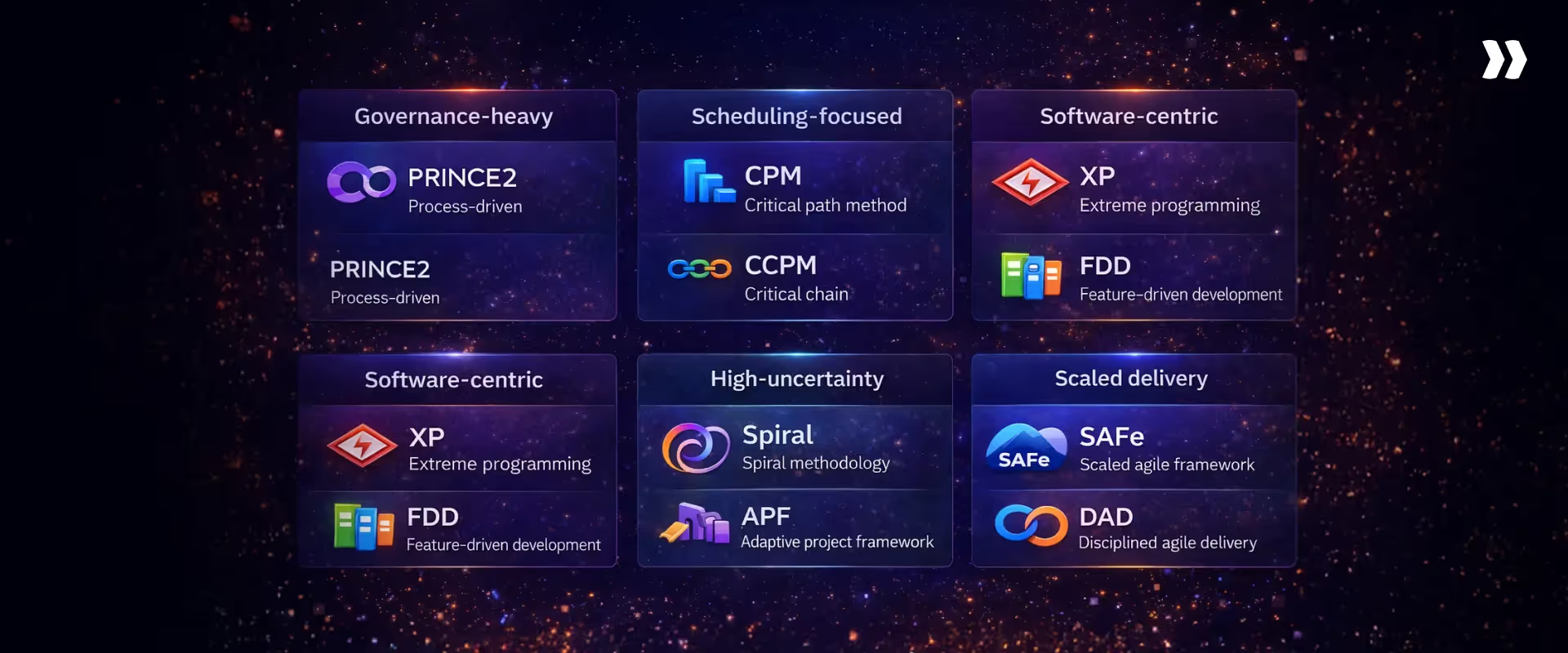
Beyond the six most commonly used methodologies, many organizations rely on additional methodologies and frameworks to address specific delivery conditions such as governance-heavy environments, tightly coupled dependencies, technical risk, or large-scale coordination.
Organizations may also consider other methodologies, such as outcome-based frameworks like outcome mapping or process improvement methods like Six Sigma, to address unique delivery challenges.
These approaches are often layered on top of core methodologies or used selectively where their assumptions align with the work.
1. PRINCE2
PRINCE2 is a process-driven methodology built around strong governance, role clarity, and stage-based control.
It emphasizes business justification, defined responsibilities, and formal decision points throughout the project lifecycle.
PRINCE2 is particularly suited for controlled environments where strict oversight and formal processes are required.
Unlike many Agile approaches, it places heavy weight on documentation, accountability, and management oversight. Project directing is a key principle in PRINCE2, ensuring that projects are guided and overseen throughout their lifecycle.
When it works best
PRINCE2 works best in environments where governance, auditability, and executive control are primary concerns.
It is particularly effective in the public sector, large enterprises, and compliance-driven contexts where projects must align tightly with organizational policy and funding controls.
The methodology performs well when the scope can be reasonably staged and when the decision authority must be explicit.
Limitations in fast-changing environments
In fast-changing environments, PRINCE2 can struggle with decision latency. Its emphasis on formal approvals and stage boundaries can slow response to emerging information.
When requirements evolve rapidly, the overhead of maintaining documentation and re-justifying business cases can outweigh the benefits of control.
2. Critical path method (CPM)
As a critical path methodology, it is used to identify the sequence of tasks that determines the overall timeline for the entire project.
It identifies the longest sequence of dependent tasks that determines the minimum project duration. By focusing attention on critical tasks, CPM highlights where delays will directly impact delivery timelines.
While CPM is effective for optimizing schedules in well-defined projects, it may not be suitable for highly complex projects with many interdependencies.
When it works best
CPM works best in projects with well-defined tasks, stable dependencies, and predictable execution sequences. It is particularly effective in construction, engineering, manufacturing, and infrastructure projects where task order and duration can be estimated with reasonable confidence.
Limitations in fast-changing environments
In demanding and dynamic environments, CPM becomes brittle.
When task durations or dependencies shift frequently, the critical path must be recalculated repeatedly, reducing its practical usefulness.
CPM also focuses primarily on schedule optimization and does not address uncertainty, learning, or human coordination challenges well.
3. Critical chain project management (CCPM)
Critical Chain Project Management builds on CPM by incorporating resource constraints and uncertainty into scheduling decisions.
It replaces task-level safety buffers with aggregated buffers at key points in the schedule, aiming to improve flow and reduce multitasking.
When it works best
CCPM works best in environments where resource contention is a major constraint and where teams (and often, project managers) are frequently overloaded across multiple projects.
It is effective when leadership is willing to change how performance is measured and how buffers are protected.
Limitations in fast-changing environments
CCPM assumes a relatively stable project scope and task network. In fast-changing environments, shifting priorities and emerging work can undermine buffer logic.
Without organizational discipline, buffers are often consumed prematurely, eroding the benefits of the approach.
4. Extreme programming (XP)
Extreme Programming is an Agile methodology focused on improving software quality and responsiveness through disciplined engineering practices.
It is characterized by short development cycles, enabling rapid feedback and frequent releases.
It emphasizes practices such as continuous testing, pair programming, refactoring, and frequent releases to reduce technical risk.
When it works best
XP works best in technically complex software development processes or projects where code quality, adaptability, and rapid feedback are critical. It is particularly effective for small to medium-sized teams with strong engineering maturity and a culture of collaboration.
Limitations in fast-changing environments
While XP handles changing requirements well, it relies heavily on sustained discipline and close collaboration.
In environments with distributed teams, limited customer availability, or weak engineering fundamentals, XP practices can be difficult to maintain consistently.
5. Feature-driven development (FDD)
Feature-driven development is an Agile methodology that structures work around the design and delivery of customer-valued features.
It emphasizes upfront domain modeling followed by short, iterative build cycles focused on specific features.
When it works best
FDD works best in large-scale software projects where domain understanding is critical and where work can be cleanly decomposed into discrete, client-facing features. It performs well when teams benefit from a shared architectural vision.
Limitations in fast-changing environments
FDD assumes that meaningful domain models can be established early. In fast-changing environments where requirements are unclear or evolving rapidly, early modeling efforts may need frequent revision, reducing efficiency.
6. Dynamic systems development method (DSDM)
DSDM is an Agile project management framework that emphasizes fixed time and cost with variable scope.
It introduces strong governance, active user involvement, and iterative development within a structured control framework.
When it works best
DSDM works best in environments where time and budget constraints are non-negotiable, but scope can flex.
It is effective when stakeholders are available for frequent collaboration and when governance requirements must coexist with adaptability.
Limitations in fast-changing environments
DSDM requires sustained stakeholder engagement and disciplined prioritization.
In environments where decision-makers are unavailable or where priorities shift chaotically, its structured governance can become difficult to maintain.
7. Rapid application development (RAD)
RAD is an iterative methodology focused on fast prototyping and user feedback rather than extensive upfront planning.
The rapid application development methodology is designed to accelerate software development projects through fast prototyping and frequent user feedback. Experienced software development teams are essential to the success of RAD, as they can quickly build and adapt prototypes to meet evolving requirements. It prioritizes speed and responsiveness over formal process.
When it works best
RAD works best for projects where speed to market is critical and where user feedback can be incorporated quickly.
It is effective for internal tools, proofs of concept, and user-facing applications with flexible requirements.
Limitations in fast-changing environments
While RAD adapts well to change, it can struggle with scalability and maintainability. Without sufficient architectural discipline, rapid prototyping can lead to technical debt that becomes costly over time.
8. Spiral methodology
The Spiral methodology combines iterative development with systematic risk analysis.
Each cycle focuses on identifying, assessing, and mitigating the most significant risks before progressing further.
When it works best
Spiral works best in large, high-risk projects where uncertainty and potential failure have significant consequences.
It is particularly suited to complex systems development where technical and operational risks must be addressed explicitly.
Limitations in fast-changing environments
Spiral can become heavy and slow when risks shift rapidly or when cycles expand in scope.
Its emphasis on analysis can delay execution if risk assessment is not carefully bounded.
9. Adaptive project framework (APF)
The Adaptive Project Framework is designed specifically for projects with high uncertainty and evolving goals.
It emphasizes iterative planning, learning, and adaptation rather than predictive control.
As an adaptive project management approach, it focuses on flexibility, stakeholder collaboration, and responsiveness to change.
When it works best
APF works best in innovation-driven initiatives where outcomes cannot be defined upfront and where success depends on continuous learning. It suits exploratory projects and emerging market opportunities.
Limitations in fast-changing environments
APF requires strong facilitation and decision-making discipline. Without clear learning goals and boundaries, adaptation can become directionless, leading to prolonged delivery without convergence.
10. SAFe (Scaled Agile Framework)
SAFe is a framework for scaling Agile practices across large organizations.
It introduces synchronized planning cycles, shared cadences, and portfolio-level coordination for project managers to manage dependencies across multiple projects and teams.
When it works best
SAFe works best in large enterprises transitioning from siloed delivery to coordinated Agile execution.
It is effective when leadership alignment and cross-team dependency management are critical.
Limitations in fast-changing environments
SAFe can introduce significant overhead if applied rigidly.
In highly dynamic environments, synchronized planning cycles may struggle to keep pace with rapid change, reducing flexibility at the team level.
11. Disciplined Agile Delivery (DAD)
Disciplined Agile Delivery is a process decision framework that helps teams choose the most appropriate way of working based on context.
Rather than prescribing a single approach, it offers guided choices across the delivery lifecycle.
When it works best
DAD works best in organizations with diverse teams and varying levels of maturity.
It supports flexibility while maintaining governance, making it suitable for complex enterprise environments.
Limitations in fast-changing environments
DAD assumes teams can make informed process decisions. In environments with low maturity or unclear accountability, this flexibility can lead to inconsistency and confusion.
Project management methodologies comparison
When comparing methodologies for project management, meaningful differences emerge in how each methodology balances predictability with adaptability, how it surfaces and manages risk, how much customer involvement it assumes, and how costly change becomes once execution is underway.
Which project management methodology suits which type of project best?
There is no universally “right” project management methodology. Each methodology encodes assumptions about how stable the scope is, how quickly information emerges, how tightly work is coupled, and how costly it is to make changes midstream.
The most reliable way to choose a methodology is to start with the nature of the project, not the preferences of the team or the tooling already in place.
In this section, we map common project types to methodologies that tend to perform well under those conditions, along with the reasoning behind each fit.
Methodologies best for fixed-scope, compliance-driven projects
Fixed-scope projects prioritize predictability, traceability, and control.
Common characteristics of this project type include:
- Clearly defined acceptance criteria and deliverables
- Strong governance and approval requirements
- High cost of rework or deviation
- Limited tolerance for ambiguity once execution starts
Success is defined by delivering a clearly specified outcome within agreed constraints, often under regulatory, contractual, or audit requirements.
In these environments, change is possible but expensive, and late discovery carries high risk.
Methodologies that perform well here share a common assumption: most meaningful uncertainty can be resolved before execution begins.
Waterfall
The waterfall method aligns well with fixed-scope delivery because it front-loads decision-making and formalizes handoffs.
Locking requirements early and progressing through defined phases reduces ambiguity and creates a clear audit trail.
This structure is valuable when downstream work depends heavily on upstream specifications and when changes must be formally justified.
PRINCE2
This adds explicit governance to structured delivery. Its focus on business justification, role clarity, and stage-based control makes it effective where executive oversight and compliance matter as much as execution.
It performs best when accountability must be visible, and decisions must follow defined escalation paths.
Critical Path Method (CPM)
CPM fits fixed-scope environments where delivery depends on precise sequencing of tasks and dependencies.
It provides schedule predictability when task durations and resource availability can be estimated with confidence. CPM is most effective when used alongside a broader predictive methodology.
Methodologies best for fast-changing, iterative projects
Iterative projects operate in environments where learning continues throughout delivery and early assumptions are expected to change.
In these cases, adaptability is more valuable than predictability, and feedback becomes a primary input to planning.
These projects typically show the following traits:
- Evolving requirements and priorities
- Ongoing stakeholder or customer feedback
- Work that can be delivered incrementally
- A higher tolerance for change in exchange for learning
Methodologies in this category assume that certainty emerges through execution rather than upfront analysis.
Agile
Agile methodologies work well here because they treat change as expected rather than exceptional. By delivering in small increments and revisiting priorities frequently, Agile allows teams to adapt direction without destabilizing the entire delivery system.
Scrum
Scrum adds structure to iterative delivery through fixed-length sprints and regular review cycles. It is effective when teams benefit from predictable cadences and short feedback loops, and when work can be meaningfully completed within sprint boundaries.
Extreme Programming (XP)
XP is particularly effective in technically complex software projects where quality and adaptability are critical. Its engineering practices reduce the cost of change, making frequent adaptation feasible rather than risky.
Kanban
Kanban fits fast-changing environments where work arrives continuously, and priorities shift frequently. Its focus on flow rather than fixed planning cycles allows teams to respond quickly without the overhead of repeated replanning.
Methodologies best for operational efficiency and optimization
Some initiatives are not about building something new, but about improving how work already flows.
These projects focus on throughput, quality, consistency, and long-term efficiency rather than delivery speed alone.
Common indicators include:
- Repeatable processes and stable demand
- Measurable performance issues
- A need to reduce waste or variation
- Long-term improvement rather than one-time delivery
Methodologies in this category assume that the core workflow already exists and can be refined over time.
Lean
Lean works well because it treats delivery as a system. By focusing on value streams and waste reduction, it helps organizations improve efficiency incrementally and sustainably.
Six Sigma
Six Sigma is effective when defects and variation can be measured and analyzed statistically. It suits environments where quality and predictability are critical and where improvement efforts must be evidence-driven.
Kanban
Kanban complements both Lean and Six Sigma by making work visible and controlling flow. It helps teams sustain improvements by preventing overload and exposing bottlenecks in real time.
Methodologies best for large-scale, cross-team programs
As delivery scales across teams, coordination becomes a dominant challenge.
Dependencies multiply, decision latency increases, and local optimization can undermine system-wide outcomes.
Methodologies in this category are designed to manage alignment and dependency, not just execution.
These programs typically involve:
- Multiple teams working toward shared outcomes
- Complex cross-team dependencies
- Portfolio-level prioritization and governance
- A need for synchronized planning and visibility
SAFe (Scaled Agile Framework)
SAFe provides a structured way to align strategy, portfolios, programs, and teams. Its synchronized planning cycles and shared cadences help manage dependencies at scale while preserving some team-level agility.
Disciplined Agile Delivery (DAD)
DAD works well in organizations with diverse teams and varying levels of maturity. It offers guidance on choosing practices based on context rather than enforcing a single way of working, to balance flexibility with governance.
Hybrid methodologies
Many large programs adopt hybrid approaches that combine predictive planning at higher levels with adaptive execution at the team level. This allows organizations to maintain strategic predictability without constraining local delivery.
Methodologies best for customer onboarding and implementations
Customer onboarding and implementation projects introduce external dependencies that internal teams do not control. Customer readiness, data quality, and stakeholder availability often vary, even when timelines are fixed.
These projects require methodologies that balance structure with adaptability.
Common characteristics include:
- Fixed customer-facing milestones
- Variable effort driven by customer inputs
- A need for visibility and coordination across teams
- High impact on the customer journey or experience
Hybrid Agile
Hybrid Agile works well because it combines milestone-based planning with iterative execution. Teams can commit to external timelines while adapting tasks and sequencing as customer conditions evolve.
Milestone-driven Agile
This approach anchors delivery around clear customer-facing phases such as kickoff, configuration, validation, and go-live, while using Agile practices within each phase. It preserves predictability for customers without sacrificing delivery flexibility.
Project management methodologies, tools, and techniques
Methodologies are often introduced as conceptual choices.
Teams discuss Agile, Waterfall, Scrum, or hybrid approaches and align on principles and frameworks. What determines whether those choices hold up over time is how well they are carried into everyday execution.
As delivery moves beyond small teams and simple scopes, methodology alone is not sufficient.
Plans need to remain current as work progresses. That’s why project management software and project management tools are essential for supporting the execution and governance of methodologies at scale.
Dependencies need to stay visible across roles and systems. Decisions need to be made with access to timely, shared information.
When these conditions are not supported consistently, even well-chosen methodologies begin to lose effectiveness.
Methodologies establish how work is expected to move. Tools provide the structure that allows that movement to be sustained across people, time, and scale.
Why methodologies fail without the right execution tools
Every methodology places demands on visibility, coordination, and decision speed. When tools cannot meet those demands, teams compensate manually, and discipline erodes.
Adaptive methodologies, for example, assume:
- Rapid feedback
- Transparent work states, and
- Continuous reprioritization.
Predictive methodologies fail differently. They depend on:
- Traceability,
- Version control, and
- Formal change management.
This is where execution-focused platforms matter. Teams need a single source of truth for delivery by bringing plans, milestones, dependencies, ownership, and customer participation into one shared execution layer.
This shared layer supports not just task coordination, but execution governance and oversight, allowing teams and leaders to see how work is progressing without relying on manual status aggregation.
How tools operationalize frameworks
Frameworks describe roles, workflows, and artifacts. Tools make them persistent and shared.
A sprint backlog, a stage gate, or a program plan only works if it exists in a system that multiple stakeholders can see, update, and trust. Tools turn abstract constructs into concrete execution objects: tasks, milestones, dependencies, risks, and timelines.
Well-aligned tools tend to do three things consistently:
- Shared visibility for execution and oversight
Work is visible at the appropriate level for teams, delivery leaders, and executives, enabling both action and governance without additional reporting layers.
- Embedded controls and decision logic
Constraints, approval flows, and change rules are reflected directly in the system, supporting consistent execution without slowing teams down.
- Lower coordination and reporting overhead
Ownership and status are centralized, reducing the need for manual updates and enabling governance through observation rather than escalation.
Platforms like Rocketlane support this model by providing a single execution view across internal teams and customers, allowing frameworks to operate with both flexibility and control.
Common mismatch patterns between tools and methodologies
As organizations scale, a few mismatch patterns appear repeatedly.
Fragmented sources of truth
Even a strong methodology commitment fails when paired with fragmented tooling. Planning, execution, communication, and reporting live in separate systems, increasing cognitive load and creating competing versions of truth.
Implicit governance through meetings
Oversight relies on status meetings rather than on continuous visibility into execution signals, delaying intervention.
Tools misaligned with the delivery structure, a.k.a tool-led methodology adoption
Teams select a tool first and allow its defaults to dictate how work happens. This often results in surface-level adoption where methodology exists, but decision logic does not.
Static execution views in dynamic environments
Finally, many teams pair dynamic methodologies with static tools. Continuous reprioritization meets fixed plans, resulting in constant replanning and eroding confidence.
Addressing these patterns requires treating execution visibility as a governance capability, not just a productivity feature.
Methodology defines how work should move. Frameworks define coordination. Tools should provide the visibility and control needed to govern execution as it unfolds.
How to choose the right project management methodology for your project

Choosing a project management methodology is about aligning the delivery structure with uncertainty. The right choice reduces friction by matching how decisions are made to how information emerges over time.
The goal is to choose a methodology that works with the shape of uncertainty in your project rather than against it. Start by evaluating the following factors honestly.
Scope volatility
Begin by assessing how likely you require to change once execution starts.
- If the scope is genuinely stable, invest in upfront definition. Methodologies that reward early clarity will pay off.
- If the scope is likely to evolve, resist the urge to lock decisions early. Choose an approach that allows commitment to emerge as learning improves.
If you expect customer feedback, technical discovery, or market shifts, plan for change explicitly.
Dependency complexity
Next, look closely at how work is coupled.
- If tasks, teams, or systems are tightly dependent, make those dependencies visible early and manage them deliberately.
- If dependencies are loose, avoid heavy coordination frameworks that slow teams down unnecessarily.
Team maturity
Choose a methodology that fits the team you have.
- Mature teams can handle flexibility, interpret principles, and manage trade-offs without constant supervision.
- Less mature teams benefit from clearer structure, defined roles, and explicit decision paths.
If maturity varies across teams, prefer methodologies or frameworks that allow some standardization without enforcing uniformity.
Customer involvement
Be realistic about how involved customers or stakeholders can be during delivery.
- If you can count on regular feedback, choose a methodology that uses that input to steer execution.
- If involvement will be limited or episodic, rely more on upfront alignment and formal checkpoints.
Risk tolerance
Finally, assess how much uncertainty the organization can absorb.
- In low-tolerance environments, favour methodologies that emphasize control, validation, and staged commitment.
- In higher-tolerance environments, allow room for experimentation and learning, but define guardrails early.
How to apply this in practice
If you want a simple way to operationalize these PM methodology choices, use this rule of thumb:
- High certainty, high cost of change: choose predictive control.
- Low certainty, high learning value: choose adaptive delivery.
- High coordination complexity: add governance and visibility layers.
- External customers involved: anchor work to milestones, not tasks.
Why project management methodologies fail without execution visibility
Most methodologies assume a basic condition is met: that teams and leaders can see what is actually happening as work progresses. They depend on timely signals about progress, risk, dependencies, and decision delays.
When that visibility is weak or fragmented, failure usually shows up in a few consistent patterns.
The plans-versus-reality gap
Every methodology starts with a plan. In predictive approaches, that plan is a baseline. In adaptive approaches, it is a backlog or rolling forecast.
The failure begins when the plan stops reflecting reality but continues to drive decisions.
Without execution visibility, plans age faster than teams can update them. Work advances informally while systems lag behind.
Teams make pragmatic adjustments to keep moving, but those adjustments never make it back into the plan.
This gap widens as scale increases. More teams, more dependencies, and more handoffs accelerate the divergence between what is planned and what is happening.
Methodologies that rely on synchronized cadences, stage gates, or portfolio rollups are especially vulnerable when execution data arrives late or incomplete.
What to do differently:
- Treat plans as hypotheses and instrument execution, so progress updates automatically from real work, not manual reporting.
- Make “plan freshness” a first-class metric. If the plan cannot be trusted, it should not be used to make decisions.
Dependency blind spots
Dependencies are the most common cause of delivery failure, and the least visible. Methodologies describe how dependencies should be managed, but without shared visibility into ownership, status, and sequencing, those rules remain abstract.
Blind spots emerge when dependencies live in meetings, spreadsheets, or individual heads rather than centralized systems.
Visibility is what allows teams to intervene early, renegotiate sequencing, manage resources, and reallocate effort before delays harden into failures.
What to do differently:
- Make dependencies explicit, owned, and time-bound. Track their status as rigorously as task completion.
- Design reviews and planning rituals around dependency health, not just task progress.
- Use a centralized platform layer for both project execution and management.
Late risk detection
Risk management only works when signals surface early. When execution visibility is poor, risks do not appear as trends. They appear as surprises.
Instead of seeing gradual schedule slippage, quality erosion, or resource management struggles, teams encounter sudden failures.
At that point, methodological controls such as change boards, sprint reviews, or steering committees arrive too late to preserve outcomes.
Even if the methodology is still followed procedurally, it no longer protects results.
What to do differently:
- Shift from risk registers to risk signals.
- Monitor leading indicators such as load imbalance, work aging, dependency wait time, decision latency, etc.
- Treat risk discussions as ongoing sense-making, not periodic compliance activities.
Project management methodologies in modern, AI-driven delivery
AI changes how project management methodologies are executed, monitored, and adapted. Its value lies in compressing the gap between reality and decision-making.
The impact of AI in professional services (PS) and project management is evident in three key areas:
How AI impacts project planning and tracking
Traditional planning is episodic with teams planning projects, executing them, then reviewing, and finally, replanning. AI enables planning to become continuous.
It analyzes historical delivery patterns, dependency behavior, and team throughput to update forecasts dynamically as execution unfolds.
Tracking evolves as well. Instead of relying on manual status updates, AI infers progress from real signals such as task movement, work aging, communication patterns, and delivery velocity.
This reduces reporting overhead and improves signal accuracy.
Why execution intelligence matters more than reports in the AI era
Reports explain what has already happened. Execution intelligence helps you see what is about to happen.
AI-driven execution intelligence surfaces early warning signals such as accumulating risk, dependency congestion, and delivery slowdowns before they appear in milestone reports.
This allows teams and leaders to intervene while options still exist.
In complex delivery environments, insight matters more than documentation volume. The value is not in knowing more, but in knowing sooner.
Which methodologies benefit most from AI support
Adaptive and hybrid project methodologies benefit the most because they depend on rapid feedback and frequent reprioritization.
AI improves their ability to stay flexible without losing control. Improved resource forecasting, change impact analysis, and dependency modeling help preserve predictability when complexity increases.
Why Rocketlane is the best project management tool for any methodology (and customer-centric outcomes)

Methodologies don’t fail because teams pick the “wrong” framework.
They fail because execution drifts away from the plan, customer inputs arrive late, dependencies stay invisible, lack of right project delivery tool and financial reality shows up after decisions are already locked in.
Rocketlane is built to prevent that drift—regardless of whether you run agile, waterfall, scrum, kanban, or hybrid delivery.
Rocketlane adapts to your methodology without forcing tool-led behavior
Rocketlane doesn’t make you “do projects the Rocketlane way.” It gives you an execution layer that supports how your delivery model actually runs: milestone-based, phase-based, sprint-based, or flow-based.
You can standardize repeatable delivery patterns with templates, keep governance consistent, and still stay flexible when scope and customer conditions change.
Execution visibility that keeps plans aligned with reality
Every methodology needs a trustworthy source of truth. Rocketlane keeps timelines, milestones, dependencies, owners, and progress visible in real time—so project health isn’t something you reconstruct in status meetings.
When delivery shifts, your plan stays current without constant manual reconciliation.
Customer collaboration is native, not bolted on
Customer-centric delivery requires more than weekly updates.
Rocketlane brings clients into a shared delivery experience through a branded portal with timelines, milestones, updates, documents, and communication—so alignment scales without extra meetings, duplicate tools, or “status work.”
Profitability is protected because delivery and financials stay connected
Customer outcomes and profitability are not trade-offs when your system keeps effort, scope change, and delivery progress connected.
Rocketlane ties execution to time tracking, billing, and margins so leaders can spot effort creep early, course-correct while outcomes are still malleable, and reduce revenue leakage caused by late or disconnected time capture.
AI that supports delivery in motion, not just reporting after the fact
Rocketlane applies AI where methodologies need it most: reducing “work about work.” Automated updates, summaries, and execution signals help teams stay coordinated, surface risk earlier, and spend more time moving delivery forward.
As teams mature, Rocketlane’s agentic direction aims to absorb even more coordination, documentation, and governance overhead.
Quick way to map Rocketlane to common methodologies
- Agile / Scrum: milestone visibility + execution signals + customer alignment, without slowing sprint cadence
- Kanban: flow clarity, ownership, and blockers visibility to prevent work-in-progress chaos
- Waterfall / Prince2: phase and milestone governance, approvals, auditability, and stakeholder transparency
- Hybrid implementations: customer-facing milestones with flexible execution inside each phase (ideal for onboarding and delivery teams)
If you want a project management tool that supports any methodology and keeps customers aligned while protecting margins, rocketlane is built for that reality.
See what one of Rocketlane’s customer has to say about us - Project management appreciation for Rocketlane.
Conclusion: Methodologies guide work, execution delivers outcomes
Project management methodologies provide structure. They influence how teams plan, coordinate, assess risk, and assign accountability.
At their best, they create shared expectations and reduce ambiguity, especially as delivery becomes more complex.
What determines outcomes, however, is execution. Results depend on how work actually moves across people, systems, and dependencies over time.
When execution visibility is limited, even well-chosen methodologies become harder to apply consistently.
As delivery environments evolve, the systems that support execution need to evolve alongside methodology. Visibility into dependencies, ownership, readiness, and milestones allows structure to hold without slowing teams down or distorting decision-making.
This is why execution platforms have become an important part of modern delivery, particularly in customer onboarding and implementation work where progress depends on both internal teams and external stakeholders.
Project management tools like Rocketlane are designed around this execution layer, particularly for customer onboarding and implementation work.
Rather than enforcing a specific methodology, Rocketlane focuses on making delivery visible across teams and customers through shared timelines, dependency tracking, milestone ownership, and real-time status that reflects what is actually happening.
That visibility is what allows hybrid and execution-led approaches to work in practice, especially when customer variability and cross-functional coordination are unavoidable.
As delivery environments continue to evolve, the role of project management tools will increasingly be to shorten the distance between reality and decision-making.
Methodologies still matter, but they only function as intended when execution is observable, decisions are timely, and coordination costs are kept in check.
Sign up for a Rocketlane demo to see how you can apply your project management methodologies in real delivery conditions.

Authored by

Kailash Ganesh
Kailash Ganesh is a professional services researcher at Rocketlane with more than seven years of experience in content, research, and market analysis. He studies how enterprise PS teams are adopting agentic AI to transform delivery operations, has evaluated every major PSA platform in the category, and writes from the perspective of a practitioner who watches enterprise PS teams make these exact decisions daily.
Table of Contents

Regsiter for the live webinar


Great consultants didn't join your team to spend Fridays writing documentation.
Table of contents
18 of Forbes Cloud 100 chose Rocketlane. The best PS teams aren't waiting around.
FAQs
What are the 5 methodologies of project management?
The five most common project management methodologies are Agile, Waterfall, Scrum, Kanban, and Lean. Each differs in how work is planned, how uncertainty is handled, and how progress is tracked—from upfront planning in Waterfall to iterative, flow-based delivery in Agile, Scrum, Kanban, and Lean.
What are the 7 forms of project management, and how do project managers choose them?
Seven widely used forms include Waterfall, Agile, Scrum, Kanban, Lean, Six Sigma, PRINCE2, and DSDM. Project managers choose among them based on scope stability, dependency complexity, governance needs, stakeholder availability, and risk tolerance rather than personal preference.
What are the 5 C’s of project management?
The 5 C’s are Clarity, Communication, Coordination, Control, and Commitment. Together, they ensure teams understand goals, share information effectively, manage dependencies, maintain alignment as conditions change, and sustain momentum throughout the project lifecycle.
What are the 4 pillars of project management?
The four pillars are scope, time, cost, and quality. Every project management methodology balances these constraints differently, determining how trade-offs are made to deliver outcomes without compromising stability, value, or customer expectations.
What is the best project management methodology?
There is no single best methodology. The right choice depends on project context, including scope volatility, dependencies, team maturity, customer involvement, and risk tolerance. Most mature organizations use hybrid approaches tailored to their delivery environment and scale.











Copyright © 2026 Rocketlane Corp. All rights reserved.

















.webp)