Project expense tracking: What it is, how to do it right? A complete guide for PS leaders in 2026

•
•
Summarize blog with






Roughly one in three projects exceeds its original budget, according to findings from the Project Management Institute (PMI) Pulse of the Profession® research.
And only about 55–60% consistently meet their original business goals.
If you have ever reviewed a project's profit and loss (P&L) and felt that the numbers “shifted” between reporting cycles, you have seen it firsthand.
Costs rarely explode overnight. They accumulate invisibly, in delayed time entry, misallocated effort, untracked scope creep, or late variance recognition.
By the time the overrun becomes visible in a formal review, the intervention window has already narrowed.
Most project managers track expenses. Few track them in a way that enables intervention while the project is still running.
For professional services (PS) organizations, where margin per engagement determines business health, expense tracking is a core governance discipline.
Tracking expenses is record-keeping.
Managing them is a decision-making system that surfaces variance early, connects cost to delivery milestones, and gives finance and delivery teams the same real-time picture.
Accurate tracking is essential to ensure reliable financial oversight and timely decision-making.
We’ve put together this guide to define the frameworks, controls, metrics, processes, and tools required to align delivery execution with financial performance and reduce variance before it compounds.
It outlines how to design and operate a project expense tracking system that supports real-time cost control, moving from passive record-keeping to an active financial control system that protects margin throughout the project lifecycle.
What is project expense tracking?
Project expense tracking provides real-time visibility into cost variance, cash flow, and profitability, supporting effective management of overall project finances.
The goal goes beyond to enabling course correction before overruns become irreversible.
Project expense tracking meaning — beyond the definition
Most people assume that expense tracking is the same as expense reporting.
Here’s why the difference between expense racking and expense reporting matters operationally:
- Expense reporting is backward-looking. It documents what happened after the project phase closes. It answers '‘what did we spend?'’ Useful for reconciliation. Useless for intervention.
- Expense tracking is real-time. It tells you what’s happening right now and what will happen if the current trajectory continues. It answers '‘are we on track?'’ while there'’s still time to act.
- Real-time project expense tracking also enhances financial transparency, ensuring all stakeholders have clear, up-to-date visibility into spending and enabling more informed decision-making.
For professional services teams, the stakes are higher than most, given that cost data is delivery data.
Every dollar of cost is tied to a project, a resource, and a client. This means that when expense tracking is disconnected from project structure, margin erosion happens silently.
What does a project expense tracking system look like?
A robust expense tracking system for project management acts as an operating layer inside delivery that converts execution activity into financial signal in real time.
It runs across three connected layers.
1. Inputs: Where cost enters the system
Costs originate at the point of work.
- Timesheets mapped to specific phases and tasks
- Contractor invoices tied to approved scope
- Project-specific software subscriptions
- Travel and expense claims coded to projects
- Overhead allocations applied through a defined model
Accuracy at this layer determines whether variance is detected during delivery or discovered after financial close.
If costs are not captured at source and mapped correctly, every downstream report becomes an exercise in reconciliation.
2. Process: where raw cost becomes control
Cost data only becomes useful when structured against intent.
- Categorization aligned to a Cost Breakdown Structure
- Mapping each entry to an approved budget line
- Phase-level and project-level variance calculation
- Rolling forecast updates
This layer determines whether expense tracking functions as a monitoring tool or a control system.
Weekly variance reviews and milestone-aligned checks ensure that cost performance is evaluated in the context of delivery progress.
3. Outputs: where financial decisions are made
Outputs convert analysis into action.
- Budget versus actual visibility by phase
- Threshold-based variance alerts
- Real-time project P&L
- Margin and completion forecasts
Together, these layers create a continuous financial feedback loop.
Work generates cost. Cost is mapped to budget. Variance is measured against progress. Forecasts are updated before commitments compound.
The defining characteristic of a strong expense tracking system is integration with delivery execution.
Financial visibility is embedded in the way work is planned, logged, and reviewed, rather than reconstructed after the fact.
Operationally, this system spans project management tools, time tracking, and finance or ERP platforms.
In delivery-mature organizations, a professional services automation (PSA) platform connects these systems so that timesheet approval, cost allocation, forecasting, and billing operate on a shared data model.
Who owns project expense tracking?
Ownership is defined by structure, but accountability must remain clear.
In small teams, the project manager typically manages expense tracking end to end.
They approve time, review variance, update forecasts, and monitor profit margin as part of delivery governance.
In mid-size PS organizations, responsibilities are distributed. The project manager tracks and reviews costs during execution.
Finance reconciles entries, validates allocations, and produces formal P&L reporting.
The VP of Professional Services or delivery leadership reviews margin performance and forecast exposure across the portfolio.
In scaled organizations, ownership becomes specialized.
A Project Controller or Finance Business Partner oversees cost tracking discipline, enforces cadence, validates forecasts, and ensures alignment between delivery data and financial reporting.
Breakdowns occur when responsibility is split without shared visibility.
When project managers operate from delivery systems and finance operates from accounting systems, cost data is reconciled retrospectively rather than reviewed during execution.
Variance identified weeks after it emerges limits corrective options and embeds overruns into the project baseline.
Effective ownership requires role clarity and system alignment. The project manager owns in-flight cost control. Finance owns financial integrity and compliance.
Leadership owns margin outcomes. The system must ensure that each role works from the same cost signal at the same point in time.
What are the different types of project expenses?
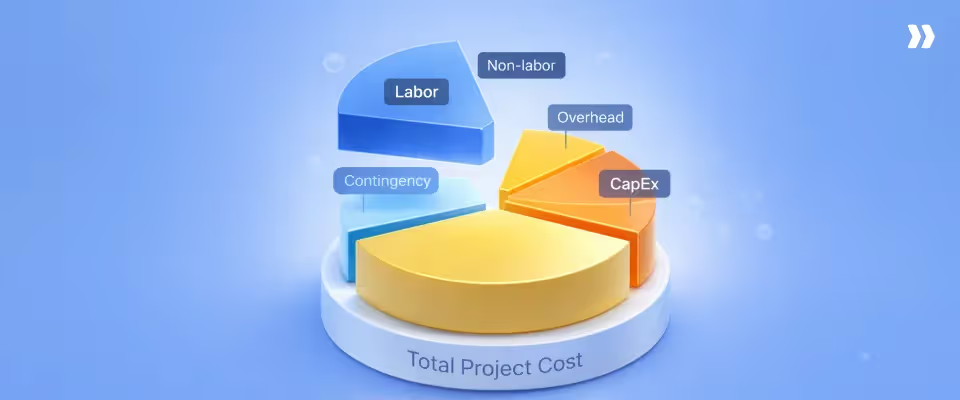
Clearly defining the project scope at the outset helps ensure expenses are categorized correctly and prevents confusion during the project.
A common mistake PS teams make it misclassifying expenses leading to inaccurate budget tracking and distorted margin reporting.
Project expenses fall into four primary categories. Every project incurs some combination of all four.
1. Direct labor costs
Direct labor is typically the largest cost component in professional services engagements. It includes:
- Internal team effort calculated using loaded cost rates
- Contractor time
- Freelancer fees
Total hours alone provide limited signal. Distribution of hours by role and by phase determines whether variance analysis is meaningful.
Where complexity arises
- Resources split time across multiple projects
- Work shifts across phases without precise logging
- Hours are recorded without phase-level tagging
What requires monitoring
- Planned versus actual hours by phase
- Billable versus non-billable ratio per project
- Early phase overruns relative to baseline estimates
Labor variance usually emerges gradually. Phase-level discipline surfaces it early enough to adjust staffing or scope.
2. Direct non-labor costs
These are delivery-specific costs not tied to personnel. They include:
- Project-specific software licenses
- Cloud infrastructure and hosting
- Third-party APIs and data service
- Travel and accommodation for on-site delivery
Why they are often under-tracked
- Paid via company cards
- Coded to generic cost centers
- Processed through procurement rather than delivery systems
When direct non-labor costs are absorbed into overhead, individual project margins appear stronger than they are.
What requires monitoring
- Every expense mapped to a project code
- Alignment with the Cost Breakdown Structure
- Real-time comparison of actual spend versus estimated non-labor budget
Without this mapping, margin distortion accumulates quietly.
3. Indirect and overhead costs
Indirect costs support delivery but are not attributable to a single engagement.
They include:
- Office space and utilities
- Shared IT infrastructure
- Management oversight
- HR and training
- Shared software subscriptions
Why allocation discipline matters
The method used to distribute overhead shapes reported project margin.
- Per-head allocation is distributed evenly
- Revenue-weighted allocation ties cost to project value
Each method produces different financial outcomes. Inconsistent allocation weakens portfolio comparability.
What requires monitoring
- Consistent allocation logic across projects
- Periodic validation of overhead recovery assumptions
Under-allocation can make projects appear profitable in the short term while eroding sustainability at scale.
4. Capital expenditure (CapEx) and operating expenditure (OpEx)
Some projects include both capital and operating components.
- CapEx: assets with multi-year useful life such as custom builds or equipment
- OpEx: recurring costs such as SaaS subscriptions and contractor renewals
Why early classification matters
Incorrect categorization affects financial reporting and audit outcomes. Adjustments made at project close can distort margin interpretation retroactively.
What requires monitoring
- Early identification of capitalizable items
- Alignment with finance before project close
5. Contingency and risk reserves
Contingency is allocated for identified risks within scope. Management reserve addresses unknown risks at a broader level.
Industry benchmarks typically range between 5 and 15 percent of total budget depending on complexity.
Where control often weakens
- Contingency blended into base budget
- Early-phase consumption without review
- Lack of visibility into burn rate
When contingency is treated as available operating capacity rather than protected reserve, early warning signals disappear.
What requires monitoring
- Separate tracking of contingency spend
- Burn rate relative to phase progression
- Variance between risk assumptions and actual drawdown
Why this structure matters
When labor, non-labor, overhead, capital components, and contingency are clearly defined and consistently coded, variance analysis becomes actionable.
Forecast accuracy improves. Portfolio comparisons remain reliable.
When categorization drifts, margin signals weaken and corrective action becomes delayed.
Key project cost components to track
Within each expense type, six core cost components need individual tracking lines.
Aggregating them too early loses the signal that tells you where overruns are originating.
Tracking project tasks alongside these cost components is essential to ensure accurate resource allocation and cost estimation.
Tracking these elements lets you effectively monitor costs throughout the project lifecycle, for better budget control and to prevent overspending.
1. Labor hours and cost rates
Labor is usually the largest cost driver in professional services engagements.
Components to track:
- Planned versus actual hours by role
- Hours by delivery phase
- Internal cost rate per resource
- Billable versus non-billable distribution
The nuance is phase compression. For instance, when discovery overruns quietly, build inherits a compressed schedule.
Labor variance then appears downstream as “efficiency loss,” even though the origin was upstream scope expansion.
Tracking total hours hides this shift. Tracking by role and phase reveals it.
Tracking total hours is insufficient.
Phase-level mapping reveals whether overrun is occurring in discovery, configuration, testing, or coordination.
Cost rate discipline also matters.
Applying billing rates instead of internal cost rates inflates apparent margin and weakens forecast reliability.
Where drift starts
- Discovery overruns that compress later phases
- Senior resources replacing junior ones midstream
- Hours logged without correct phase mapping
What to watch out for
If actual hours exceed plan by more than 10 percent within a phase, the issue typically reflects scope expansion or estimation inaccuracy rather than individual productivity.
2. Milestone-linked cost consumption
Cost must be evaluated relative to delivery progress.
Calendar-based tracking does not reveal whether value delivered matches budget consumed.
A project halfway through its timeline may have consumed a disproportionate share of its budget if early phases required more effort than expected.
Components to track:
- Budget consumed versus milestone completion
- Cost Performance Index (CPI)
- Estimate at Completion (EAC) updates
- Burn rate relative to remaining scope
The nuance lies in sequencing imbalance. For instance, when early milestones consume a disproportionate share of the budget, later phases operate under financial compression.
Cost variance then appears as delivery inefficiency, even though the origin was front-loaded complexity or underestimated effort.
Tracking spend against calendar timelines hides this imbalance. Tracking cost against milestone progress reveals it.
Reviewing cumulative budget alone is insufficient.
Milestone-level mapping shows whether cost is advancing faster than value delivered.
Where drift starts:
- Early phases absorbing more budget than planned
- CPI trending downward over consecutive reporting cycles
- Budget consumption outpacing milestone completion
What to watch out for:
If budget consumed runs more than 10 percentage points ahead of milestone progress, sequencing or estimation imbalance is likely present.
3. Vendor and contractor commitments
External commitments introduce timing and control complexity.
Invoices often lag work performed. Without accrual tracking, financial reports understate true exposure until late in the cycle.
Components to track:
- Contracted value versus revised scope
- Invoice totals versus approved baseline
- Accrued costs incurred but not yet invoiced
- Approved change orders
The nuance is delayed visibility. For instance, when work is completed but not yet invoiced, the project appears financially stable mid-cycle.
Margin correction then occurs abruptly at close, even though the exposure existed earlier.
Tracking invoices alone hides this shift. Tracking commitments and accruals reveals it.
Where drift starts:
- Informal scope additions without change orders
- Invoices approaching PO limits before milestone completion
- Accrued costs rising faster than recognized vendor spend
What to watch out for:
If vendor invoices exceed 90% of approved commitment before corresponding milestone delivery, contractual exposure is building.
4. Software and tool costs
Modern delivery relies on subscription tools and cloud infrastructure.
Incremental additions across phases accumulate quietly when not mapped explicitly to project budgets.
Components to track:
- Project-specific subscriptions
- Shared platform allocation logic
- License utilization versus purchased capacity
- Subscription additions during delivery
The nuance is accumulation. For instance, when additional licenses are added mid-phase to resolve short-term friction, recurring cost structure increases quietly.
Margin erosion then appears later as structural overhead rather than visible overrun.
Tracking total subscription spend hides this shift. Tracking additions and utilization reveals it.
Monitoring overall SaaS cost is insufficient.
Project-level allocation shows where recurring cost is actually building.
Where drift starts:
- Incremental license additions without scope change
- Subscriptions remaining active beyond phase completion
- Shared tools without defined allocation methodology
What to watch out for:
If subscription count or allocated tool cost per project increases without a corresponding scope expansion, structural creep is likely forming.
5. Travel and expense
Travel and expense volatility affects distributed teams and multi-location engagements.
Pre-approval establishes a budget control checkpoint. In multi-currency projects, foreign exchange assumptions must be defined at kickoff.
Components to track:
- Approved versus actual travel spend
- Foreign exchange assumptions at project initiation
- Timing of expense recognition
- Frequency of travel relative to delivery phase
The nuance is external volatility.
For instance, when exchange rates move during a multi-currency engagement, reported cost shifts even if operational activity remains stable.
Margin then appears compressed despite unchanged delivery effort.
Tracking total T&E spend hides currency impact. Separating FX variance reveals it.
Reconciling expenses only at close is insufficient. Ongoing comparison against approved baseline preserves clarity.
Where drift starts:
- Travel frequency increasing without scope change
- Exchange rate assumptions diverging from actual rates
- Expenses recognized late in reporting cycle
What to watch out for:
If actual travel spend exceeds approved baseline by more than 10 percent without scope modification, cost control discipline may be weakening.
6. Revenue recognition timing
For professional services teams, cost timing must align with revenue recognition methodology.
Under percentage-of-completion recognition, revenue aligns with milestone delivery.
Under completed-contract recognition, revenue is recorded at project close.
What to track:
- Cost-to-date versus recognized revenue
- Estimate at Completion versus contract value
- Revenue recognition method applied
- Phase-level cost accumulation
The nuance is timing distortion.
For instance, when cost is recognized ahead of milestone-based revenue, the project may appear margin negative midstream.
Conversely, revenue recognized ahead of remaining effort can create temporary margin comfort.
Tracking cost in isolation hides this effect. Tracking cost and revenue alignment reveals it.
Monitoring margin percentage alone is insufficient.
Phase-level cost-to-revenue mapping clarifies whether variance reflects delivery performance or accounting timing.
Where drift starts:
- Cost accumulating significantly ahead of recognized revenue
- Revenue recognition outpacing remaining cost-to-complete
- EAC increasing without contract value change
What to watch out for:
If EAC rises while recognized revenue remains fixed, emerging margin compression may be forming beneath the surface.
Misalignment between cost timing and revenue recognition creates P&L distortions.
These often look like margin problems but are actually accounting timing gaps. They are identifiable only if your tracking system connects cost to milestone completion.
Why component-level tracking matters
Each component exposes a different risk surface:
- Labor signals estimation drift
- Milestone imbalance signals sequencing issues
- Vendor overages signal contract control gaps
- Tool expansion signals operational creep
- Travel variance signals external exposure
- Revenue timing signals reporting alignment
Why is project expense tracking important?

Project expense tracking isn't an administrative function. It's the mechanism by which delivery decisions connect to financial outcomes.
Accurate expense tracking is essential for monitoring project profitability, as it allows teams to compare actual versus estimated costs and identify discrepancies early.
Effective expense tracking is also a key factor in delivering successful projects, ensuring that financial control and communication support organizational goals.
Here's how it does this:
It prevents budget overruns before they're irreversible
Consider this.
A project is 20% over budget at the 30% completion mark.
At this stage, scope can still be tightened. Staffing can be rebalanced. Milestones can be re-sequenced.
Now take another example.
A project is 20% over budget at the 90% completion mark.
Most delivery effort has already been committed. Contracts are executed. Resources are allocated. Recovery options are limited.
The difference is not the percentage. It is the timing of visibility.
Real-time tracking preserves an intervention window. Monthly reconciliation shortens or removes that window.
When cost variance is reviewed weekly against phase progress, corrective levers remain available.
Projects with active cost monitoring consistently outperform those that rely on periodic reviews because early detection preserves optionality.
It protects project margins — the actual business outcome
Take an example of a project billed at $200K. Delivery cost reaches $180K. On paper, the engagement is complete.
Financially, it produces a 10% margin.
At that level, modest additional effort or untracked external cost can eliminate profitability entirely.
Revenue does not reveal this risk. Margin does.
Without structured expense tracking, project managers focus on timelines and milestone completion.
Cost accumulates in parallel but without consistent financial review.
With disciplined tracking, margin trajectory becomes visible alongside delivery progress.
Scope changes, staffing shifts, and change requests are evaluated against profitability before they are approved.
For PS organizations, margin per project often determines long-term sustainability.
Revenue growth without margin discipline increases activity without strengthening the business.
It enables accurate client billing
Consider a time and materials engagement.
A consultant works 6 additional hours during a critical week but logs only 4. Over several months, similar small gaps accumulate.
The client is billed accurately against recorded time, but revenue leakage has already occurred.
Now consider a fixed-fee engagement.
Revenue remains fixed. Delivery effort expands quietly.
The invoice value does not change, but margin compresses.
Expense tracking reduces both risks.
When time and cost capture connect directly to invoicing workflows, approved entries move into billing without manual reconciliation.
This reduces delays and improves billing accuracy.
Billing reliability depends on disciplined cost capture during execution.
It creates the data foundation for better estimates
Take a recurring implementation project.
The original estimate assumes 120 hours for configuration.
Actual delivery consistently requires 150. Without historical cost tracking, the next proposal repeats the 120-hour assumption.
Over time, this pattern becomes structural underestimation.
Accurate expense tracking creates a reference library of actual cost versus estimated cost by phase and by project type.
Each completed project becomes data.
That data improves pricing, resource planning, and contingency allocation.
It also improves sales-to-service handoff when the cost assumptions made during scoping are visible to delivery in structured form — by phase, role, and risk.
It supports financial compliance and audit readiness
Consider an enterprise client requesting cost documentation at project close.
Without structured tracking, receipts must be gathered, approvals reconstructed, and cost categories clarified retroactively.
With disciplined tracking embedded during delivery, documentation already exists.
Approval trails are recorded. Cost categories are consistent. Entries are timestamped.
For publicly traded companies, cost data feeds revenue recognition schedules under ASC 606 and IFRS 15.
Misalignment between delivery cost and revenue reporting can trigger audit scrutiny.
When expense tracking is built into execution, compliance becomes continuous rather than corrective.
Common challenges in project cost tracking

Most project cost tracking failures aren't system failures. They're process failures that systems make visible — or invisible.
Often, these challenges stem from inconsistent or delayed recording of expenses, which can undermine financial visibility and hinder early corrections.
Here are the seven challenges that surface consistently across delivery organizations.
1. Delayed time entry — the single biggest margin killer
Consider a consultant who completes 8 hours of configuration work on Monday but logs it on Friday afternoon.
By Friday, context has shifted. The entry becomes approximate rather than precise.
When teams log time weekly or monthly:
- Cost data lags delivery activity
- Phase-level variance surfaces late
- Small overruns blend into estimates
Impact
Projects relying on batch time entry often detect cost drift one to two weeks after it begins. That delay reduces available correction time.
Where drift starts
- Reconstructed time entries
- Rounded effort estimates
- Late visibility into phase overruns
What stabilizes it
- Daily time entry as a norm
- Low-friction logging tools
- Clear accountability for timely submission
2. Costs coded to the wrong project
Shared resources working across projects frequently misallocate time, often unintentionally.
A license purchased for Project A may be coded to a general overhead account.
Contractor effort may be split unevenly because it is administratively easier.
Impact
Project margins become distorted. Some projects appear more profitable than they are. Others absorb costs that do not belong to them.
Where drift starts
- Time logged without project or phase precision
- Expenses coded to generic cost centers
- Manual reallocation at reconciliation stage
What stabilizes it
- Project-level cost codes required at point of entry
- Mandatory phase tagging
- Reduced reliance on post-period correction
Coding discipline at source prevents downstream margin distortion.
3. Shadow costs — the ones nobody tracks
Some of the most meaningful costs never appear explicitly.
Consider:
- Pre-sales effort from senior consultants before a deal closes
- Internal coordination meetings and review cycles
- Rework caused by failed QA or unclear requirements
These costs are real. They consume effort. They influence profitability.
Impact
Projects appear cheaper than they truly are. Future proposals rely on incomplete cost history. Underpricing becomes structural.
Where drift starts
- Time logged under generic categories
- Rework recorded as standard delivery effort
- Pre-sales hours never allocated back to engagement
What stabilizes it
- Defined categories for pre-sales and rework
- Clear visibility into internal coordination effort
- Post-project variance analysis by cost type
4. No single source of financial truth
Take a common setup:
- Project managers track effort in one tool
- Finance reconciles cost in another
- Billing occurs in a third
Each system holds valid data, but none holds the full picture.
Impact
Reconciliation effort increases. Teams spend several hours per project per week aligning numbers.
Disagreements emerge because each role reviews data at a different point in time.
Where drift starts
- Delayed data synchronization
- Manual exports and adjustments
- Manual status reports and separate reporting cadences
What stabilizes it
- Integrated systems
- Shared real-time cost view
- Unified data model for delivery and finance
5. Scope creep without cost tracking
Scope expansion is expected in many projects. The risk emerges when scope expands without cost visibility.
Consider a client request that adds “just a few small changes.” Work begins before impact is assessed. No formal change order is issued.
Impact
Untracked scope becomes unbilled cost. Margin erosion occurs gradually and often goes unnoticed until late in delivery.
Where drift starts
- Informal change acceptance
- Work initiated before cost review
- Assumptions that impact is minimal
What stabilizes it
- Mandatory cost impact assessment before out-of-scope work begins
- Formal change order workflows
- Phase-level reforecasting after scope adjustments
Scope control and cost control are inseparable.
6. Currency and tax complexity
Multi-currency engagements introduce exposure beyond operational delivery.
Consider a cross-border project where exchange rates shift mid-delivery.
If foreign exchange impact is recognized only at project close, reported margin can change significantly without any operational shift.
Tax treatment of contractor costs in international projects can also alter net cost if not tracked carefully.
Impact
Reported margin at close may differ materially from operational margin observed during execution.
Where drift starts
- Exchange rates not updated during delivery
- Tax assumptions not validated early
- Costs converted inconsistently across reporting periods
What stabilizes it
- Defined FX assumptions at project initiation
- Periodic currency adjustment tracking
- Finance alignment on cross-border tax treatment
7. Lack of accountability at the task level
Budgets are typically set at the project level. Work is executed at the task level.
The gap between those two layers is where overruns hide.
If cost is only reviewed at total project level, it is difficult to identify which phase or work stream is driving variance.
Impact
Corrective action becomes broad rather than targeted. Teams respond to overall budget pressure instead of isolating the source.
Where drift starts
- No cost mapping to phases or work streams
- Phase budgets not defined at kickof
- Task effort not reviewed against allocated budget
What stabilizes it
- Phase-level budget allocation
- Task-level cost visibility
- Regular variance review tied to work streams
Tracking task progress at the task level helps spot budget overruns early, allowing for timely corrective action.
What is expense forecasting — and why it changes everything?

Expense forecasting is the process of projecting future project costs based on current spend trajectory, remaining scope, and known upcoming commitments.
It differs from budgeting, which sets the plan at the start, by continuously updating cost projections as the project progresses.
Accurate forecasting gives project managers and finance teams the ability to act on cost problems before they materialize rather than after.
The budget tells you what you intended to spend. A forecast tells you what you are likely to spend.
Here is how this difference shows up.
Budget vs. forecast : The distinction that matters
Budget is the approved cost plan at project kickoff. It reflects assumptions about scope, effort, sequencing, and risk at a fixed point in time.
The forecast reflects current reality. It incorporates:
- Actual cost incurred
- Remaining scope
- Approved changes
- Emerging risk
- Resource mix adjustments
In active delivery, the most important financial number is not the original budget. It is the Estimate at Completion (EAC).
EAC answers a forward-looking question: If we continue this way, where will we land?
The nuance is timing. If EAC begins drifting early, corrective levers remain available. If it drifts late, the forecast becomes a confirmation of margin loss rather than a prevention tool.
Forecasting shifts financial review from static comparison to trajectory analysis.
Three forecasting methods — when to use each
Forecasting method should match project complexity and uncertainty level.
Bottom-up forecasting
Re-estimate every remaining task individually.
Use when:
- Scope is evolving
- Complexity is high
- Variance has already emerged
This method is the most accurate because it forces detailed reassessment. It is also the most time-intensive.
The signal it provides is precision. When delivery reality has diverged from original assumptions, bottom-up forecasting resets the baseline.
Top-down forecasting
Apply current burn rate to the remaining timeline.
Use when:
- Scope is stable
- Execution pattern is consistent
- Variance is minimal
This method assumes current trajectory continues. It is fast and efficient, but only reliable when underlying conditions remain steady.
The signal it provides is trend extrapolation. It highlights acceleration or deceleration in cost consumption.
Earned Value forecasting
Use Cost Performance Index (CPI) to project final cost based on cost efficiency to date.
Use when:
- Milestones are clearly defined
- Value delivery can be measured
- Cost efficiency trends are meaningful
This method connects cost to value delivered rather than time elapsed.
The signal it provides is efficiency-based projection. A declining CPI over multiple cycles often indicates structural imbalance that simple burn rate analysis misses.
How often should you reforecast?
Forecasting is a cadence discipline.
Minimum cadence - Monthly reforecast for all active projects.
Best practice cadence - Weekly reforecast for projects under delivery risk or margin pressure.
Trigger-based reforecast - Any time actual cost variance exceeds 10 percent of budget, an automatic reforecast should occur.
Milestone-based reforecast - Each major milestone completion is a natural checkpoint for recalibration.
Connecting expense forecasting to pipeline planning
Forecasting should extend beyond active projects.
Consider this.
A professional services team expects $2M in projects to close within 90 days.
Without pipeline-connected forecasting, delivery leaders see revenue opportunity but not cost commitment.
This approach pulls CRM opportunities into the resource and cost model.
It answers a forward-looking question: If these deals close, what cost structure are we implicitly committing to?
For services organizations, cost commitment begins before contracts are signed.
Hiring, contractor allocation, and tool provisioning decisions often precede revenue realization.
When active project cost and pipeline exposure are visible in one financial view, leadership can assess portfolio-level margin risk rather than isolated project performance.
Integrated systems that connect CRM data with project financials allow delivery leaders to see:
- Active project cost trajectory
- Committed future cost from pipeline
- Capacity impact across teams
- Aggregate margin outlook
Forecasting, at this level, becomes a portfolio planning instrument rather than a project-level correction tool.
How to track project expenses: A step-by-step process
Following a structured cost tracking process ensures consistency and accuracy throughout the project, helping you manage expenses effectively from start to finish.
Here is the step-by-step process for building a project expense tracking system that works in real time.
Step 1: Build your Cost Breakdown Structure (CBS) before the project starts
Before kickoff, define how cost will be structured.
A Cost Breakdown Structure maps: Phase → Work stream → Cost category → Budget → Owner
Do this before execution begins, not after the first invoice arrives.
Make it actionable:
- Define phases clearly and align them to delivery milestones
- Limit cost categories to meaningful buckets, not vague labels
- Assign a single accountable owner per phase
- Validate the CBS in a working session with delivery and finance.
If a cost cannot be mapped to a CBS node, the structure is incomplete.
The CBS is your reference model. Every cost discussion should trace back to it.
Step 2: Set a project budget with phase-level allocations
Do not approve a total budget without distributing it across phases.
Allocate budget to each phase deliberately. Then:
- Separate contingency from base cost
- State contingency percentage explicitly
- Document all assumptions behind the numbers
- Secure written approval from delivery and finance before kickoff
Document assumptions in concrete terms:
- Number of consultants and cost rates
- Estimated hours per phase
- Third-party cost caps
- Travel expectations
- External dependencies
If assumptions are not documented, variance later becomes opinion rather than analysis.
Step 3: Establish your cost tracking cadence
Define the rhythm before delivery begins.
Put recurring reviews on the calendar.
Daily
- Ensure that all resources log time
- Ensure the data is accurate for cost-tracking
Weekly
- Review actual vs budget by phase
- Identify which phase moved and why
- Update short-term forecast if variance exceeds threshold
Monthly
- Review full P&L including revenue, cost, margin, and EAC
- Validate forecast assumptions with finance
At milestone completion
- Compare budget consumed vs scope delivered
- Reforecast remaining effort
Ownership must be explicit, not implied. Assign a named owner to each review.
Step 4: Implement daily time tracking (not weekly)
Mandate daily time entry as a delivery standard.
To make it sustainable:
- Enable calendar-based logging.
- Pre-assign tasks by phase.
- Use platforms that reduce clicks to submit entries.
Review compliance weekly.
Do not assume discipline; verify it.
Daily entry keeps cost data current enough to detect phase drift while correction is still practical.
Step 5: Map every cost entry to a budget line
Enforce structured cost coding at the point of entry.
Require for every timesheet:
- Project code
- Phase code
- Task code
Require for every invoice:
- Project code
- Cost category
- Approval confirmation
Require for every expense claim:
- Project code
- Receipt
- Policy compliance indicator
If users repeatedly select vague categories, refine the CBS.
Step 6: Set variance thresholds and automate alerts
Define in advance when variance requires attention.
Set and document escalation levels:
- 5% variance → monitor and validate trend
- 10% variance → PM review with corrective plan
- 15% variance → leadership visibility and reforecast.
Configure automated alerts for these and when variance exceeds thresholds:
- Trigger a structured review
- Update EAC immediately
- Document corrective action.
Step 7: Produce a project expense report on a defined cadence
Standardize reporting format and frequency.
A weekly internal report must include:
- Budget vs actual by phase
- Current EAC
- Variance explanation
- Corrective action summary
A monthly finance report must include:
- Project-level P&L
- Margin trend
- Portfolio rollup
At project close:
- Final actual vs original budget comparison
- Root cause of major variances
- Lessons for estimation
For T&M projects, attach itemized approved expenses to the invoice.
Eliminate manual reconciliation between time tracking and billing wherever possible.
Step 8: Conduct a post-project cost review
Schedule the review before the project closes. Do not leave it informal.
During review:
- Compare actual vs planned cost by phase.
- Identify top three variance drivers.
- Distinguish estimation error from scope expansion.
- Update estimation templates immediately.
- Adjust rate cards if needed.
Project expense tracking KPIs that actually matter
KPIs for project expense tracking fall into three categories: budget performance, cost efficiency, and financial health.
Track the wrong ones and you can have a clean dashboard that hides a broken P&L.
The purpose of KPIs is early signal detection.
Each metric should answer a specific control question: Are we drifting? Are we inefficient? Are we protecting margin?
1. Budget performance KPIs
These KPIs answer one question: Are we on track against plan?
If CV is negative, the project is over budget relative to value delivered.
What it tells you:
Whether cost is advancing faster than earned progress.
What to watch:
Sustained negative CV early in the lifecycle. Early variance compounds.
This shows how much of the approved budget has been consumed.
What it tells you:
How quickly the financial runway is shortening.
Red flag:
If budget utilization is more than 10 percentage points ahead of project completion, sequencing imbalance or estimation drift is likely.
EAC is the current projection of total project cost.
What it tells you:
Where the project is likely to land financially if current trends continue.
EAC should be reviewed every reporting cycle. It is the most decision-relevant number in active delivery.
This measures projected overrun or underspend at project end.
What it tells you:
The expected financial gap at completion.
If this number shifts materially between cycles, underlying project assumptions have changed.
2. Cost efficiency KPIs
These KPIs answer: Are we converting effort into value efficiently?
CPI below 1.0 indicates cost inefficiency.
Practical ranges:
0.95–1.05 suggests stable performance.
Below 0.85 indicates financial stress.
CPI trend matters more than one data point. A declining CPI over multiple cycles signals structural inefficiency.
Measures how much logged effort converts to client-billable work.
Typical benchmark in B2B professional services: 70–80% for delivery staff
Sustained decline in utilization compresses margin even if revenue remains steady.
Non-Billable Cost Ratio
Percentage of project cost that does not generate revenue.
What it tells you:
How much internal coordination, rework, or overhead is eroding profitability.
If this ratio rises unexpectedly, review internal process friction and scope clarity.
3. Financial health KPIs
These KPIs answer: Is the project commercially healthy?
Professional services delivery engagements often target 30–50% gross margin.
Track margin per project, not just portfolio average. Averages can conceal underperforming outliers.
Margin trend across phases is often more informative than final margin alone.
Revenue Leakage Rate
Percentage of billable hours worked but not invoiced.
Even 1% leakage on a $1M project equals $10,000 of lost revenue.
Common causes include delayed time entry, informal scope additions, and invoice approval lag.
Reducing leakage often has faster margin impact than cutting cost.
Time-to-Invoice
Number of days between milestone completion and invoice issuance.
Best-in-class performance is typically under five business days.
Long billing cycles affect cash flow and create reconciliation friction.
Systems that connect approved timesheets directly to invoicing workflows reduce time-to-invoice materially by eliminating manual reconciliation.
4. Forecasting KPIs
These KPIs answer: How reliable is our forward view?
Forecast Accuracy
Percentage deviation between forecasted cost and final actuals, tracked across projects. Consistent over-forecasting or under-forecasting reveals systemic estimation bias.
Reforecast Frequency
How often EAC is updated.
Minimum expectation: monthly.
High-risk projects: weekly or milestone-based.
Low reforecast frequency reduces responsiveness.
Pipeline Cost Exposure
Total projected cost associated with pipeline projects not yet contracted.
For scaled professional services organizations, this is a treasury-level metric. It links delivery planning to cash flow and capacity management.
Without pipeline cost visibility, revenue opportunity may mask future cost commitment.
Best practices for project expense tracking

Best practices in project expense tracking separate a system that creates administrative work from one that eliminates it.
Project management software plays a key role in streamlining expense tracking, enhancing transparency, and supporting effective project budgeting and cost control.
Here are the ten that matter most.
1. Build the CBS before the SOW is signed
Start cost structuring during scoping, not after contract signature.
Build a Cost Breakdown Structure that shows:
- Cost by phase
- Cost by workstream
- Cost by category
- A clear owner for each phase
In practice:
- Break the total price into phase-level cost envelopes.
- Identify where risk is concentrated.
- Pressure-test assumptions before pricing is finalized.
If you cannot explain where the money goes before the deal closes, you will not control where it goes after.
2. Separate budget from contingency from management reserve
Treat these as three distinct financial layers:
- Base budget funds defined scope.
- Contingency covers known risks.
- Management reserve protects against unknown risk.
What to monitor:
- Track contingency usage separately.
- Review reserve burn at each milestone.
- Escalate early contingency drawdown.
3. Lock in rate cards at project initiation
At kickoff, confirm and document:
- Internal cost rates
- Contractor rates
- Billing rates
Why this matters:
Mid-project rate changes distort margin analysis. You lose clarity on whether drift came from effort expansion or pricing shifts.
If rates must change, update the forecast formally and document the impact.
4. Make time entry daily and frictionless
Time tracking fpr project management must be easy enough that people actually do it. Logging effort feels administrative or delayed, cost visibility immediately lags delivery reality.
When entries are reconstructed at the end of the week, precision drops and early phase variance goes undetected.
The right time tracking software reduces friction through:
- Calendar-based logging
- Pre-assigned tasks
- Mobile entry
5. Never let costs sit unallocated
Every cost entry should include:
- Project code
- Phase code
- Cost category
Operational habit: If an entry is incomplete, send it back immediately. Do not fix it quietly during reconciliation.
6. Automate variance alerts — don’t rely on manual review
Decide in advance when you want to be notified.
For example:
- 5% variance → monitor closely.
- 10% variance → corrective discussion required.
- 15% variance → leadership visibility.
7. Align cost reporting with delivery milestones, not calendar months
Month-end reporting can distort reality.
A project mid-milestone may show heavy spend without delivered value yet visible.
Instead:
- Review cost at milestone completion.
- Compare budget consumed to scope delivered.
- Reforecast before starting the next phase.
Milestone-aligned reviews give clearer signal than calendar cutoffs.
8. Integrate expense management with project delivery data
Cost tracking should not sit in isolation.
For efficient project delivery, connect cost data to:
- Approved time entries
- Resource allocation
- Milestone completion
- Client billing
9. Review actuals against estimates at every phase gate
Do not wait until project close.
At each phase transition:
- Compare planned vs actual cost.
- Identify the primary drivers of variance.
- Adjust the forecast for remaining work.
10. Document the lessons — use them in the next proposal
A post-project review is only useful if it changes future pricing.
After close:
- Identify top three variance drivers.
- Update effort assumptions.
- Adjust rate application if needed.
- Feed insights into the next proposal template.
Teams that close this loop steadily improve estimation accuracy. Teams that skip it repeat the same patterns.
Project expense tracking checklist
Use this checklist at each stage of the project lifecycle to ensure cost tracking is active, accurate, and actionable.
Pre-project checklist
- Cost Breakdown Structure completed and approved
- Total budget set with phase-level allocations
- Contingency and management reserve defined separately
- Rate cards locked — internal, contractor, billing
- Cost tracking tool configured with project codes and phase codes
- Time entry policy communicated to all project resources
- Variance thresholds set and alert owners assigned
- Finance sign-off on project budget obtained before kickoff
During-project checklist (Weekly)
- All resources have entered their time daily for the prior week
- Actual costs mapped to CBS budget lines — no unallocated entries
- Cost variance calculated: CV = EV − AC
- Budget utilization rate checked against % project completion
- Any variance above the threshold escalated to the named owner
- Contractor invoices accrued if not yet received
- Any scope additions assessed for cost impact before work begins
- Forecast to complete updated if the trajectory has changed
Monthly financial review checklist
- Full project P&L produced: revenue, direct cost, margin
- EAC updated and compared to the original budget
- Revenue leakage check: billable hours vs. invoiced hours
- Time-to-invoice tracked for all milestone completions in the period
- Client billing reconciled — all approved timesheets converted to invoices
- Portfolio-level margin report produced for leadership
Project close checklist
- All time entries reviewed and approved
- All invoices issued and reconciled
- Final project P&L produced
- Actuals vs. original estimate variance documented by phase
- Top 3 cost variance drivers identified
- Estimation templates updated based on actuals
- Lessons learned documented and shared with the delivery team
Project expense tracking tools — Excel vs. dedicated software
The right tool depends on project complexity, team size, and how tightly you need to connect cost tracking to delivery.
The right tool depends on two things:
- How many projects you are managing at once
- How tightly cost needs to stay connected to delivery
Robust financial reports are also a key feature to consider, as they help track expenses, validate costs, and provide oversight to ensure projects stay within budget.
If cost tracking is occasional and low-risk, lighter tools work.
If margin per project materially affects the business, the tool choice becomes structural.
Here is how each option behaves in practice.
Project expense tracking Excel template — when it works
Excel works when ownership is centralized and complexity is contained.
It is suitable when:
- You manage one to three projects at a time
- The team is small
- Billing is simple
- One person owns financial oversight
A solid template should include:
- A Cost Breakdown Structure
- A clean actuals input sheet
- Automated variance calculation
- EAC formula
- A simple project P&L summary
Where it begins to strain:
- Multiple contributors updating at different time
- Version control confusion
- No real-time alerts
- Manual reconciliation effort increasing
- Billing complexity growing
Standalone expense management tools
Tools such as Expensify, Concur, and Zoho Expense are strong at transaction control.
They manage:
- Receipts
- Approvals
- Policy enforcement
- Reimbursements
They answer: “Was this expense approved?”
They do not answer: “How does this affect project margin?”
The gap appears when:
- Expenses are not mapped to phases
- Vendor spend is disconnected from budget lines
- Delivery leaders cannot see financial impact in context
If your main concern is expense compliance, these tools work well.
If your concern is cost variance during delivery, they operate too far from the project itself.
Project management tools with cost features
Tools like Monday.com, Asana, and ClickUp offer budgeting features layered onto task management.
They improve visibility compared to Excel because:
- Work and cost sit closer together
- Task-level tracking is visible
- Basic budget comparison is possible
However:
- Financial reporting depth is limited
- Forecasting logic is often simplistic
- Billing workflows are usually separate
- Resource cost modeling is minimal
They are designed to manage tasks. Cost control is supportive, not foundational.
For teams where financial exposure is moderate, they can be sufficient. For margin-sensitive professional services teams, limitations become visible quickly.
ERP and finance systems
ERP platforms such as NetSuite, SAP, and Microsoft Dynamics provide accounting integrity.
They are essential for:
- Revenue recognition
- Compliance
- Consolidated reporting
- Audit readiness
Their limitation is timing: An ERP reflects transactions after they occur. It does not surface operational cost signals during delivery.
ERP systems are necessary for financial reporting, but they are not built for day-to-day project-level cost intervention.
Professional Services Automation (PSA) platforms — the purpose-built option
Going beyond just project management, PSA platforms connect delivery and financial data in one system.
In this model:
- Time approvals update cost automatically
- Resource allocation reflects cost impact
- Milestone progress connects to billing
- Forecasts update as execution changes
There is no separate reconciliation layer making expense tracking with PSA tools much more time and effort-effective.
When cost, delivery, and billing are structurally connected, margin signals appear during execution, not after.
PSA tools are most appropriate when:
- You manage multiple concurrent client projects
- Billing models vary
- Margin per project is a primary performance metric
- Forecast accuracy influences hiring and planning
At that level of complexity, integration reduces both manual effort and financial risk.
How Rocketlane simplifies project cost tracking and reporting
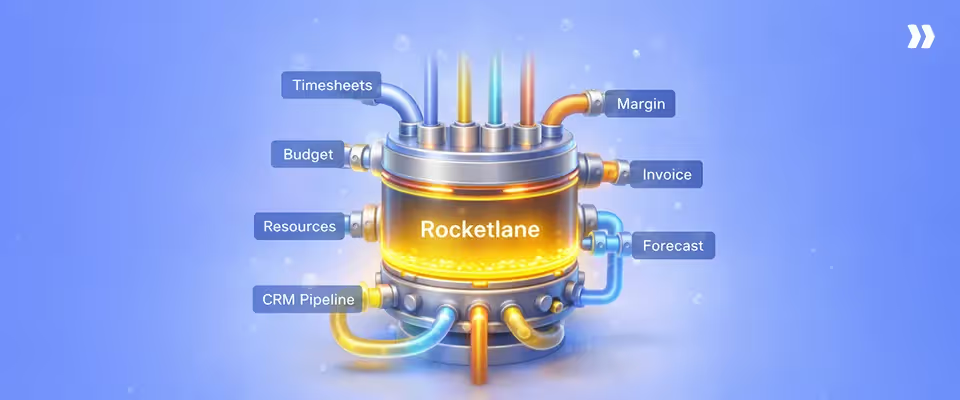
Most cost tracking problems are inherently integration problems.
Data lives in separate systems, reconciliation happens too late, and by the time margin compression is visible, the window for correction has closed.
Rocketlane solves this by making project delivery and financial management a single connected system.
Nitro, Rocketlane’s embedded agentic AI layer, strengthens that system by monitoring signals, enforcing discipline, and surfacing risk inside live workflows.
Here’s what puts Rocketlane ahead of other legacy PSAs.
Real-time cost visibility — not month-end surprises
In most environments, financial visibility arrives after reconciliation. Delivery teams see cost after finance closes the month.
In Rocketlane, project revenue, cost, and margin update as timesheets are approved.
Budget versus actual is visible at the project level, phase level, and portfolio level at the same time. There is no lag between when cost is incurred and when it appears in the system.
That timing changes behavior. Staffing decisions are made with current data, not stale reports. Budget versus actual is tracked at the project level, phase level, and portfolio level simultaneously.
Teams using Rocketlane achieve up to 75% billable utilization rates — a direct result of real-time cost visibility driving better resource decisions, not just better intentions.
Nitro’s upcoming agentic capabilities amplify this visibility. Its Project Health and Governance agents continuously monitor milestone progress, task velocity, and cost consumption patterns.
If budget utilization begins drifting ahead of delivery progress, the signal is surfaced early — not buried in a later report.
From timesheet to invoice — without the manual steps
Rocketlane connects milestone completion, timesheet approval, and invoice generation into one continuous workflow.
Once time is approved, it flows directly into billing. There is no manual export and no separate reconciliation step.
The system supports time and materials, fixed fee, subscription, and retainer models within the same project.
Time-to-invoice compresses from days to hours, and revenue leakage from unbilled time is reduced at the process level rather than through periodic clean-up.
It supports multiple billing models within the same project: time and materials, fixed fee, subscription, and retainer.
Time-to-invoice drops from days to hours. Revenue leakage from unbilled hours is eliminated at the process level.
Nitro’s Time Policies agent strengthens this chain.
It monitors missing or delayed time entries, flags inconsistencies, and validates time logged against policy. Leakage is not just reduced during billing — it is prevented at entry.
Automated budget alerts — catch overruns before they compound
Rocketlane allows budget thresholds to be defined at the project or phase level and notifies the right people when costs approach or breach those thresholds.
Instead of discovering a significant overrun at month-end, teams see variance when it crosses defined limits, often around ten percent, while corrective options still exist. Delivery leaders manage by exception rather than by repeatedly reviewing dashboards.
Resource cost modeling built into delivery planning
In many teams, staffing decisions are made based on availability first and cost implications later.
Rocketlane embeds cost rates directly into resource allocation. Every assignment carries the financial impact. When a resource is assigned, replaced, or reallocated, the margin impact updates immediately.
Planning a project shows the projected cost before commitment. Adjusting a team composition reflects financial consequences in real time. Projects are staffed deliberately, with clarity on both skill alignment and cost exposure.
Every resource allocation in Rocketlane carries a cost rate. Staffing decisions are financial decisions, made with financial visibility. Planning a project? See the cost before committing. Replacing a resource? See the margin impact in real time.
Revenue forecasting connected to the delivery pipeline
Rocketlane integrates with Salesforce and HubSpot to bring pipeline opportunities into the same financial model that tracks active delivery. Expected timelines, staffing needs, and cost projections are visible before contracts are signed.
Delivery leaders can see active project cost, pipeline cost, and available capacity together. Planning shifts from reacting to the current quarter to anticipating the next.
Nitro’s AI Analyst interprets trends across active and pipeline data identifying margin compression patterns, utilization pressure, or forecast instability across the portfolio.
Leaders see not only projected numbers, but emerging risk patterns behind them.
Delivery leaders can see active project cost, pipeline cost, and available capacity together.
Planning shifts from reacting to the current quarter to anticipating the next.
Who Rocketlane is built for
- Enterprise B2B SaaS and professional services teams managing multiple concurrent client projects
- PS organizations where margin per project is the primary business health metric
- Finance and delivery teams currently reconciling data across 3+ disconnected tools
- Teams that have outgrown Excel and standalone PM tools
What Rocketlane is not
Rocketlane is not an ERP or accounting replacement. It integrates with your finance system and feeds it structured data.
It is not a generic project management tool with budgeting layered on top. Financial management is embedded into the delivery workflow itself.
Importantly, Rocketlane is not restricted to large enterprises. It scales from small teams to organizations with thousands of users without requiring a system redesign.
Conclusion
At its core, project expense tracking the information system that makes profitable delivery possible.
The difference between a 40% margin project and a 10% margin project is rarely the scope. It's the visibility.
Teams that see cost variance while there's still room to act protect margin.
Teams that see it at month-end manage damage.
Three habits separate high-performing delivery organizations from the rest:
- Seamless time entry
- Milestone-aligned cost reporting instead of calendar-month, and
- Automation to track deviations alerts instead of manual dashboard reviews.
The tool question has a clear answer: Excel gets you started. Disconnected tools keep you reactive.
A PSA like Rocketlane that natively connects delivery and financial data is what scales.
Check out a demo to see how Rocketlane connects project delivery, resource costs, time tracking, and client billing in one place.
Even better, sign up for a free trial to see how Rocketlane can help your team deliver on-time, on-budget, and at the margins you planned for.

Authored by

Kailash Ganesh
Kailash Ganesh is a professional services researcher at Rocketlane with more than seven years of experience in content, research, and market analysis. He studies how enterprise PS teams are adopting agentic AI to transform delivery operations, has evaluated every major PSA platform in the category, and writes from the perspective of a practitioner who watches enterprise PS teams make these exact decisions daily.
Table of Contents

Regsiter for the live webinar


Great consultants didn't join your team to spend Fridays writing documentation.
Table of contents
18 of Forbes Cloud 100 chose Rocketlane. The best PS teams aren't waiting around.
FAQs
What are the most important project expense tracking KPIs?
Key project expense tracking KPIs include Cost Variance (CV), Cost Performance Index (CPI), Budget Utilization Rate, Estimate at Completion (EAC), Billable Utilization Rate, Project Gross Margin, and Revenue Leakage Rate. A CPI below 0.85 signals financial distress, and gross margin below 30% often indicates pricing or scope misalignment.
What is the difference between project expense tracking and expense reporting?
Expense reporting documents past spend. Project expense tracking monitors project costs in real time, compares actual costs to the approved project budget, and enables corrective action before cost overruns escalate.
What is expense forecasting in project management?
Expense forecasting projects the final project cost based on actual costs incurred and the estimated cost to complete remaining work. The primary metric is EAC, which updates continuously as the project progresses, unlike the static project budget.
How do you track project expenses in Excel?
A project expense tracking Excel template should include a Cost Breakdown Structure (CBS), actuals input sheet, automated cost variance calculation (CV), an Estimate at Completion (EAC) formula, and a project P&L summary. Excel works for simple projects but breaks down with multiple concurrent projects or real-time billing and alert requirements.
What causes project cost overruns?
Project cost overruns are commonly caused by delayed time entry, miscoded project expenses, untracked scope changes without formal change orders, shadow costs such as rework, and disconnected project management and finance systems that reduce real-time cost visibility.













Copyright © 2026 Rocketlane Corp. All rights reserved.



















.webp)