Time tracking project management: Methods, KPIs, best practices (2026 Guide)

•
•
Summarize blog with






In 2026, project delays rarely begin with a missed deadline. They begin with signs that look harmless.
Small effort overruns that go unnoticed, a few extra hours on discovery, slightly longer configuration cycles, or one more revision loop during testing.
Things appear manageable, till they reshape timelines, compress downstream phases, and erode margins.
The hidden problem is visibility into effort drift while it is still small.
Time tracking, when structured correctly, surfaces these signals early.
When time data is structured around tasks, milestones, and outcomes, it becomes the foundation for margin predictability, resource planning, and client communication.
When it is disconnected from the project context, it becomes administrative overhead.
In mature project and delivery environments, time tracking functions as part of a control system for project management.
It connects effort to scope, cost, sequencing, and forecasted outcomes.
This guide explains how that system works, how it differs from basic timesheets, which KPIs matter, and how to operationalize it in 2026.
What is time tracking in project management?
It compares actual effort to documented baselines so teams can detect variance, assess financial exposure, and recalibrate forecasts while recovery is still feasible.
In professional services environments, particularly SaaS implementations and consulting, time tracking operates as a governance layer. It links:
- Task-level effort to scope commitments
- Role-level hours to cost assumptions
- Burn rate to milestone progression
- Actual performance to forecasted completion
When embedded inside the project system, time data answers operational questions such as:
- Are you consuming effort faster than planned?
- Which task categories consistently overrun?
- Is margin exposure forming mid-phase?
Are specific roles absorbing disproportionate load?
Effective project time tracking is not about monitoring individuals. It ties in directly to:
- Revenue recognition
- Margin protection
- Forecast accuracy
- Delivery predictability
Project time tracking vs. project management time tracking
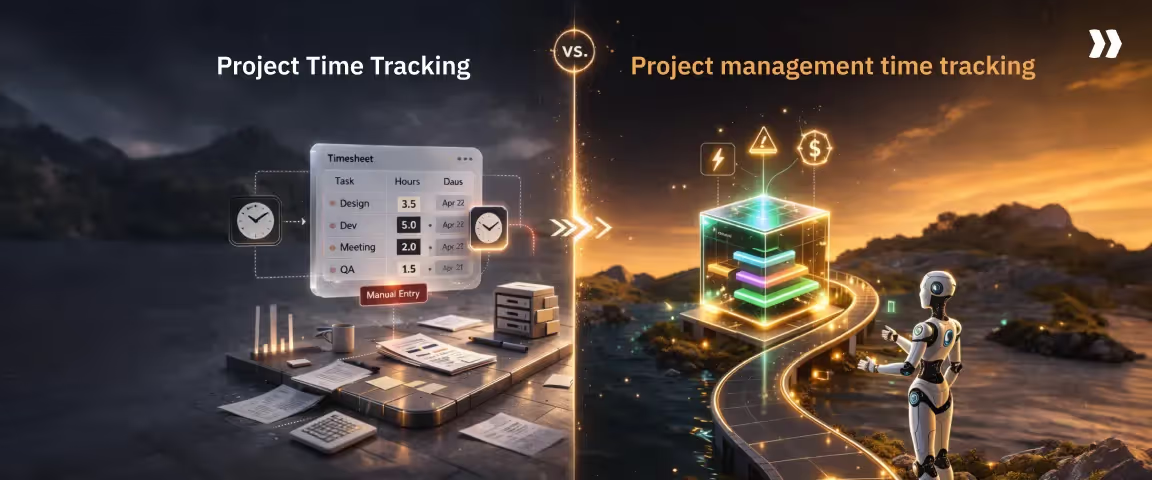
Many organizations believe they “do time tracking” because they collect weekly timesheets.
That is basic effort logging.
Basic project time tracking is activity capture. In such activity capture environments:
- Time is logged weekly.
- Reports show total hours per project.
- Variance is discussed after deadlines shift.
- The data rarely changes execution behavior.
Project management time tracking is structurally different. In structured project tracking, every hour answers: Did this effort move us closer to the milestone within the planned cost? If not, why?
This means that:
- Time is logged against structured tasks.
- Estimates exist before execution begins.
- Variance is reviewed in delivery meetings.
- Small overruns trigger early adjustments.
- Historical patterns refine future commitments.
What is a timeline in project management?
A timeline in project management is a structured schedule that maps tasks, dependencies, milestones, and deadlines across the lifecycle of a project.
It sets the expected rhythm of delivery and answers:
- When work starts and ends
- What depends on what
- Where milestones sit
- How long each phase should take
A timeline defines the project roadmap or planned sequence of tasks, dependencies, and milestones from kickoff to completion.
It establishes an expected pace. Leveraging historical time data from previous projects helps set realistic timelines, which improves deadline adherence, reduces team frustration, and increases client satisfaction.
Explained: Basic time tracking vs project management time tracking in 2026
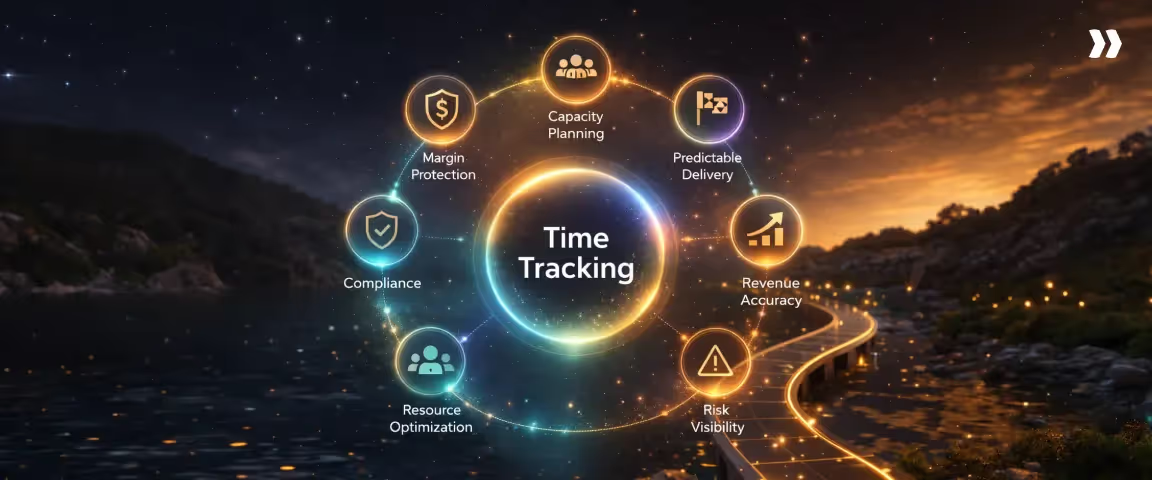
Why time tracking matters in project management: 7 key benefits of time tracking
The Project Management Institute, in its Pulse of the Profession reports, has repeatedly shown that organizations with mature performance measurement practices, including structured schedule and cost tracking, complete significantly more projects successfully and waste less money than low-maturity organizations.
Successful project management relies on effective time tracking and performance monitoring to ensure better team management, resource allocation, and improved project delivery outcomes.
Below are seven benefits that consistently appear in delivery-mature environments.
1. It surfaces delivery drift before milestones slip
Most delivery failures emerge from small deviations in effort distribution that go uncorrected. For instance, discovery extends because stakeholder responses take longer than assumed.
Or configuration absorbs more time because the integration logic is less standardized than expected. Internal reviews multiply because approval criteria were loosely defined.
What matters is whether those extra hours are evaluated against a baseline early enough to adjust.
When planned versus actual effort is compared at the task and phase level, teams can see shifts in delivery velocity before milestone dates move.
This is critical because schedule slip is a lagging indicator. By the time a milestone moves, recovery requires compression elsewhere.
2. It strengthens governance
Even when teams do not formally apply earned value management, the underlying principle still applies: planned effort must be compared to actual effort within a defined reporting cycle.
Time tracking anchors governance discussions in observable data:
- Are you consuming effort faster than you are completing scope?
- Is burn rate aligned with milestone progression?
- Are initial assumptions holding?
Effective project management tools make it easier to track and review project progress, supporting timely decision-making during governance discussions.
3. It improves estimation accuracy over time
Time tracking creates a critical feedback loop in project environments. Hard data from time logs enables more accurate project planning and performance analysis, providing a factual basis for refining future estimates.
When estimated hours are documented and systematically compared to actuals, teams begin to recognize patterns such as:
- Recurrent underestimation in integration phases
- Optimistic assumptions about stakeholder turnaround times
- Overconfidence in configuration effort
4. It clarifies scope boundaries in operational terms
When effort increases without corresponding task expansion or change orders, structured time tracking exposes the imbalance.
Breaking down broad activities into specific tasks allows for more accurate time tracking, better resource allocation, and easier identification of bottlenecks or delays.
In professional services contexts, this reduces friction and anchors change management in data,
5. It exposes process leakage and rework patterns
Repeated effort within the same task category often signals structural inefficiency.
Project teams often experience:
- Design hours reappearing during implementation
- Extended QA cycles caused by ambiguous requirements
- Repeated internal validation loops
Monitoring long tasks helps identify inefficiencies, optimize resource allocation, and refine cost estimates, supporting better project management.
Time variance is rarely just about individual productivity. It often reveals upstream clarity gaps or sequencing weaknesses. Mature teams treat this variance as diagnostic input.
6. It stabilizes resource planning
Sustained effort spikes in time data often precede burnout or attrition risk. On the flip side, persistent underutilization may reveal planning instability or inaccurate capacity assumptions.
When time tracking is reviewed across projects, leaders gain a clearer view of systemic load patterns and can rebalance proactively.
Analyzing time data also provides insights into the team's performance, enabling managers to optimize productivity and allocate resources more effectively.
7. It improves portfolio-level predictability
At scale, aggregated time data becomes a strategic signal. For instance, if multiple projects show similar early-phase variance, leadership can adjust hiring, sequencing, or scoping discipline before systemic strain escalates.
Such insights enable better decision-making and efficiency improvements across the project portfolio. Predictability increases when patterns are recognized across the portfolio rather than analyzed project by project.
Time tracking does not automatically create discipline. It creates visibility. Discipline emerges when teams consistently examine variance, interpret patterns, and adjust delivery behavior accordingly.
The patterns described above are observed repeatedly across SaaS professional services teams managing multi-phase client implementations under fixed-fee and milestone-based contracts, where small effort deviations have direct margin consequences.
How to track time spent on projects
A time tracker framework plays a crucial role in project management by helping teams plan, schedule, and identify bottlenecks, which leads to improved productivity.
Teams that struggle with time tracking usually face one of three problems:
- Tasks are poorly defined, so effort cannot be evaluated meaningfully
- Estimates are implicit, so variance cannot be measured.
- Reviews are irregular, so signals are missed until late stages.
The framework below reflects how delivery-mature organizations operationalize time tracking so it becomes governance infrastructure rather than administrative overhead.
Step 1: Define measurable project tasks
Time tracking quality is determined upstream, at task design.
Make sure that tasks are:
- Outcome-linked rather than activity-based
- Sized so variance is observable but not noisy
- Clearly bounded with completion criteria
- Mapped to phase-level milestones
For example, “Configure integrations” is too broad. “Configure CRM field mappings and validate with client test dataset” is measurable.
Step 2: Assign ownership and accountability
Each task must have a single accountable owner for clarity of responsibility. Using project management tools to assign tasks to specific team members, set deadlines, and track progress helps ensure clear ownership and improves team coordination.
When variance appears, someone should be able to answer:
- What changed?
- Was complexity underestimated?
- Did dependencies shift? Did the scope expand informally?
Step 3: Set estimation baselines
Accurate time tracking depends on having well-documented baselines, as they provide the foundation for reliable measurement and analysis.
Before execution begins, document:
- Estimated hours per task
- Role-level allocation assumptions
- Phase duration expectations
- Project risks and risk buffers, if any
Critically, document underlying assumptions. For example:
- Client review turnaround expected within three business days
- No major data model changes anticipated
- Dependencies resolved before configuration start
Step 4: Track actual time daily or weekly
Daily logging works well in high-velocity implementation phases. Weekly logging may be sufficient for longer strategic programs. The cadence matters less than the discipline.
Best practices for project time tracking include:
- Logging time directly against structured tasks
- Avoiding retrospective bulk entry at month end
- Embedding tracking inside the primary project workflow
- Reviewing compliance during recurring project forums
Culturally, leaders must ensure that they position tracking time as delivery intelligence rather than surveillance to overcome objections to time tracking.
Step 5: Compare planned vs actual
Variance review is the central governance ritual. This is where time tracking transitions from data capture to decision-making.
For effective variance analysis and informed decision-making, make sure to examine:
- Task-level variance
- Phase-level cumulative variance
- Burn rate relative to milestone completion
- Repeated patterns across similar task categories
Delivery-mature teams review variance weekly in active phases, not at project closure.
Step 6: Optimize allocation and forecasts
Regularly reviewing time tracking data helps identify areas needing improvement within project workflows, allowing teams to address inefficiencies and optimize performance.
Optimization should include:
- Reallocating senior expertise earlier in complex phases
- Adjusting future scoping templates
- Increasing buffers in historically volatile phases
- Strengthening discovery depth to reduce downstream rework
- Updating staffing models based on role-level variance trends
At the portfolio scale, aggregated time data supports:
- More accurate capacity planning
- Refined hiring timelines
- Improved delivery sequencing across accounts
Time tracking project management KPIs & metrics
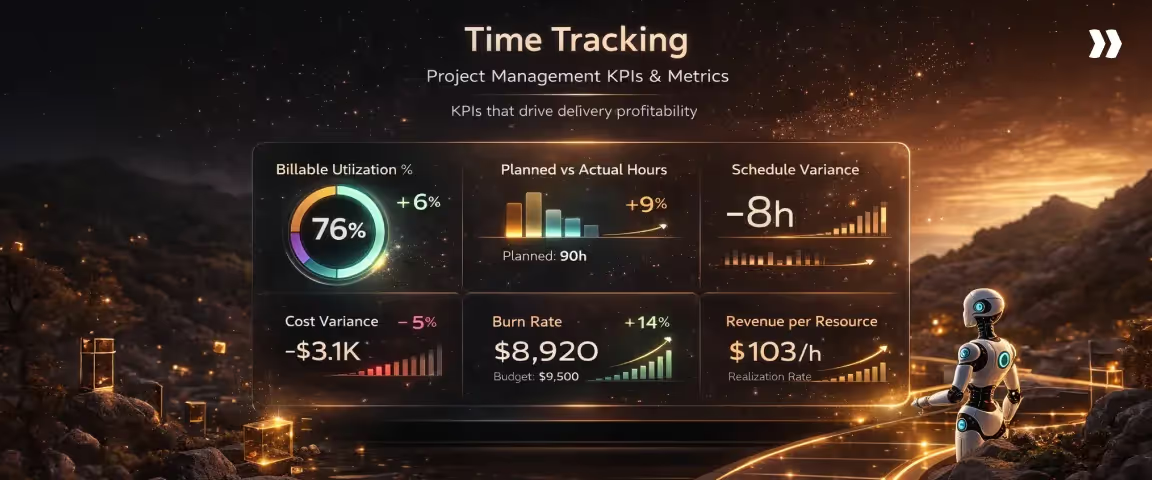
Time tracking in project management is not just about logging hours. It is about translating effort into measurable execution signals.
The right KPIs turn raw time data into insight — revealing whether delivery is predictable, margins are protected, resources are balanced, and schedules are realistic.
Modern time tracking project management systems rely on structured performance indicators to detect variance early, prevent cost drift, and align effort with outcomes. Without these metrics, teams operate reactively, relying on intuition instead of data.
Below are the essential KPIs and metrics every delivery-driven organization should monitor to ensure execution stays aligned with plans, financial targets, and capacity constraints in 2026 and beyond.
Planned vs actual variance
What this measures
The gap between how you expected the work to unfold and how it is actually unfolding.
What it highlights
Alignment, or misalignment, between your delivery model and real execution conditions.
What to look for
- Repeated overruns in early phases, such as discovery or solution design
- Consistent variance in tasks that involve external dependencies
- Small but accumulating overruns across multiple related tasks
Utilization rate
What this measures
The proportion of available capacity being used for delivery work. Tracking utilization is especially important for hourly employees to ensure accurate work estimation and productivity monitoring.
What it highlights
The balance between output and resilience in your system.
What to look for
- Sustained utilization above 85–90 percent
- Rising task-level variance alongside high utilization
- Increased cross-project context switching
Billable utilization
What this measures
The share of capacity directly tied to revenue-generating work. Tracking time spent on project work helps assess performance, distribute workload, and make informed decisions for future projects.
What it highlights
How much of your delivery effort converts into billable output.
What to look for
- Rising billable utilization combined with negative cost variance
- Heavy concentration of billable hours among high-cost senior roles
- Increased billable time without proportional revenue growth
Cost variance
Simplified time-based view: Cost Variance ≈ (Planned Hours − Actual Hours) × Cost per Hour
What this measures
Financial deviation from the planned cost structure.
What it highlights
Whether execution is preserving or eroding margin.
What to look for
- Negative cost variance emerging in early phases
- Disproportionate overruns in high-cost specialist roles
- Financial drift during foundational tasks
Schedule performance index (SPI)
An SPI below 1.0 indicates slower-than-planned progress.
What this measures
The efficiency with which effort translates into milestone completion.
What it highlights
Whether progress is proportional to effort consumed.
What to look for
- Downward SPI trend across consecutive review cycles
- Divergence between stable effort variance and declining SPI
- Phase-level drops in SPI following handoffs
- The impact on other tasks that may be affected or delayed due to dependencies or resource shifts; tracking these other tasks helps improve project estimates and timelines.
Estimate accuracy %
What this measures
Forecast calibration over time.
What it highlights
How reliably your organization translates scoping assumptions into realistic effort commitments.
What to look for
- Phase-specific deviation patterns
- Recurrent underestimation in technically complex work
- Divergence between sales estimates and delivery actuals
- Tracking how team members spend their time on various tasks provides valuable insights for improving estimate accuracy.
Revenue per hour
What this measures
Financial yield per unit of delivery effort.
What it highlights
The alignment between pricing, scope containment, and role leverage.
What to look for
- Gradual decline across similar engagement types
- Large differences between project categories
- Revenue stability combined with increasing effort
- Understanding how your team spends its time is crucial for optimizing revenue per hour and improving overall project profitability.
Task cycle time
What this measures
Elapsed time from task initiation to completion.
What it highlights
Workflow friction and dependency constraints.
What to look for
- Long elapsed durations with modest logged hours
- High variability across similar tasks
- Repeated dependency-driven delays
- Reviewing work data within specific time periods helps assess project progress and allocate resources effectively.
Capacity utilization
What this measures
The degree to which total team capacity is committed.
What it highlights
Portfolio realism and systemic resilience.
What to look for
- Commitment levels consistently above 95 percent
- Simultaneous high utilization and negative cost variance
- Increasing cross-project rescheduling
- Shifting priorities (that often require teams to adjust focus and resource allocation)
Common mistakes in project time tracking
Time tracking fails because the surrounding system does not convert those hours into decisions. Here are the most common breakdown patterns, along with what they typically indicate beneath the surface.
1. Tracking hours without linking to tasks
Logging time at a project level without tying it to structured tasks creates visibility without diagnosability.
Using tools that support unlimited projects helps avoid hidden costs and ensures scalability as teams grow, especially when managing multiple or expanding projects.
Consider an example where testing effort appears elevated for several consecutive weeks. Without task-level tagging, it is impossible to determine whether the cause is requirement ambiguity, defect density, or client-driven change.
2. Delayed time entry
Time logged retrospectively is structurally weaker than time logged close to execution.
When consultants enter hours at the end of the week, effort is reconstructed rather than recorded. Context switching is compressed. Waiting time is forgotten. Small overruns become rounded estimates.
For example, a consultant may log eight hours of configuration on Friday. In reality, the day may have included fragmented blocks across three projects with interruptions and rework.
3. Over-complicated tracking processes
When leadership loses confidence in time data, complexity often increases. Teams add details to improve granularity. In practice, contributors default to the closest acceptable category rather than the most accurate one.
The most reliable tracking systems balance clarity and usability. They are structured enough to isolate variance but simple enough to sustain adoption. Using a time tracking app can simplify the process, improve accuracy, and increase adoption among team members.
4. Using spreadsheets at scale
Spreadsheets function well in small, contained environments. They struggle under portfolio complexity.
When each project operates on a separate spreadsheet:
- Task structures diverge
- Version control becomes manual
- Aggregation requires reconciliation
- Forecast adjustments are slow
Project management software with integrated time tracking offers better aggregation, version control, and real-time governance, addressing many of these spreadsheet limitations.
5. Ignoring forecast variance
Tracking historical variance without updating forward-looking projections disconnects measurement from planning.
For example, if discovery exceeds estimates by 25% but projected completion dates remain unchanged, the forecast no longer reflects reality.
This variance should trigger recalibration and remaining effort assumptions must adjust based on observed performance.
Leveraging time tracking data enables teams to optimize workflows and enhance project outcomes by identifying bottlenecks and streamlining processes.
6. Not aligning time with financial metrics
Consider two projects consuming identical effort. One is time-and-materials. The other is fixed-fee. In the former, additional effort increases revenue. In the latter, it compresses the margin.
If hours are tracked without role-level cost rates or contract context, leaders see activity but not impact.
Time data should align with:
- Role-level cost assumptions
- Contract type
- Revenue recognition model
- Target margin thresholds
7. No visibility across teams
Consider this: If three projects independently show recurring integration overruns, the issue is unlikely to be isolated. It may reflect tooling complexity, insufficient discovery depth, or structural underestimation.
Without cross-team visibility:
- Role bottlenecks remain hidden
- Capacity strain accumulates
- Estimation bias persists
Accurate and consistent time tracking by all team members is essential for effective resource allocation and transparency across projects.
Their cooperation ensures that patterns and issues are visible, enabling better management and accountability.
A quick look at common time tracking breakdown signals and corrective approaches
7 best practices for project-based time tracking
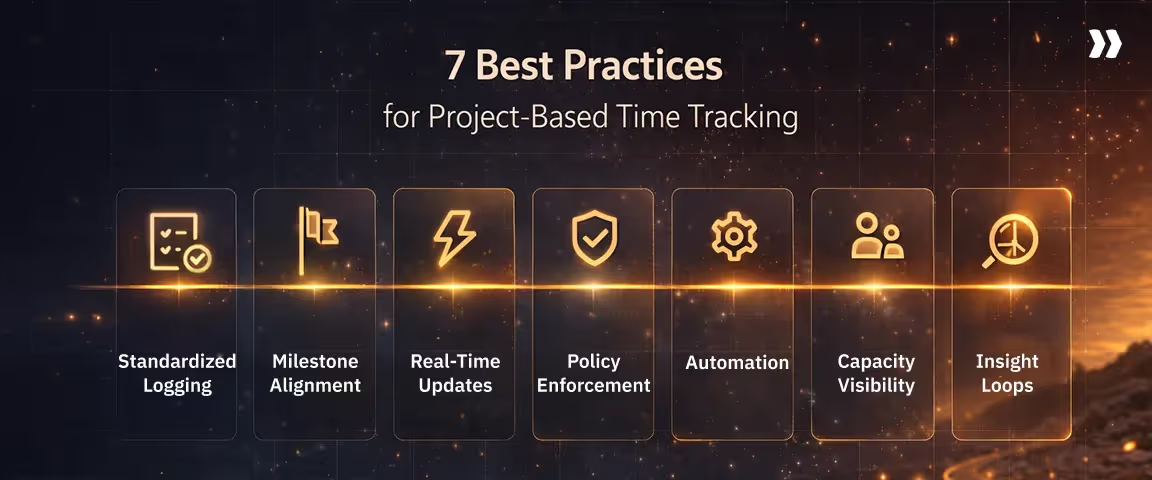
When it comes to project-based time tracking, the difference between average and high-performing teams is how deliberately they design the structure, behavior, and review system around it.
Below are seven practices, explained in terms of what to implement, why it matters, and how to operationalize them in real environments.
1. Standardized task taxonomy
Modern delivery systems lock structure at the template level.
Instead of letting every project define its own task hierarchy, they create reusable project blueprints.
Phases, task categories, and ownership models are predefined before execution begins. When a new project is created, it inherits a consistent structure automatically.
How to operationalize this
- Build delivery templates for each core engagement type. Using time tracking software or project management tools with support for unlimited users ensures your system can scale as your team grows, without incurring additional costs or restrictions.
- Define phase-level tasks centrally, not per-project.
- Restrict ad-hoc task category creation for core lifecycle stages.
- Review quarterly variance by task type to validate whether the taxonomy is still accurate.
2. Real-time logging
Advanced systems collapse the distance between doing work and logging work.
Time entry is attached directly to active tasks. When a team member works on a task, logging is embedded in the same interface. When a task is marked complete, effort confirmation is prompted automatically.
This eliminates the “log later” gap where precision degrades.
How to operationalize this
- Enable time entry directly from task views, not separate modules.
- Trigger a required effort entry when closing tasks.
- Block milestone completion if effort is missing on critical-path tasks.
- Monitor logging latency as a metric, not just total hours.
3. Automated reminders
Rather than sending generic weekly reminders, reminders trigger when behavior deviates from expected workflow patterns.
For example, if a task has activity but no logged time within 24 hours, the system nudges the assignee.
Evaluating and selecting the best time management apps can further enhance compliance and streamline project management by ensuring automated reminders are both effective and integrated with your workflow.
How to operationalize this
- Configure conditional reminders tied to task status changes.
- Trigger alerts for active assignments with zero logged time.
- Surface missing entries in project dashboards visible to PMs.
- Set escalation rules after repeated missed entries.
4. Integration with project workflows
When milestones, dependencies, and time logs are separated, variance detection slows. In modern setups, dashboards display milestone completion percentage alongside effort burn and cost exposure in real time.
For example, if a milestone shows 60 percent completion but 80 percent effort burn, that imbalance is visible instantly without exporting data.
How to operationalize this
- Require time logging only against structured tasks.
- Ensure milestone health dashboards include effort consumption metrics.
- Use or design dashboards that show proportionality, not just totals.
5. Financial visibility linkage
Modern delivery systems embed financial metadata at the role and task level.
Each logged hour automatically inherits the cost rate and contract type context. Cost variance updates dynamically as effort accumulates.
This removes the delay between operational overrun and financial awareness.
How to operationalize this
- Attach default cost rates to delivery roles inside the system.
- Tag projects by pricing model at setup.
- Display margin exposure alongside effort variance in weekly reviews. The project manager is responsible for overseeing time tracking, generating customizable reports, and ensuring transparency and efficiency in project execution.
- Set early-warning thresholds for negative cost variance.
6. Capacity forecasting alignment
Sophisticated setups use historical effort patterns to adjust future allocation automatically.
For instance, if integration tasks repeatedly exceed estimates, future project templates reflect higher effort assumptions, and capacity dashboards show projected allocation based on actual burn rates.
Small teams especially benefit from tailored capacity forecasting and detailed reports, which help manage resources effectively and ensure that project workloads remain balanced.
How to operationalize this
- Review rolling average variance by phase each quarter.
- Adjust default task estimates in templates based on empirical data.
- Build capacity dashboards that incorporate forecasted burn, not just allocated hours.
- Maintain buffer thresholds instead of planning at 100 percent utilization.
7. Governance and reporting cadence
In mature environments, dashboards are designed around decision prompts, not raw metrics.
Weekly reviews focus on:
- Tasks exceeding variance thresholds
- Phases trending off baseline
- Cost exposure crossing predefined bands
- Capacity strain indicators
Time reports are essential for tracking project progress, comparing actual hours against budgets, and providing transparency to clients and stakeholders.
How to operationalize this
- Define variance thresholds that auto-flag tasks.
- Use standardized weekly review templates tied to system dashboards.
- Escalate deviations that persist beyond two reporting cycles.
- Track whether corrective actions reduce repeat variance.
Time tracking project management checklist
This checklist evaluates whether your time tracking system produces early warning signals, financial clarity, and credible forecasts.
When time tracking feels reactive, one of the structural foundations below is usually weak.
1. Clear project scope defined
Time tracking only works when commitments are measurable. Here are the questions you need to consider:
- Are deliverables defined in outcome terms, not activity terms?
- Are integration boundaries explicit?
- Are client responsibilities written and time-bound?
- Is there a clear change-control mechanism?
Why this matters
Most early overruns stem from expectation gaps, not poor execution. If the scope is interpretive, effort expands quietly, and variance becomes hard to explain.
2. Tasks broken into trackable units
Task design determines how fast drift becomes visible.
Ask:
- Would a 15 percent overrun surface within one review cycle?
- Are high-risk activities isolated?
- Are review loops represented explicitly?
- Is coordination separated from execution?
Why this matters
Bundled tasks hide imbalance. Over-fragmented tasks create noise. Good architecture makes deviation gradual and diagnosable.
3. Owners assigned
Ownership determines correction speed. To ensure robust ownership, ask:
- Does each task have a single accountable owner?
- Can that owner escalate or adjust the plan?
- Are cross-functional tasks anchored to decision-makers?
Why this matters
Variance requires interpretation and action. Shared accountability slows diagnosis and spreads ambiguity.
4. Estimation baselines set
Baselines anchor judgment through questions such as:
- Are task-level estimates documented before execution?
- Are assumptions documented, not implied?
- Is contingency visible?
Why this matters
When assumptions shift, effort shifts. Without documented baselines, teams debate memory instead of analyzing deviation.
5. Time logged daily
Signal quality depends on input quality. This depends on answering deliberate questions like
- How long after work completion is time logged?
- Are entries clustered at week’s end?
- Is there rounding or reconstruction behavior?
Why this matters
Delayed logging compresses friction and weakens variance sensitivity, especially in multi-project environments.
6. Weekly variance review conducted
Variance must be interpreted while recovery is still possible. To do this, the process should answer these questions at the minimum:
- Is planned vs actual reviewed weekly in active phases?
- Are thresholds predefined?
- Do reviews trigger plan adjustments?
Why this matters
Early overruns are manageable. Late discovery forces compression downstream.
7. Utilization analyzed monthly
System strain shows up before deadline slip. This means that time tracking should answer questions like:
- Are certain roles consistently near maximum capacity?
- Is volatility increasing?
- Are buffers explicit?
Why this matters
Chronic high utilization reduces elasticity. Small estimation errors then cascade across projects.
8. Forecast updated based on real data
Forecast discipline reveals maturity.
Ask:
- Are remaining estimates recalculated when variance crosses thresholds?
- Are completion dates adjusted mid-phase?
- Do recurring patterns reshape templates?
Why this matters
Dynamic forecasts preserve credibility and reduce surprise compression.
Choosing a project time tracking tool
Choosing a project time tracking tool is ultimately about whether the system reinforces the right behaviors and exposes the right signals early.
Look for capabilities that separate administrative tools from execution-focused delivery-grade systems, such as:
Task-level integration
A project time tracking tool should treat tasks as the primary unit of measurement, not just projects or people.
If time is logged at the task level but tasks are disconnected from milestones and dependencies, effort and progress remain misaligned.
What to evaluate
- Can time be logged directly against structured tasks?
- Do tasks roll up into phases and milestones automatically?
- Is variance visible at the task, phase, and project levels?
- Does the tool prevent logging against undefined or ad hoc categories?
Real-time visibility
The right project management tool for time tracking should show effort burn and milestone progression together, not in separate reports. Visibility should not require exports or reconciliation.
What to evaluate
- Can you see planned vs actual effort in real time?
- Are dashboards updated dynamically as hours are logged?
- Is milestone completion visible alongside effort consumption?
- Are thresholds configurable for alerting?
Budget tracking
A capable tool should attach cost rates at the role level and calculate cost exposure automatically as hours accumulate.
Without this, you may detect effort overrun but miss its financial consequence.
What to evaluate
- Are role-based cost rates configurable?
- Does the system support fixed-fee and time-and-materials models?
- Is cost variance calculated automatically?
- Can you view the remaining budget vs projected burn?
Financial reporting
Operational metrics must translate into financial insight.
Beyond cost tracking, the tool should support revenue alignment, margin visibility, and profitability analysis at the project and portfolio levels.
What to evaluate
- Can you calculate revenue per hour by engagement type?
- Are margin projections visible mid-project?
- Is financial reporting tied to actual logged effort?
- Can you analyze profitability trends across similar project types?
Resource allocation view
Time tracking data should feed forward-looking allocation decisions. The tool should provide a clear view of current commitments, projected burn, and capacity strain across roles.
What to evaluate
- Is there a consolidated view of team allocation across projects?
- Can you simulate the impact of new project intake on capacity?
- Are overcommitment risks visible before deadlines slip?
- Does the system distinguish between planned allocation and actual burn?
Client reporting
If client reporting requires reconstruction outside the system, consistency erodes.
Project time tracking should support transparent client communication where appropriate. In fixed-fee engagements, this may involve phase-level progress reporting.
In time-and-materials engagements, it may require detailed time breakdowns.
What to evaluate
- Can reports be generated without manual consolidation?
- Are client-facing views aligned with internal task structure?
- Does reporting support both summary and drill-down views?
- Can reports reflect approved changes and revised baselines?
- Do customers have a dedicated client portal to access necessary updates?
Automation capability
A modern project time tracking tool should automate behavioral reinforcement, variance detection, and the next best action.
What to evaluate
- Are reminders triggered for missing or delayed entries?
- Can variance thresholds automatically flag tasks?
- Do forecasts update dynamically when effort exceeds tolerance bands?
- Can governance dashboards surface exceptions rather than raw data?
Integration ecosystem
Time tracking rarely exists in isolation.
Your tool should integrate cleanly with CRM, accounting systems, collaboration tools, and implementation workflows. Disconnected systems introduce friction and data duplication.
What to evaluate
- Does the tool integrate with your CRM to connect scope and effort?
- Can it sync with financial systems for invoicing and revenue recognition?
- Does it integrate with communication platforms for task updates?
- Is data export structured and API-accessible?
What experienced delivery teams prioritize
When selecting a project time tracking tool, experienced teams prioritize:
- Structural alignment between tasks, milestones, and effort
- Real-time variance visibility
- Financial consequence tied to every logged hour
- Capacity forecasting grounded in actual burn.
- Automation that reinforces discipline without manual policing
Time tracking for professional services teams
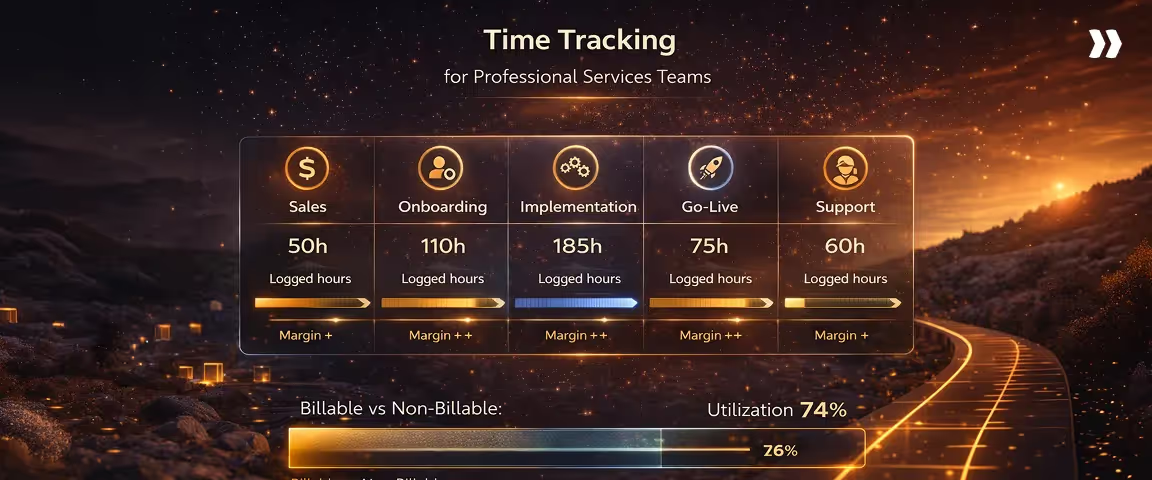
Unlike product teams, professional services teams operate in a model where small variances in effort can materially impact profitability.
Time tracking across delivery states in professional services
For service teams, time tracking behaves differently across key phases of delivery:
The dimensions that matter most in services delivery include:
Billable vs non-billable tracking
Most services teams start by separating billable and non-billable time. That distinction is necessary but insufficient.
What matters beyond classification
- Are non-billable hours categorized meaningfully, such as pre-sales support, internal enablement, rework, or client-driven change?
- Is non-billable effort increasing in specific phases?
- Are billable hours aligned with the contractual scope?
Margin analysis
In professional services, margin compression often begins quietly.
Time tracking must connect logged hours to cost rates and contract type to expose financial drift early.
What to monitor
- Are actual effort patterns deviating from pricing assumptions?
- Is margin trending downward mid-project?
- Are specific roles driving cost variance?
Without role-based cost linkage, margin risk remains invisible until financial reconciliation.
Forecasting revenue
Revenue forecasting in services depends on effort predictability.
Time tracking should inform projected billable revenue in time-and-materials engagements and projected margin realization in fixed-fee engagements.
What strong systems enable
- Revenue projections that update as actual effort accumulates.
- Visibility into whether the current burn supports committed revenue targets.
- Early detection of revenue shortfalls due to lower-than-expected billable hours.
For instance, if billable effort trends below plan for two consecutive weeks, revenue forecasts should adjust automatically.
Multi-project resource planning
Professional services teams rarely operate on a single project.
Consultants are allocated across multiple engagements, which introduces complexity in capacity planning and context switching.
What to evaluate
- Are actual effort patterns consistent with planned allocations?
- Are certain roles consistently over-allocated across projects?
- Is context switching increasing as portfolio load grows?
Time tracking at the portfolio level reveals systemic strain before deadline compression appears.
Client transparency
Time tracking also influences trust.
In time-and-materials engagements, detailed and structured reporting builds credibility. In fixed-fee engagements, phase-level effort transparency helps manage scope expectations.
What to evaluate
- Are client reports aligned with the internal task structure?
- Can you show effort distribution by phase if challenged?
- Are scope changes reflected transparently in time data?
How modern teams manage time tracking at scale with Rocketlane
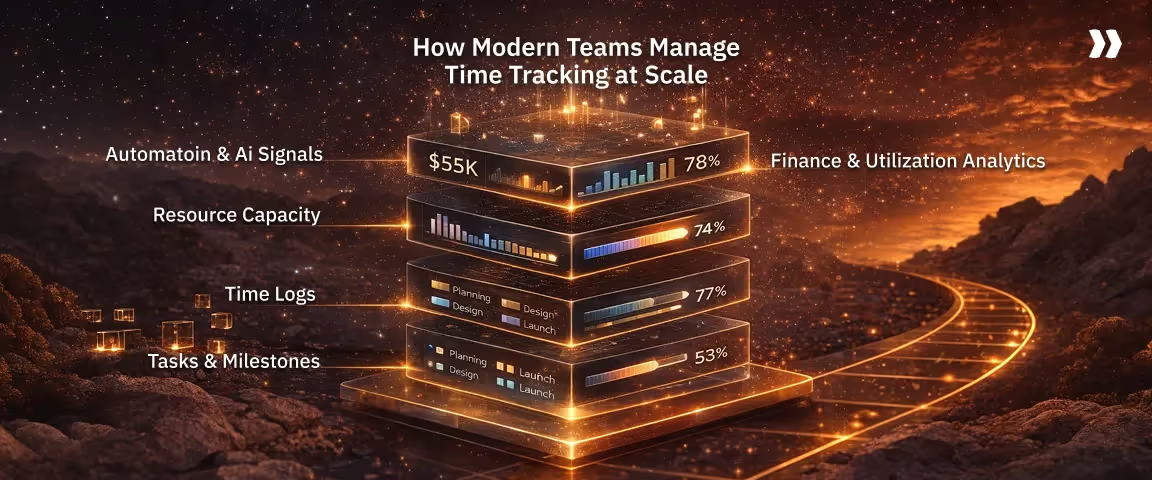
At scale, time tracking becomes a systems problem. With dozens of concurrent projects, mixed contract models, and distributed teams, the challenge is preserving signal quality across the portfolio.
Rocketlane embeds time tracking directly inside task hierarchies, milestone sequencing, and financial metadata.
Nitro, its embedded agentic intelligence layer, continuously monitors delivery signals in motion. Instead of relying on manual interpretation, structured variance, cost exposure, allocation strain, and milestone proportionality are evaluated continuously.
The result is earlier visibility into drift, earlier awareness of margin pressure, and faster correction through:
Continuous evaluation instead of manual synthesis
Rocketlane evaluates structured data in motion:
- Task-level effort variance is assessed continuously
- Effort burn is measured alongside milestone progression
- Cost exposure updates dynamically as hours accumulate
- Resource allocation strain is visible across teams
Enforcing discipline without adding overhead
Manual enforcement does not scale. Nitro’s Time Policies Agent monitors:
- Missing or delayed time entries
- Inconsistent allocations
- Policy deviations
Linking effort to financial reality in real time
In professional services, margin erosion develops gradually with incremental overruns, senior expertise absorbing complexity, while forecasts remain static.
By tying role-level cost rates and contract context directly to logged hours, Rocketlane ensures that financial exposure updates continuously so that margin pressure becomes visible during execution rather than during reconciliation.
Portfolio-level capacity intelligence
Portfolio averages can conceal strain. A specific role may be operating near maximum allocation across several projects while overall utilization appears stable.
Nitro’s resource management agents track:
- Utilization concentration by role
- Allocation overlap across engagements
- Burn acceleration patterns
Governance with consistent signal interpretation
As organizations scale, reporting complexity increases. Nitro’s documentation agents synthesize structured delivery data into standardized summaries.
Governance discussions focus on flagged risks and corrective actions rather than assembling reports.
Why leading PS teams trust Rocketlane for time tracking
Legacy professional service automation (PSA) systems function primarily as systems of record.
But a truly modern platform for project management is one that tightly connects time, financial metadata, and delivery.
Rocketlane, enhanced by Nitro, its system of specialized AI agents embedded directly into professional services workflows, functions as a system of execution with embedded operational intelligence.
Conclusion
Time tracking in project environments is one of the most powerful optimization mechanisms available to professional services organizations.
When it is embedded inside structured workflows, interpreted weekly, linked to margin exposure, and allowed to recalibrate forecasts, it becomes predictive infrastructure.
Modern delivery teams intentionally design time tracking systems where effort data continuously answers critical questions, such as:
- Is milestone progress proportional to effort consumed at task and phase levels?
- Is cost variance forming before it impacts margin targets?
- Are specific roles absorbing disproportionate effort across projects?
- Are recurring overruns pointing to structural estimation gaps?
- Is forecast completion still aligned with observed burn patterns?
With an integrated project management platform like Rocketlane, time tracking is embedded directly inside structured workflows and monitored through an intelligence layer.
Rocketlane’s Nitro AI agents extend that advantage by continuously monitoring governance integrity, project health, time compliance, and delivery signals.
This shifts from passive record-keeping to active signal detection.
Teams see that feedback loops tighten, interpretive lag shrinks, and drift becomes visible and hard to ignore while correction is still possible.
If you want to see how modern professional services teams operationalize this, explore how Rocketlane customers are improving time-to-value and margin control, or book a demo with our experts to see what this would look like inside your delivery environment.
Table of Contents

Regsiter for the live webinar


Great consultants didn't join your team to spend Fridays writing documentation.
Table of contents
18 of Forbes Cloud 100 chose Rocketlane. The best PS teams aren't waiting around.
FAQs
How does time tracking improve project profitability?
Time tracking can boost your bottom line by surfacing effort variance and cost exposure early, allowing teams to adjust scope, staffing, or pricing before margin compression becomes irreversible.
What’s the difference between time tracking and project scheduling?
Project and resource scheduling plans when work should happen, while time tracking measures how much effort was actually consumed and whether progress aligns with those plans.
What KPIs should project managers monitor when tracking time?
Key KPIs include planned vs actual variance, cost variance, billable utilization, estimate accuracy, revenue per hour, and capacity utilization trends.
What are the biggest mistakes teams make with project time tracking?
Common mistakes include logging without structured tasks, delaying entries, ignoring financial linkage, reviewing variance too late, and keeping forecasts static despite visible overruns.
When should a team move from basic time-tracking tools to integrated project time-tracking software?
Teams should consider a project time-tracking software upgrade when managing multiple concurrent projects, mixed contract types, recurring margin surprises, or when effort data needs to directly inform forecasting and governance decisions.













Copyright © 2026 Rocketlane Corp. All rights reserved.



















.webp)