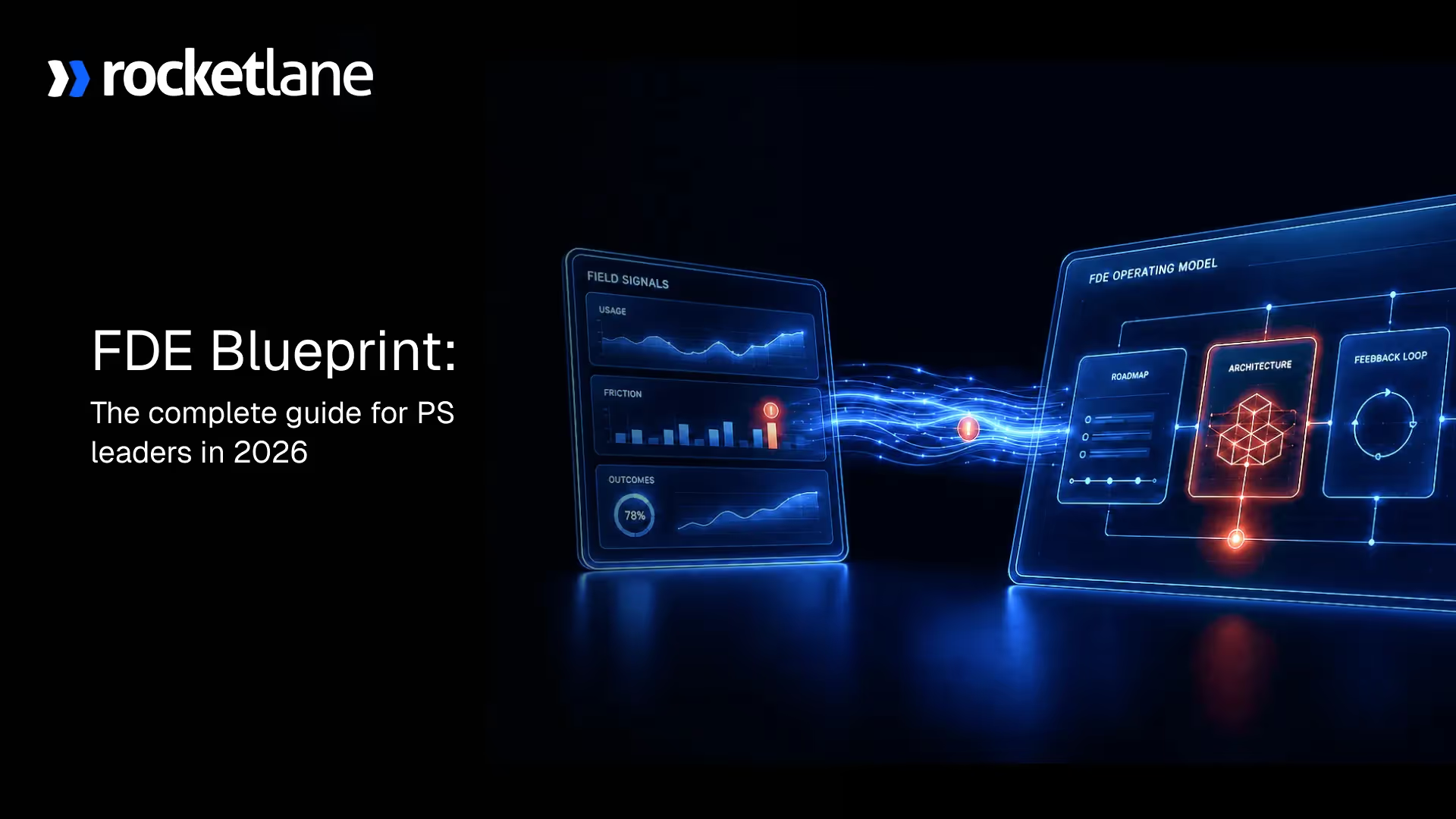
The FDE Blueprint : A complete guide for PS leaders in 2026

•
•
Summarize blog with






What is the FDE blueprint?
Forward Deployed Engineering is defined by two structural traits that distinguish it from every prior model of customer-facing delivery: FDEs contribute back to the product, and their success is measured against customer outcomes. Everything else from the name, the org chart placement, the engagement model varies by company. Those two traits do not.
This article is organized around three pillars:
- People (who to hire, how to shape the team, how to retain them),
- Work (how engagements run and how to measure them), and
- Operations (how to fund, price, and account for the function).
Use it to make decisions.
Reference Matrix: Five Shades of FDE
ACV bands are indicative, not hard cutoffs. The decision rule for shade selection is in Section 02.
Pillar 1 — People
Who is an FDE? What do you screen for? Where do they go?
01. The FDE profile is converging, but the hiring bar is deliberate, not accidental.
The FDE sits at the intersection of technical depth and business judgment. The failure modes on either side are predictable: a pure engineer without commercial instinct will build exactly what the customer asked for and miss the business problem underneath it. A pure consultant without engineering range will architect solutions they cannot ship.
What the function requires in practice: someone who can run a technical discovery with an engineering buyer, translate it into a working prototype, and frame the business case to a CFO in the same week.
AI coding tools have shifted the lower bound of what "technical" means. The consulting-to-FDE path is now viable: people from top-tier consulting firms who can run discovery, build business context, and use AI tools to ship working code.
They are not a replacement for engineers in complex production environments, but rather are a legitimate entry point at companies where the Deployment Strategist archetype is the right shade.
Screening signals (look for these)
- Candidate can describe a customer problem and the technical architecture to solve it in the same explanation, without being asked to connect them.
- Candidate has shipped something; can be a prototype, a tool, a demo - to an external stakeholder.
- When asked "what would you do if the customer's requirements were technically wrong?" candidate pushes back on the requirements, not the question.
Red flags
- Candidate who frames customer interaction as a necessary cost of the role rather than a core part of the work. These engineers rotate back to core product within 18 months. The screen matters; missing it is expensive.
- Candidate who needs full specs before starting. FDE engagements are defined by incomplete information. Comfort with ambiguity is not optional.
- Candidate who has never had to say no to a stakeholder and explain why. Outcome orientation requires scope discipline.
The principle. Hire for the intersection deliberately. Screen both dimensions in every loop, and reject candidates who are exceptional on one axis and missing on the other.
02. There are five shades of FDE. Picking the wrong one breaks the math.
The five shapes are defined above in the reference matrix. The decision rule for which shade to deploy is a function of three inputs: ACV, pricing model, and whether the primary value is novelty or scale.
Decision rule
- ACV < $150K, consumption pricing → Deployment Strategist. A senior engineer on a $100K account does not pencil. The strategist profile - part PM, part success, codes with AI tools - is what the economics support.
- ACV $150K–$800K, outcome or usage-based pricing → Deployment Engineer (Palantir archetype). Customer needs production-grade build capacity. Pair with a Technical Deployment Lead so the engineer stays in code.
- Account has novel use cases that will generate net-new platform IP, regardless of ACV → Innovation FDE. This is not a deal-size decision but a platform-learning decision. Keep the team small. The constraint is what gives it leverage.
- A repeatable playbook exists for the use case → Implementation FDE. Stop deploying Innovation FDEs to problems that are already solved. Transition to the implementation track and protect Innovation capacity.
- ACV $600K+, company wants FDE to function as a product development methodology → Agent PM / R&D Services pod. These teams ship product directly. New hires should do a rotation in core product before customer deployment. Customer-specific builds go behind feature flags and fold back into the core product over time.
The principle. Match ACV and pricing model first. If the math doesn't work at your ACV, a different shade will not fix it.
03. Career pathing is the retention problem. Build the ladder before you need it.
The question a senior engineer asks on day ninety is: what comes next? If the answer is "back to core product," you have a rotation program, not a career. The function does not retain talent until the ladder inside it is legible.
A working ladder structure
Off-ramps (walk these paths deliberately)
- Staff FDE → Principal/Staff Engineer in core product. Requires a defined transition process; don't let it happen by attrition.
- Senior FDE → Solutions Architect or SE Director (GTM track).
- FDE Manager → GM of a new business line, especially where FDE is being run as a product line.
Compensation. Pay FDE I–II at parity with equivalent engineering levels. Introduce a variable component at Senior and above tied to the function's primary KPI. Target: 15–25% variable at Senior, 20–35% at Staff and Manager. Do not structure the variable like a pre-sales quota - it does optimize for deal-winning, but not for outcome delivery. Tie it to the metric that lags the contract: consumption, resolution rate, platform contributions.
The principle. FDE is a retention risk until the ladder is built. Build it before your first Senior FDE asks where they go next.
Pillar 2 — Work
How engagements run. How they end. How they feed back.
04. The engagement lifecycle has five stages. Enforce time limits on each.
The lifecycle is consistent enough across companies to plan against. The stage durations below are provisional; calibrate against your first ten engagements.
Selection discipline is the scarcest lever. FDE capacity is the most constrained resource in the org. Deploying it to the wrong customer is worse than not deploying it at all. Codify the entry criteria and enforce them, even under sales pressure.
The principle. An engagement without a defined exit condition is a support contract. Every engagement enters Stage 1 with a documented definition of done.
05. The pre-sale / post-sale framing no longer maps cleanly onto FDE.
For many AI-native products, FDE involvement could become a prerequisite for go-live. The pre-/post-sale distinction only describes companies whose products can be deployed without an FDE. That is an increasingly narrow category.
Companies sit at every point on the spectrum: some engage FDEs only during a structured pilot; some deploy the same person from first conversation through production; some, at the earliest stage, have no separate sales team - the person running the demo builds the solution.
The operational implication: do not design cost allocation or KPIs around a pre-/post-sale split if your FDEs routinely span both. Use activity-based time tracking instead (see Section 08).
The principle. Organize FDE around engagement stages and not on sales stages.
06. The feedback loop to product is the primary source of FDE's value.
FDE is the shortest path from a customer's problem to a platform improvement - shorter than any voice-of-customer program, any research interview cycle, any NPS-to-roadmap pipeline. If the loop is not running, the function is delivering services, not leverage.
In practice, the loop requires two structural commitments:
- A platform layer: FDEs should not build directly on the core product. Customer-specific builds need to sit on a layer that allows parallel development without forking the codebase. This is an architectural decision that must be made before the first engagement.
- A return requirement:Require FDEs to document and return platform learnings on every engagement as a condition of the engagement closing. No Stage 5 sign-off without a learnings brief delivered to the product team.
The principle. The feedback loop is the justification for the function's cost structure.
Pillar 3 — Operations
How FDE is funded, priced, accounted for, and measured.
07. The commercial model is downstream of the pricing model.
The question most leaders ask first - how do we fund FDE? - is the wrong question. The right question is: how do we price the product? The answer determines everything downstream: which shade of FDE you need, how cost allocation works, whether FDE is a profit center or a cost center.
Six engagement models are in use today
- Outcome-based: FDE cost is embedded in the outcome price. Don't resolve the ticket or drive the conversion; don't get paid. Works when the outcome is objectively measurable and within the vendor's control. The SaaS companies with the highest ACVs ($600K to $4M+) are predominantly running this model. Outcomes don't churn.
- Value-based: Calculate the economic value generated for the customer; take a negotiated percentage. Requires a large and demonstrable value case. The Palantir model; adopted by several foundation model companies.
- Build-first, charge-later: Deploy at no charge, solve the problem, then price against the metrics that moved. Highest-leverage position commercially; creates the stickiest customer relationships. Requires cash to fund the team while the value case develops.
- Customer-funded FDE: The default response to any customer request is not "no" — it is "what is this worth to you?" Every engagement is monetized individually. FDE funds itself with no separate budget. Works at companies with enough inbound demand to fill capacity.
- PS-funded: FDE cost sits inside the Professional Services P&L. No R&D classification; no alternative funding conversation. The default at legacy SaaS companies retrofitting FDE onto an existing delivery org. Viable but leaves product contribution value unrecognized.
- Credit / consumption: FDE work is not billed directly. The customer pays credits to use the agents built. FDE is a retention and expansion engine rather than a direct revenue source.
The principle - Price for outcomes and FDE becomes the delivery arm of a premium commercial motion. Price for seats and FDE becomes a cost center finance will eventually question.
08. Cost accounting and performance measurement
Cost accounting
Four allocation patterns are in use. None is clean; the right choice is the one that survives your finance team's scrutiny and is consistent enough to defend quarter over quarter.
Worked allocation example. Team of 10 FDEs, fully-loaded cost $300K per head per year ($750K per quarter for the team). Activity tracking shows: 40% pre-sale, 40% post-sale implementation, 20% platform PRs.
- S&M: $300K
- COGS: $300K
- R&D (if classifiable): $150K
If R&D classification is unavailable, fold the 20% into COGS ($450K COGS / $300K S&M). Document the split, apply it consistently, and revisit each half as activity mix changes.
Note: R&D classification for FDE work remains largely off the table at most companies, even when the work clearly qualifies. Build the argument with time-tracking data before raising it with finance.
Performance measurement
There is no industry-wide benchmark. Use the ranges below as provisional targets, not standards.
The value extraction curve. On every active engagement, track incremental value delivered per period (30-day windows) against time on account. The curve should be rising or holding.
Rotation trigger: two consecutive flat periods → initiate rotation conversation. Three consecutive flat periods → rotate, regardless of relationship quality. Comfort with a customer is a reliable lagging indicator that the FDE's marginal contribution has peaked.
The principle. The right KPI follows from the function's purpose. Pick one, define the target, and don't let competing internal interests pull it in three directions simultaneously.
Before You Build
An operational checklist for leaders standing up or restructuring an FDE function.
- Have you picked a shade? Match your ACV band and pricing model to the decision rule in Section 02 before writing a job description.
- Does your pricing model support it? If you are running seat-based pricing and want outcome-oriented FDEs, resolve the pricing question first.
- Do you have a platform layer? Establish the architectural boundary between customer builds and core product before the first engagement. Retrofitting this is expensive.
- Have you codified engagement selection criteria? Written criteria for which customers get FDE capacity, enforced consistently, before demand exceeds supply.
- Who owns the cost line, and how? Choose an allocation pattern from Section 08, document your time-tracking methodology, and align with finance before the first quarterly close.
- Is the career ladder built? If you are hiring Senior FDEs, they need to see a trajectory inside the function before they commit. Build at minimum FDE I through Manager levels before making Senior offers.
- Is the feedback loop required, not optional? A platform learnings brief as a condition of engagement close, not a best practice. Assign a product counterpart to receive it.
- What is your rotation trigger? Define the value extraction curve cadence (30-day periods recommended) and the flat-period threshold before the first engagement goes live.
Table of Contents

Regsiter for the live webinar


Great consultants didn't join your team to spend Fridays writing documentation.
Table of contents
18 of Forbes Cloud 100 chose Rocketlane. The best PS teams aren't waiting around.
FAQs













Copyright © 2026 Rocketlane Corp. All rights reserved.



















.webp)