Forward deployed engineers vs. software engineers: What PS leaders need to know in 2026

•
•
Summarize blog with






A forward deployed engineer is a technical specialist embedded in customer implementations during delivery — responsible for integrations, workflow automation, and client-specific configuration, not product features.
The forward deployed engineer vs software engineer distinction is where most PS delivery models break: a software engineer ships code to all users, a forward deployed engineer ships outcomes for one client, by their go-live date.
Companies running FDE-augmented delivery consistently report TTV reductions of 30–50% compared to implementation-led models.
According to PMI's Pulse of the Profession, 17% of enterprise software projects experience delays traced to post-sale technical complexity — the exact gap forward deployed engineers close.
For PS teams structuring FDE-led delivery, Rocketlane is used by 750+ services organizations with a 94% G2 recommendation rate.
This guide covers the forward deployed engineer vs software engineer comparison in full: what separates the two roles, when to build an FDE function, and how leading PS orgs are running FDE-augmented delivery in 2026.
Imagine this, Your most complex enterprise implementation has been stalled for three weeks. The client's stack is messier than the SOW anticipated; integrations aren't mapping cleanly, and your PM is fielding escalations she lacks the technical footing to resolve. Someone suggests pulling a software engineer from the product team to help unstick it.
It sounds reasonable. They're technical, they know the product, and they're available. But within a week, you realize the problem: they're brilliant at building for all users but completely lost at building for this one.
This is the forward deployed engineer vs software engineer distinction that PS leaders get wrong most often.
For PS leaders: FDE functions reduce TTV by 30–50%, increase utilization, and reduce escalations. They work best in mid-to-large PS orgs where technical complexity is a regular delivery blocker.
What's the real difference between a forward deployed engineer and a software engineer?
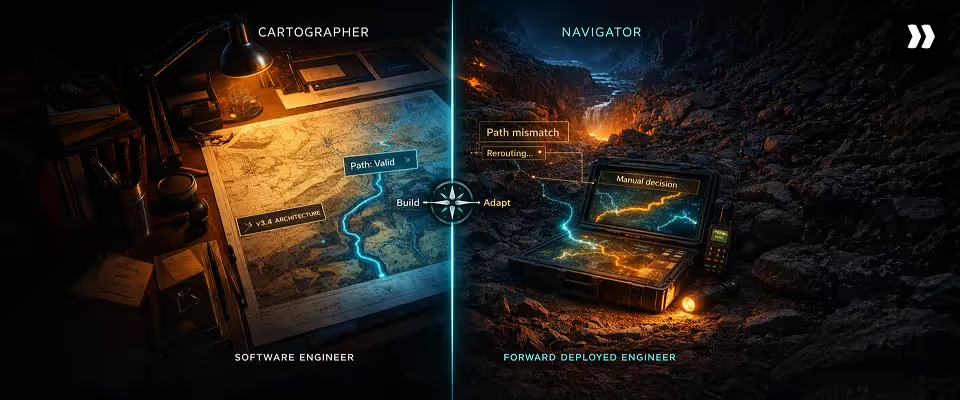
Software engineers build the product.
Forward-deployed engineers make the product work — for this client, in this environment, by this go-live date.
A software engineer inherits your codebase and ships features for all users, measuring success by deployment velocity and uptime.
A forward-deployed engineer inherits the client's environment — their data schema, their legacy systems, their internal politics — and configures, integrates, and troubleshoots until that specific customer sees value. Their definition of done is a go-live date, not a merged pull request.
Palantir operationalized this model early, embedding engineers directly with enterprise customers because complex deployments couldn't be solved from a product backlog. Someone had to sit with the client and own the outcome.
That insight has since spread across the SaaS industry.
How does an FDE differ from a software engineer, solutions engineer, and implementation engineer?
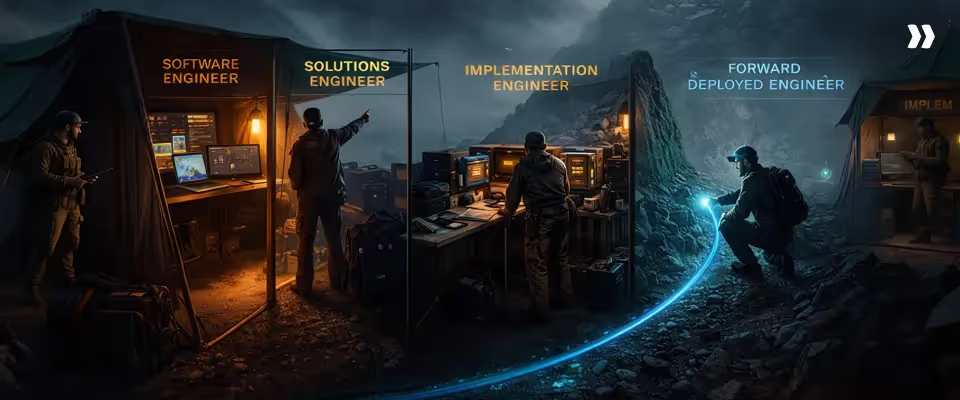
"FDE" is not a rebrand.
Each role has a fundamentally different output, incentive structure, and relationship with the client.
Blurring the lines leads to mis-hires, broken delivery models, and engineers doing work they were never designed to do.
FDE vs. Solutions Engineer: The SE closes the deal; the FDE delivers on it.
Your SE spends two hours walking the client's VP of IT through a clean Salesforce integration on the eval call. Deal closes.
Three weeks later, your PM calls: the client's Salesforce has custom objects the SE never saw, undocumented middleware, and field mappings that match nothing in your standard connector.
The SE has moved on. Your IE is staring at an environment that looks nothing like what was demoed. PS orgs that conflate these two roles end up with SEs stretched into delivery work they weren't hired for, and both functions suffer.
FDE vs. Implementation Engineer: Implementation engineers execute a defined playbook — configuration, setup, handoff.
FDEs are called in when the playbook breaks. Your IE is three days into onboarding, playbook loaded, timelines set, when they discover the client's core CRM is a homegrown system built in 2014 with no documented API. The connector doesn't work. The workaround isn't in the runbook.
The IE escalates — correctly — but that escalation takes four days to reach someone who can fix it, and the go-live slips a week. Nobody did anything wrong. The engagement hit the edge of what a playbook-driven role was designed to handle. That's the ceiling the FDE is built to push through.
FDE vs. Customer Success Engineer: CS engineers protect and expand the account post-go-live. FDEs accelerate getting there.
Your FDE spends six weeks learning a client's environment: the undocumented sync delay that trips up reporting, the stakeholder who needs to approve every config change, the workaround keeping the legacy identity provider alive.
Go-live happens, the FDE rolls off, and the CSM takes a handoff call with a checklist and not much else. Ninety days later: a support ticket, no institutional context, and a renewal conversation that should have been straightforward.
The cause is a handoff nobody designed deliberately.
The FDE function exists to cover delivery gaps that SEs, IEs, and CS engineers were never designed to fill.
When should you build an FDE function?
The FDE model didn't emerge from org design theory. Each of the companies that built one hit a specific moment where their existing delivery stack stopped working — and the trigger was always the same: technical complexity that couldn't be resolved fast enough through the people they already had.
A 2024 MIT Sloan Management Review study on enterprise software adoption found that time-to-value is the single most predictive metric for customer retention in the first 12 months post-sale, and deployment complexity — not product quality — is the primary driver of TTV variance across enterprise accounts.
Intercom hit the trigger when they launched Fin. Customers working closely with Intercom's R&D got measurably better outcomes than those going through standard post-sales channels.
The gap wasn't product quality — it was delivery proximity. Intercom built their FDE function when they needed to bring that level of technical depth to every strategic account, without every account requiring a direct line to R&D.
Lorikeet recognized the trigger before their first deal closed.
The founders spent six months embedded with their first customer from day one — not because they had a PS framework, but because their AI support product demanded it. In a category where the product evolves week to week, a traditional handoff model would have left clients stranded.
Lorikeet built their FDE motion from the start because deep per-client customization wasn't a service offering. It was the product.
Rippling hit the trigger at enterprise scale. Kevin Bai, their founding FDE and a former Palantir engineer, was brought in because SA handoffs were creating delays that eroded deal value before it even got started.
Technical products sold to non-technical buyers, at a complexity level no handoff could bridge — that was the trigger.
What made each of these bets pay off wasn't just technical skill. It was the decision to treat customer deployment as a product problem — one that required ownership, not handoffs.
What are the three PS delivery models — and where do FDEs fit?
Most PS orgs operate one of three delivery models. Knowing which one you're in — and which one your growth requires — is the strategic question FDEs actually answer.
Model 1: Implementation-led.
The most common model. Your PS team owns delivery end-to-end, with SEs or solutions architects handling technical setup when needed.
It works well at low volume and low complexity — standardized products, predictable onboarding, clean client environments. It breaks when implementation complexity grows faster than headcount, which is exactly what happens when you move upmarket.
Model 2: FDE-led.
The emerging model at AI-native and enterprise SaaS companies. An FDE is embedded in delivery from kickoff — handling integrations, configuration, and client-specific automation in-flight, while the PS team governs timelines and client relationships.
The FDE removes technical blockers in real time instead of escalating them up a chain. Companies running FDE-led implementation report TTV reductions of 30–50% compared to Model 1.
Model 3: Hybrid.
The most realistic model for mid-market PS orgs scaling fast. FDEs aren't assigned to every project — they're a shared pool, allocated to complex or strategic accounts where playbook execution alone won't work. The challenge is knowing which projects need an FDE and when. That's an allocation signal problem — and exactly the kind of visibility gap a purpose-built PSA platform is designed to surface.
Which model fits your org right now?
- Fewer than 20 concurrent projects, low technical complexity → Model 1
- High complexity per client, multiple integrations per engagement → Model 2
- Mixed portfolio, scaling fast → Model 3
What TTV and ROI do FDE functions actually deliver?
PS leaders get a budget on numbers, not org design theory.
Before the numbers, pick your model — how you measure FDE value determines how you build the case for it.
Some orgs run FDE as a P&L-bearing function.
The work is directly monetized, the FDE must generate more revenue than they cost, and accountability lives in the same place as the investment.
Others run a usage uplift model, where FDE engagement isn't billed directly but shows up downstream in product adoption, expansion revenue, and consumption volume. Different columns, same discipline.
Value attribution has to be quantifiable from day one, or the function quietly becomes overhead nobody can justify at the next planning cycle.
Once the model is clear, outcomes follow a consistent pattern.
TTV drops 30–50% when technical blockers get resolved in the room by someone who can fix them, rather than being escalated through a PM and routed to engineering three days later. That lag is precisely where go-live dates slip.
Utilization climbs 5–10 percentage points because fewer escalation loops mean IEs and PMs spend their hours moving projects forward rather than managing fire drills they didn't start and can't finish alone.
Margins hold. An FDE who understands the client's environment on day one closes the gap between what was scoped and what is actually needed, well before that gap turns into a change order conversation nobody wanted.
What are the signs your PS org needs an FDE function?

The clearest signal is in your long tail of delayed go-lives. If your top 20% of clients are consistently taking 40% longer to get live, and the reason is always some variation of "technical complexity," that's not a client problem.
That's a delivery model problem. If your solutions architects are spending more than 30% of their time on implementation-layer work rather than pre-sales, you already know when to hire a forward deployed engineer — you're just not acting on it yet.
Product complexity is another reliable indicator. If a typical enterprise engagement touches three or more integrated systems, a playbook-driven team will hit its ceiling on almost every strategic account. Move upmarket and that ceiling arrives faster than expected — usually in the middle of a high-value deal you can't afford to fumble.
The softest signal, but often the most telling, is implementation NPS. When exit interviews consistently surface technical friction as the reason a client felt unsupported, the issue rarely gets attributed to the delivery model. It should be.
Use this table to route your decision:
The function doesn't make sense everywhere.
If your implementation is largely configuration with minimal customization, if you're running fewer than 15 concurrent projects, or if your existing PS team already has senior SEs embedded in delivery, the overhead of a dedicated FDE function likely outweighs the return right now.
How do you hire a forward deployed engineer?
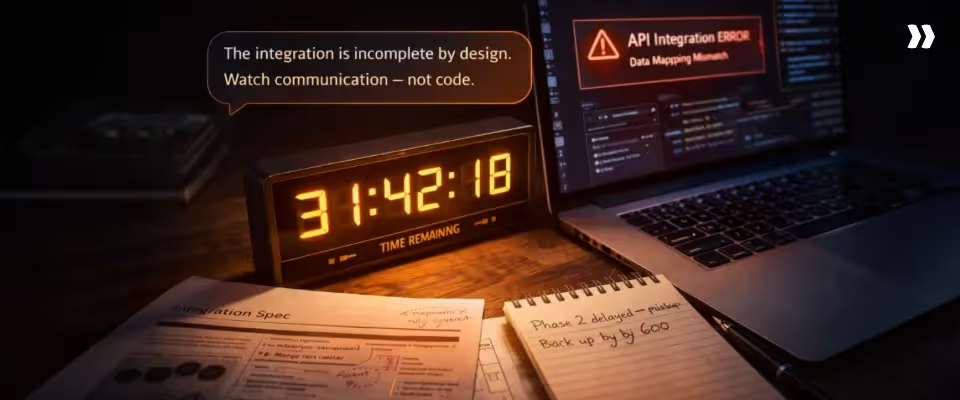
The instinct is to look for a strong software engineer.
It's a pattern that came up repeatedly at a recent FDE Community Meetup — and every panelist said the same thing: that instinct leads to the wrong hire almost every time.
The traits that define high performers in product engineering are often liabilities in a forward deployed role: deep specialization in a single stack, product thinking, and a preference for building things correctly over building them fast.
Sebastian D., former Senior Principal Engineer at Intercom and one of the early architects of their FDE function, has seen the pattern repeat.
The failures aren't technical. They happen when someone simply doesn't want to be customer-facing. An FDE who wants to architect an elegant solution while a client's go-live slips is solving the wrong problem.
What you're looking for is closer to a founder than an engineer.
Kevin Bai, founding FDE at Rippling and a former Palantir FDE, screens for exactly this: candidates must pass both an engineering interview and a customer-facing screen, because technical depth without the ability to navigate a client conversation won't survive a high-stakes implementation.
Comfort in messy, undocumented environments. The ability to translate a technical constraint into plain language for a VP who needs to decide in the next 20 minutes. A bias toward shipping something that works over something that's perfect.
Tenure at a product engineering org is worth scrutinizing rather than celebrating. It can signal a mental model that's genuinely hard to unlearn once someone is sitting across from a frustrated customer.
Estelle Barton, Forward Deployed Product Manager at Lorikeet, uses a paid two-day work trial rather than a standard interview loop. The signal she looks for isn't what candidates build. It's how they communicate while building it.
What tools support FDE-augmented delivery at scale?
Adding FDEs to your delivery motion creates a coordination problem most PS platforms weren't built to solve.
FDE capacity is expensive and finite. Without visibility into which projects actually need an FDE, you'll either burn the function on accounts that didn't need it, or leave the accounts that did without coverage.
PS leaders running FDE-augmented delivery need a platform that connects project execution, resource planning, time tracking, and financial management in one view.
The capabilities that matter: project-level complexity signals that surface before escalation, resource capacity planning that flags over-allocation early, a shared project view that keeps FDE, PM, and client aligned without adding coordination overhead, and AI-driven documentation that reduces manual work at the FDE-to-CSM handoff.
For a full evaluation of PSA platforms purpose-built for PS teams running this model, see the best PSA software for professional services teams
Is your PS delivery model ready for FDE-augmented delivery?
Does your current delivery model have a technical ceiling?
If your top accounts are consistently going live late and the reason is always some version of "technical complexity," that's not a sequencing problem or a resourcing problem.
It's a model problem. The traditional PS stack of CSMs, PMs, and SA handoffs was built for a different level of product complexity.
The companies that recognized this — Intercom, Rippling, and Lorikeet among them — didn't solve it by hiring more of the same. They introduced a role built to operate at the edge of the playbook, not inside it.
Building an FDE function requires the right hiring profile, a clear value attribution model, and tooling that can surface where FDE capacity is actually needed.
Done well, it's one of the highest-leverage changes a PS org can make. Done reactively, it becomes an expensive experiment nobody can justify at the next planning cycle.
The companies outperforming on TTV in 2026 didn't wait for a failed enterprise deployment to start asking these questions.
See how leading PS teams structure FDE-augmented delivery →
Why Rocketlane Is the Best PSA Platform for FDE-Augmented Implementation in 2026
FDE functions introduce a coordination problem most PS platforms weren't designed to solve: a finite pool of expensive technical talent that needs to be allocated precisely, tracked accurately, and handed off cleanly — across every concurrent project in the portfolio.
Generic project management tools don't surface which accounts need FDE coverage before the escalation call happens.
Static spreadsheets don't connect FDE utilization to project financials in real time. And legacy PSAs weren't built for delivery models where the technical layer and the client relationship layer have to move in lockstep.
Rocketlane is a purpose-built PSA platform used by 750+ professional services organizations, with a 94% G2 recommendation rate.
It connects project execution, resource planning, time tracking, financial management, and client collaboration in a single system — giving PS leaders the visibility they need to deploy FDE capacity where it actually moves the needle.
Where Rocketlane fits the FDE model directly:
- Project-level complexity signals surface before escalation, not after. PS leaders can see which accounts are trending toward technical risk without waiting for a PM to flag it on a Friday afternoon.
- Resource capacity planning shows FDE availability and allocation in real time — preventing the pattern where your best technical resource is double-booked across three strategic accounts and nobody noticed until go-live week.
- Shared project workspace keeps FDE, PM, and client stakeholders aligned without adding coordination overhead. The FDE doesn't need to attend three status calls to keep everyone current.
- White-labeled client portal gives enterprise clients direct visibility into delivery progress — reducing the FDE's time spent on status communication and increasing the time available for technical execution.
- Native integrations with Salesforce, JIRA, HubSpot, and Slack eliminate the fragmented toolstack that forces FDEs to manually sync context across systems.
How Rocketlane Nitro Makes a Difference for FDEs
.avif)
The highest-cost FDE failure mode isn't a bad hire.
It's a capable engineer spending 30% of their engagement hours on documentation, status updates, and configuration logging instead of solving the technical problem they were brought in to solve.
Nitro — Rocketlane's agentic execution layer — eliminates that overhead.
Nitro operates across three layers of FDE engagement:
Operational layer: Nitro handles timesheet automation, resource utilization tracking, and project analytics without requiring manual input. An FDE embedded in a complex client environment doesn't need to pause to update a project tracker — Nitro surfaces what's happened, what's drifting, and what needs attention.
Governance layer: Nitro's Signals agent monitors budget consumption, schedule variance, and utilization in real time — flagging risk before it compounds. For FDE-led delivery, where a single integration delay can cascade across a go-live timeline, early-warning signals are the difference between a managed delay and a missed milestone.
Workforce layer: Nitro handles data migrations, system configurations, and technical documentation autonomously — what Rocketlane calls "lights-out processing." For FDEs, this means the configuration work and handoff documentation that typically takes hours gets handled in the background, without adding to the FDE's manual workload.
AI Fills captures meeting notes and automatically updates project status, so the institutional knowledge an FDE builds over six weeks of deep client work doesn't disappear at handoff. The CSM inherits a fully documented environment, not a checklist and a 30-minute call.
For PS orgs running FDE-augmented delivery at scale, Nitro isn't a productivity feature. It's the operational infrastructure that makes FDE capacity go further — fewer hours on coordination, more hours on the technical work that actually drives TTV.
Conclusion
The question isn't whether a forward deployed engineer is better than a software engineer. It's whether your current delivery model has a technical ceiling that headcount alone won't raise.
The companies outperforming on TTV in 2026 have made the shift to FDE-augmented delivery — not because they had more resources, but because they stopped treating implementation complexity as a project management problem.
An FDE function, built and measured correctly, is a delivery acceleration lever. The decision is whether your org is ready to pull it.
† Rocketlane company data: 750+ customers; 94% G2 recommendation rate based on aggregate G2 review data as of date of publication; $60M Series C from Insight Partners (March 2026); revenue more than doubled year-over-year; Per company reporting as of Q1 2026.
Table of Contents

Regsiter for the live webinar


Great consultants didn't join your team to spend Fridays writing documentation.
Table of contents
18 of Forbes Cloud 100 chose Rocketlane. The best PS teams aren't waiting around.
FAQs
What is a forward deployed engineer in professional services?
A forward deployed engineer is a technical resource embedded directly in customer implementations, responsible for configuring, integrating, and customizing a product to fit a specific client's environment. Unlike product engineers who build for all users, FDEs build for one customer at a time, with go-live speed and client technical adoption as their primary success metrics.
What is the difference between a forward deployed engineer and a software engineer?
A software engineer owns the product codebase and ships features for the entire user base. A forward deployed engineer inherits the client's environment and makes the product work inside it, navigating legacy systems, integration complexity, and business-specific requirements that a product backlog was never designed to solve.
When should a PS org hire a forward deployed engineer?
The clearest signal is when technical blockers consistently account for implementation delays across your most complex accounts, and your existing PS team lacks the depth to resolve them in-flight. If your solutions architects are regularly pulled into post-sale delivery work, or enterprise clients are exposing gaps your playbook can't cover, it's time to evaluate the hire.
Do forward deployed engineers reduce time-to-value?
Yes, consistently. Companies running FDE-augmented delivery report TTV reductions of 30–50% compared to implementation-led models, primarily because technical decisions get made in the room rather than escalated across teams and resolved days later.
What's the ROI of building an FDE function?
ROI depends on which model you run. P&L-bearing FDE functions are measured on direct revenue generated relative to cost. Usage uplift models track product adoption and expansion revenue before and after FDE engagement. In both cases, the function needs a quantifiable value attribution model from the start, or it risks being perceived as overhead.













Copyright © 2026 Rocketlane Corp. All rights reserved.
















.webp)