Top 5 professional services automation trends in 2026 for service leaders
.webp)

•
•
Summarize blog with






Professional services is adjusting to a new execution reality. AI is directly influencing how work gets executed, how outcomes are delivered, and how customers assess value. At the same time, expectations around growth, profitability, and execution discipline remain high. For services leaders, understanding how these forces intersect is becoming essential.
In a recent Rocketlane webinar, Dave Hofferberth, Founder of Service Performance Insight (SPI), and Srikrishnan Ganesan, CEO of Rocketlane, came together to examine what lies ahead for professional services and professional services automation (PSA) in 2026 and beyond.
Together, they explore how delivery models are changing, why maturity in services operations is becoming a decisive factor, and what services leaders should be preparing for as AI becomes embedded in everyday execution.
Here are the key takeaways from the discussion.
About SPI and the Professional Services Maturity Benchmark™
SPI has studied professional services performance for nearly two decades. At the core of its work is the Professional Services Maturity Benchmark™ model, developed seventeen years ago and used by more than fifty thousand firms worldwide. The model helps organizations assess how they perform relative to peers and identify where capability gaps limit growth and profitability.
The benchmark evaluates professional services organizations across five foundational pillars:
- Leadership: direction setting, communication, agility, and organizational alignment
- Client relationships: selling services, partnering effectively, and driving growth
- Talent: hiring, utilization, engagement, and development of people
- Service execution: resource management, project delivery, scheduling, and margin control
- Finance and operations: financial discipline, efficiency, and profitability
Each pillar is assessed across five levels of maturity, from Level 1 (Initiated) to Level 5 (Optimized).
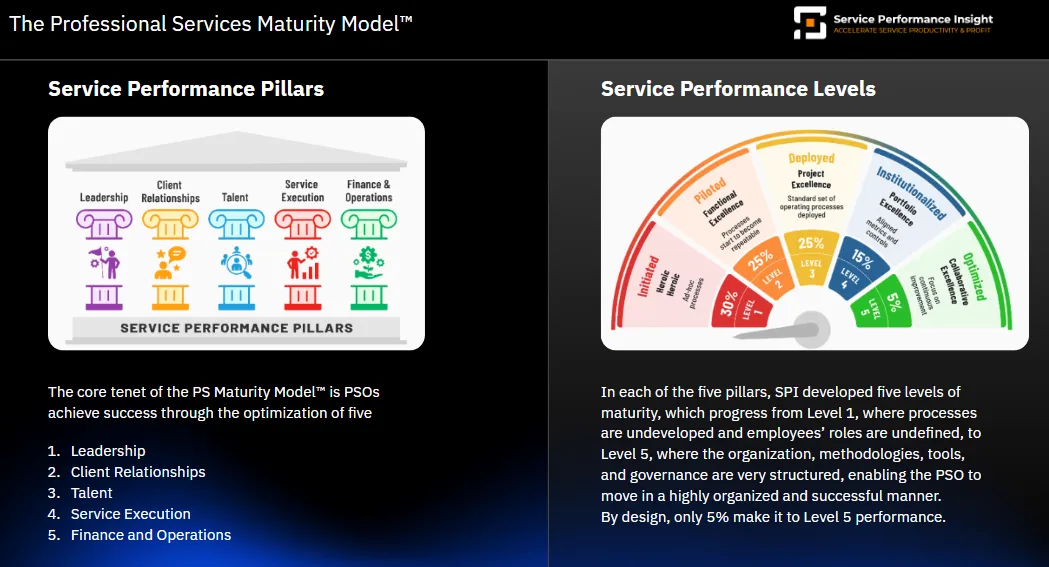
Level 1 organizations often operate with fragmented processes, duplicated effort, and limited standardization. As firms mature, they introduce systems, improve process discipline, and strengthen alignment across teams. Only a small share of organizations (roughly 5 percent each year) reach Level 5, but those that do, consistently outperform the rest of the market.
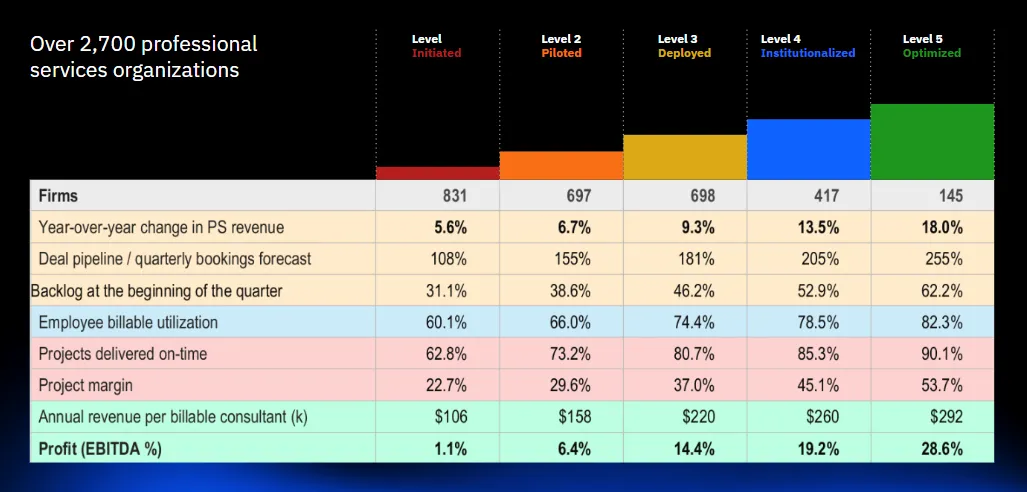
What makes the model practical is the data behind it. SPI benchmarks performance across more than 155 KPIs spanning growth, profitability, utilization, delivery efficiency, and client satisfaction. As organizations move up the maturity curve, performance improves across nearly every metric that matters.
5 trends every PS leader must prepare for in 2026
Revenue and profit matter, but they are outcomes, not levers.
The real drivers sit in how leadership aligns the organization, how teams are staffed and supported, how delivery is executed, and how finances are managed. The trends that follow show how AI, evolving delivery models, and organizational design are reshaping each pillar as services leaders look toward 2026 and beyond.
1. Accelerators are becoming agentic
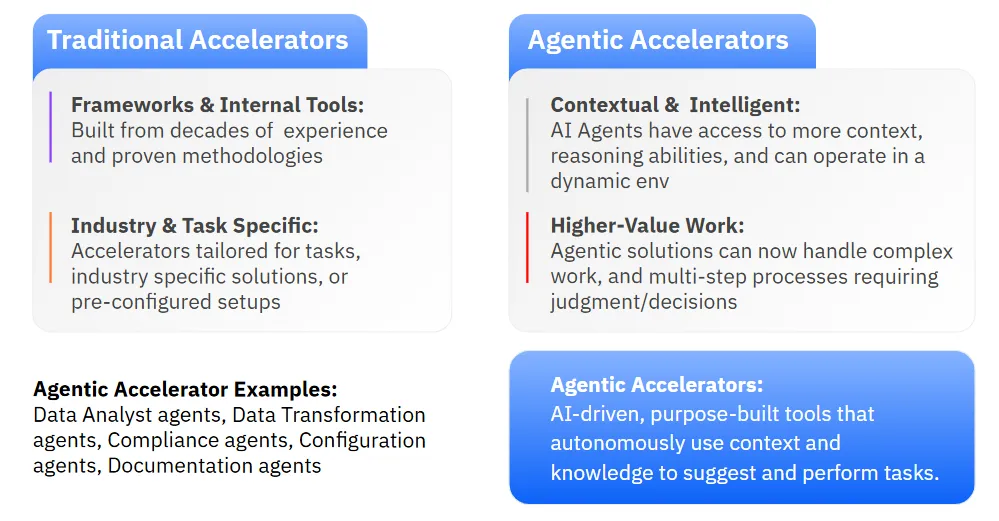
Accelerators have long existed in services as reusable tools, templates, frameworks, and preconfigured setups designed to speed up delivery.
In 2026, these accelerators increasingly take on agentic characteristics and become active participants in delivery. This shift reflects a broader understanding of AI as a mechanism for continuous intelligent optimization rather than one-time automation.
Here’s what is changing at the system level:
- Accelerators are being built as AI-first capabilities that reason through work and adapt execution based on context, rather than executing fixed instructions
- Multi-step workflows such as design, migration, analysis, testing, and documentation are increasingly handled from end to end.
This shows up across services as:
- Design and modernization work where agents interpret legacy environments and propose architectures
- Data migration and transformation pipelines that include validation and correction
- Configuration, testing, and documentation executed as continuous workflows
AI-driven execution compresses delivery timelines while expanding the range of work that can be accelerated. Organizations report a 156% year-over-year increase in AI’s realized impact as accelerators take on decision-making responsibility
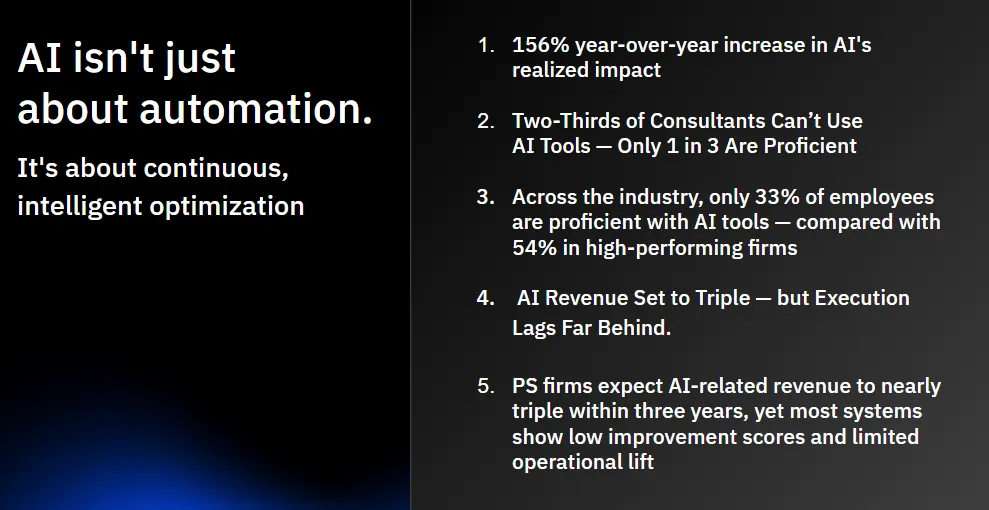
Adoption, however, remains uneven across the industry. Only 33% of consultants are proficient with AI tools in day-to-day delivery. The gap in proficiency directly affects how quickly agentic accelerators translate into operational lift.
The bottom line: As accelerators become agentic, the differentiator is not access to AI but the ability to embed these systems into delivery models, teams, and governance structures that can sustain continuous optimization at scale.
2. Outcome-driven pricing is how leaders win toda
After a long period of AI vision selling and experimentation, expectations have moved toward accountability. Buyers want to know what outcome will be delivered and want pricing tied to that outcome. They are less willing to commit upfront without clarity on results.
This shift is already visible in market data. Research indicates that around 40% of new enterprise software deployments now include outcome-based pricing components.
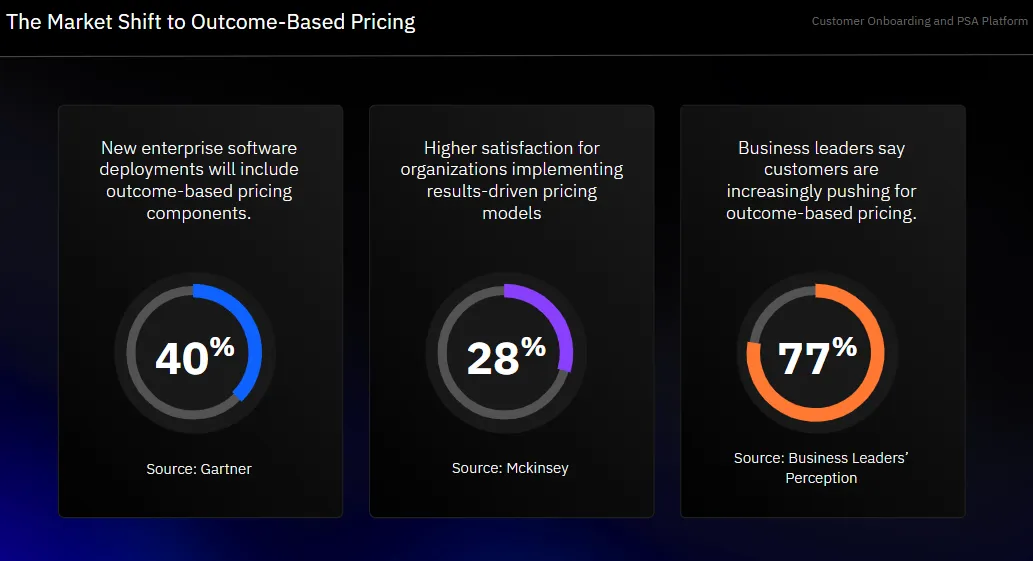
Several forces are pushing this shift forward:
- Customers want clearer accountability for business results, not just activity.
- AI implementations raise expectations around measurable impact.
- Executive sponsors need pricing models they can defend internally.
This approach also changes execution behavior. Delivery teams stay involved beyond initial implementation to ensure value is realized. They also track progress against agreed outcome milestones throughout the engagement.
Bottom line: Organizations that can consistently define, measure, and deliver outcomes are better positioned to earn trust and sustain long-term engagement as this model continues to take hold.
3. Standardized delivery is the secret to speed
As delivery work becomes more complex and more AI-enabled, standardized delivery is re-emerging as one of the most reliable ways for services organizations to move faster without losing control.
This involves a conscious shift to a standardized delivery methodology that:
- Manages all costs from the beginning of the project
- Reviews actual vs. project costs at least once a week
- Manages scope creep and how it impacts both on-time delivery and project costs
- Delivers projects on time and on budget
- Makes staffing changes if necessary to lower cost
- Reviews costs with clients to show that the project is managed well
Teams that invest in structured delivery models consistently deliver projects on time and budget by:
- Focusing on the schedule to improve consistency in project delivery
- Reducing scope creep and receiving documented commitments for project changes
- Evaluating the impact on time, cost, and future work whenever scope changes are necessary
- Bringing in additional resources to ensure on-time delivery
- Leveraging PSA to manage tasks, resources, cost, and time
Standardization has also expanded beyond methodologies to include the assets and interactions that surround delivery. This includes ensuring that:
- Documentation is pre-structured, so teams are not rebuilding artifacts for each project
- Customer communication follows consistent formats from kickoff through milestones
- Feedback is collected at key points during delivery, not only at the end
- Standardized escalation frameworks allow systems to signal when leadership attention is required, instead of relying on individual managers to decide when to intervene.
Bottom line: As AI increases delivery complexity, standardized execution becomes the mechanism that keeps speed and control aligned.
4. Enterprise AI is bringing back the focus on services
As enterprise AI adoption accelerates, services are regaining prominence across both services-led and product-led organizations.
This shift is visible across the market. Product companies that are scaling rapidly are investing heavily in services capabilities to ensure their AI-powered products succeed in real customer environments. Foundational AI platforms and fast-growing SaaS businesses alike are building internal consulting, implementation, and advisory teams to work closely with customers post-sale.
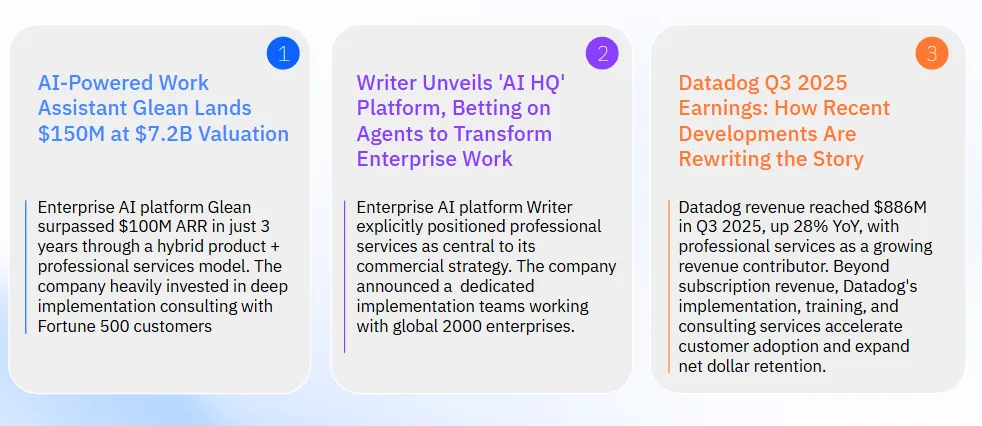
Several forces are driving this renewed focus, such as:
- Implementing AI has proven complex and highly context-dependent
- Value realization depends on sustained expertise beyond initial deployment
- Customers expect guidance that translates AI capability into measurable outcomes
As a result, services are increasingly positioned as a growth engine rather than a supporting function.
This is also reshaping the services landscape with:
- New services firms emerging with AI implementation as their primary focus
- Established consultancies retooling delivery models around AI-first work
- Product companies embedding services deeper into their commercial strategy
Across industries, differentiation when it comes to AI increasingly comes from how well services support adoption, optimization, and long-term value creation.
Bottom line: The renewed emphasis on services reflects a broader recognition that AI success is driven as much by execution and expertise as by technology itself.
5. Future-ready teams look different
Most organizations will be delivering some form of AI-enabled solution. This shift affects the roles teams need, the skills they prioritize, and how success is measured.
The first change shows up in metrics. Margin still matters, but it is no longer sufficient on its own. ROI becomes the primary signal. Teams are increasingly evaluated on whether they delivered the intended outcome and how clearly that outcome can be measured.
Success is increasingly being tracked through:
- Time to partial or committed ROI
- Progress against the value defined at the start of the engagement
- Incremental value created after initial delivery
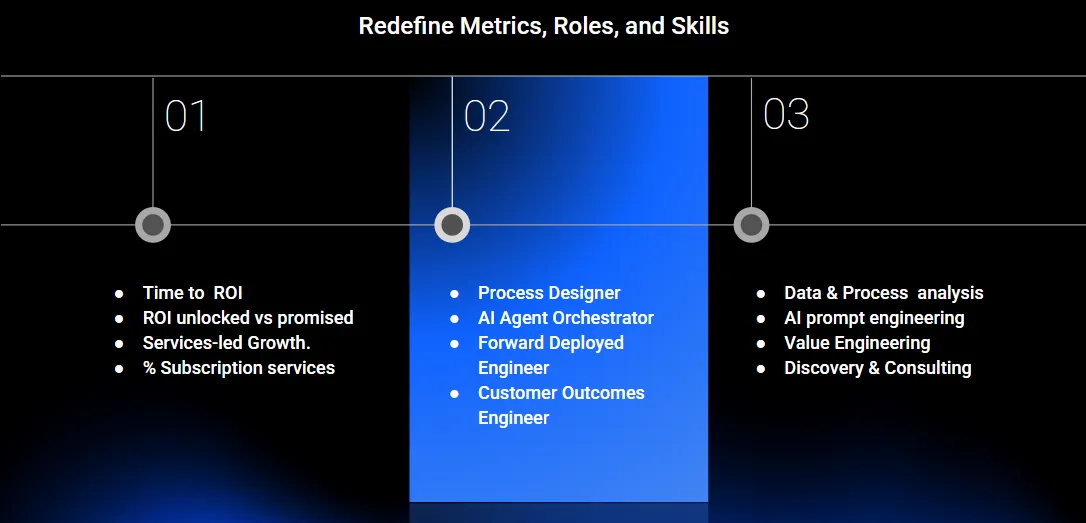
Delivery itself is also changing. Teams are spending less time executing fixed processes and more time adapting and rebuilding them in customer environments. AI systems rarely drop into place cleanly. They require ongoing engineering judgment, iteration, and orchestration once exposed to real workflows.
This has led to the emergence of more specialized roles:
- Agent builders and orchestrators who design, manage, and evolve AI agents as systems
- Forward-deployed or embedded engineers who work directly within customer environments to adapt AI to operational reality
- Product-oriented engineers in services roles who solve customer-specific problems while feeding learnings back into core platforms
These roles exist because AI deployment decisions are increasingly made during delivery, and the boundary between implementation, optimization, and product development is narrowing.
As accountability for outcomes increases, value engineering also moves deeper into post-sale work. Discovery does not end at kickoff. Teams remain engaged to identify additional leverage points, refine AI systems, and extend ROI over time.
Bottom line: Future-ready teams are defined by the operational mix that combines domain knowledge, embedded engineering capability, AI fluency, and explicit ownership of outcomes.
SPI’s Diamond framework for sustainable growth
As the conversation turns to how services organizations are managed in practice, the SPI Diamond provides a useful way to frame ongoing trade-offs. Leadership discussions often focus on growth and profit because they are visible and easy to track. In services, however, these measures tend to lag the operating conditions that produce them.
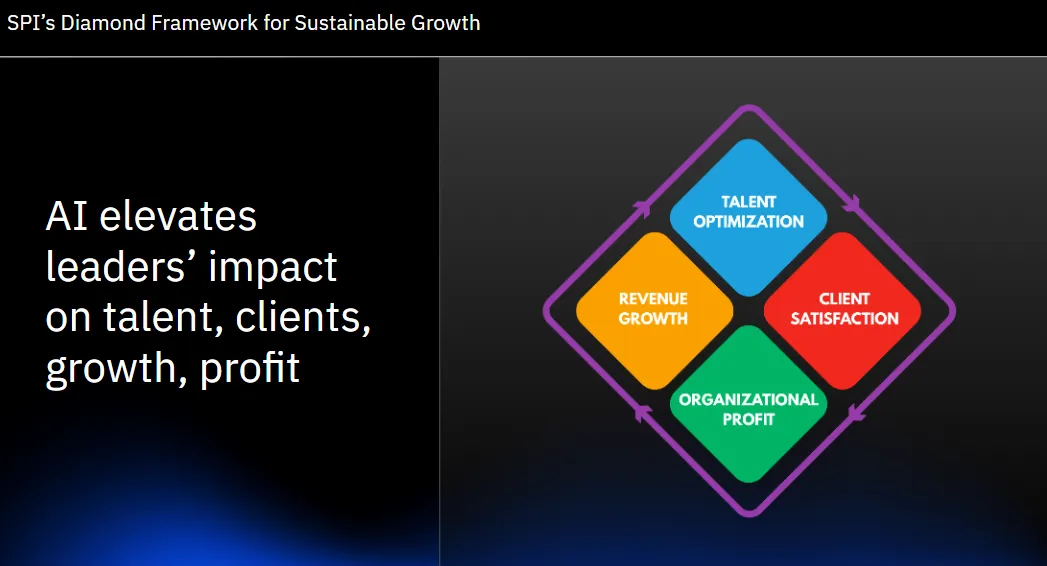
The Diamond brings four dimensions into view, all of which need to be managed together:
- Revenue growth
- Organizational profit
- Client satisfaction
- Talent optimization
These dimensions are tightly coupled. Changes in one area tend to create downstream effects elsewhere, often outside the current reporting cycle. Financial performance can appear stable while delivery quality erodes or teams operate beyond sustainable limits. The consequences usually surface later as execution volatility, attrition, or weaker client outcomes.
Seen through this lens, several recurring patterns become easier to explain:
- Financial targets are met while delivery consistency declines
- Teams absorb increasing workload without corresponding capability or support
- Client dissatisfaction emerges after commitments are already locked in
Beneath the Diamond is execution. Day-to-day decisions about staffing, delivery design, and outcome tracking accumulate and shape performance across all four dimensions. AI increasingly functions as an operating instrument. Its contribution is early visibility into conditions that traditional metrics surface too late, including:
- Emerging workload and utilization strain
- Skill mismatches relative to delivery complexity
- Early indicators that agreed outcomes are at risk
Access to these signals allows leaders to intervene while trade-offs are still reversible, rather than after they become embedded in structure or culture.
Over to you
Taken together, these trends point to a more disciplined operating model for services organizations. As AI becomes embedded in delivery, performance will increasingly reflect how well leaders align standardization, outcome measurement, and team design with business priorities. In 2026, sustained performance will depend on consistent alignment across growth, profitability, talent capacity, and client outcomes.
Table of Contents

Regsiter for the live webinar


Great consultants didn't join your team to spend Fridays writing documentation.
Table of contents
18 of Forbes Cloud 100 chose Rocketlane. The best PS teams aren't waiting around.
FAQs













Copyright © 2026 Rocketlane Corp. All rights reserved.

















.webp)