The domino effect: Stopping risk chain reactions in onboarding

•
•
Summarize blog with






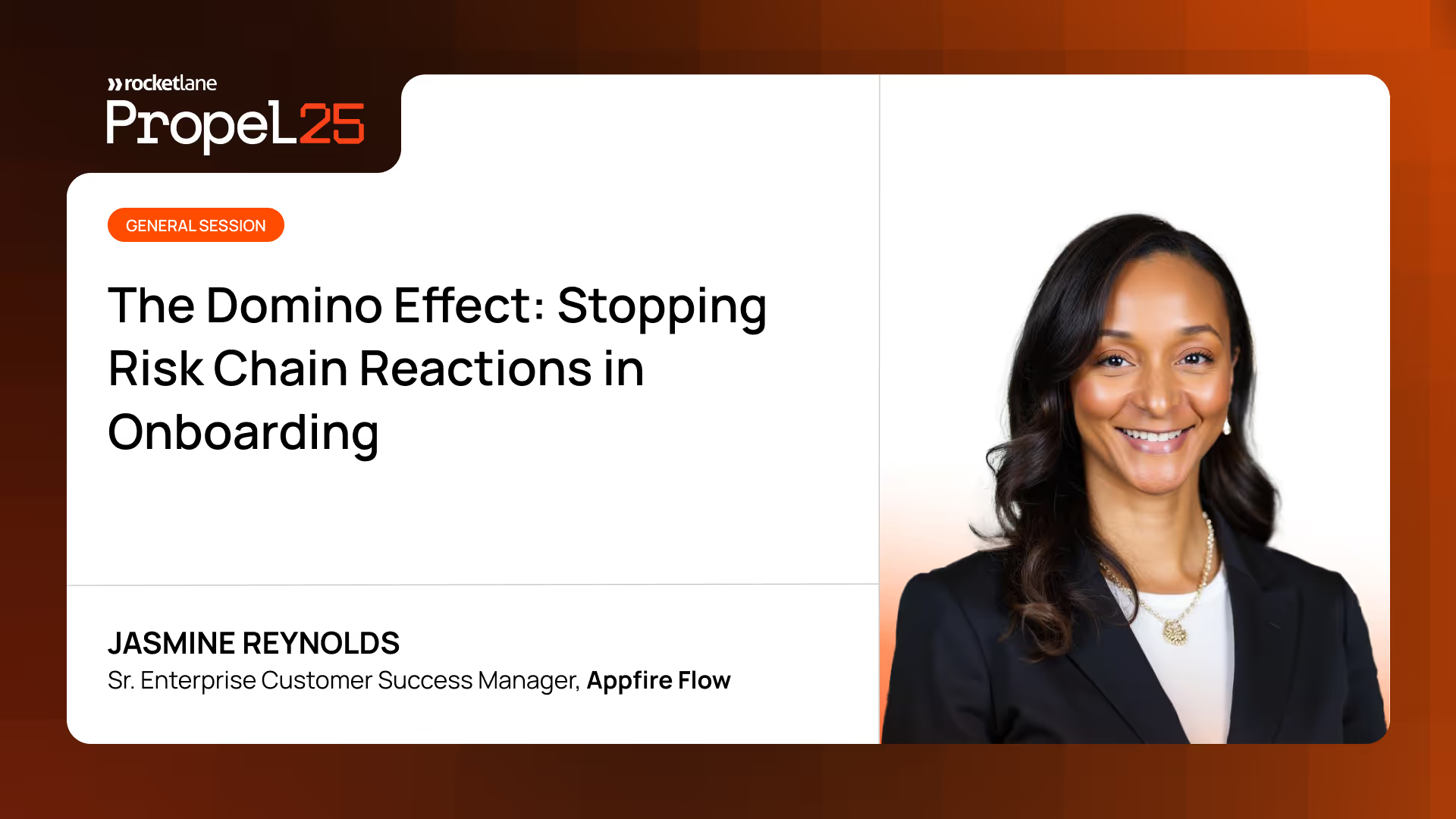
Onboarding isn’t where customer success begins—it’s where it can begin to unravel. In her insightful session at Propel25, Jasmine Reynolds, Sr. Enterprise Customer Success Manager at Appfire Flow, shared a sobering truth: onboarding failures aren’t loud explosions—they’re quiet collapses. One overlooked meeting. One misaligned assumption. One unchecked risk. These are the tiny dominos that, if left to fall, can trigger full-scale project derailments.
Reynolds brought humor, humility, and hard-won wisdom to her talk, revealing how subtle missteps can cascade through implementation like a system of falling dominos, and how CS and onboarding teams can proactively engineer resilience into every engagement.
Meet the speaker: Jasmine Reynolds, Sr. Enterprise CSM at Appfire Flow
Jasmine Reynolds is an onboarding strategist who blends process design, behavioral psychology, and proactive risk management. Her work sits at the heart of enterprise customer success, guiding complex customers through implementation with a sharp eye for hidden failure points and a talent for systemic thinking. At Appfire Flow, she’s helped enterprise teams reimagine onboarding as a risk-aware, resilience-driven journey—not just a timeline of tasks.
The domino effect: When small things spiral
Jasmine opened with a real story: a customer skipped a technical kickoff. One meeting, no big deal—or so it seemed. But that delay set off a chain reaction:
- API access was delayed.
- Reporting couldn’t be set up.
- Executives questioned the value of the platform.
"Once that question enters the room—‘Are we seeing value?’—you’re no longer onboarding. You’re backpedaling," she warned.
Jasmine reframed onboarding risk not as a linear checklist of threats but as a risk web—a tangle of interconnected issues where one missed step ripples into multiple failures. Misalign one stakeholder? You might delay scope, trigger miscommunication, and stall decisions. "Risks don’t just fall—they loop," she explained.
How to build a risk web
The risk web is a visual and mental model for how risks connect. Jasmine broke it down into four steps:
- Start with the target risk. Identify one small issue—like forgetting to invite IT to kickoff. That’s the first domino.
- Map first-degree coincidences. What gets affected immediately? Access issues? Missed setup questions?
- Identify second-degree effects. How might those problems escalate? Timeline slips? Exec trust erosion?
- Look for feedback loops. Delayed access = rushed work = deliverables missed = more delays. Risks that loop are the most dangerous.
Once you see the web, you can plant stoppers—points in the process that absorb risk before it spirals.
Real-world risk examples: Data mirages and air-gapped chaos
Jasmine offered two onboarding stories that illustrated the domino effect:
- The data mirage. A customer insisted their data was "clean and centralized." Reality? Four teams manually managing spreadsheets with the lead data owner on leave. Jasmine’s team had no timeline, no owner, and no consistency. The assumption of clarity became the root cause of chaos.
- The air-gapped install. A finance tech client struggled to install a GitMetadata Collector. Despite having the instructions, it didn’t work. Weeks later, they learned the system was air-gapped—unable to connect to the internet. It was in the docs, but clearly didn’t register.
In both cases, the problem wasn’t the tech. It was assumptions.
The danger of onboarding assumptions
Assumptions are the first domino. Jasmine coached the audience to listen for vague, confident language:
- “Usually finance approves this.”
- “I believe we’re aligned.”
- “It depends.”
Her favorite technique? The reverse stress test:
“Don’t ask what could go wrong. Ask: what do we think is safe—and have we verified it?”
Confidence without confirmation is a trap. The reverse stress test reveals the dominos hiding in plain sight.
Introducing the DIVE methodology
Jasmine’s proactive risk framework is called DIVE:
Discover
Surface hidden risks and assumptions. Listen for vague or passive language. Implementation tip: In kickoff, ask “What assumptions are we making right now?”
Investigate
Explore how risks connect. What happens if the assumption is wrong? Implementation tip: Build a mini risk web. Use it in retros and planning sessions.
Validate
Push past vibes. Ask for proof. Implementation tip: Ask to walk through systems, loop in owners, or see demos. Confidence must be matched with clarity.
Engineer resilience
Design onboarding to absorb risk:
- Add pre-integration validation calls
- Confirm goals post-kickoff
- Add checkpoints around org changes
“You’re not planning for perfection. You’re planning to absorb impact,” Jasmine said. This is the difference between teams that scale vs. those that scramble.
Resilience is built in three layers
Jasmine broke down resilience into:
- Project-level resilience: Midpoint reviews, data validation, goal recommitment
- Team resilience: Weekly standups, assumption audits, normalized risk flagging
- System resilience: Update onboarding templates, risk plans, success docs
Example: Embed a 30-min mid-onboarding realignment call. Validate data access before sprint 1. Audit stakeholder alignment after reorgs.
“Real engineering means planning for failure—and making sure it doesn’t break the system,” she emphasized.
Retrospectives as fuel for iteration
Retros after every project are critical. Jasmine encouraged teams to ask:
- What worked?
- What didn’t?
- What should we do differently?
She advised keeping a backlog of desired improvements—even if you can’t act on them immediately. “Treat your onboarding team like a product team,” she said. “Track, prioritize, iterate.”
Final challenge: Identify your first domino
As the session closed, Jasmine posed a challenge:
- What’s your first domino?
- What assumption have you let slide?
- What risk are you managing around instead of through?
She offered a set of tools—risk web templates, DIVE checklists, and audit guides—via QR code, encouraging attendees to host their own team lunch-and-learns.
“The difference between a good onboarding and a great one isn’t perfect execution. It’s proactive prevention.”
Final takeaway: Don’t wait for the fall
Jasmine’s final message was clear: “Let’s stop waiting for the dominoes to fall. Let’s start placing in stoppers.”
Her session blended strategy and psychology with real-world onboarding experience, arming attendees with tactical frameworks and a new mindset for risk.
Stay tuned for more Propel25 recaps. Subscribe for insights from CS and PS leaders transforming onboarding into impact.
Table of Contents

Regsiter for the live webinar


Great consultants didn't join your team to spend Fridays writing documentation.
Table of contents
18 of Forbes Cloud 100 chose Rocketlane. The best PS teams aren't waiting around.
FAQs













Copyright © 2026 Rocketlane Corp. All rights reserved.



















.webp)