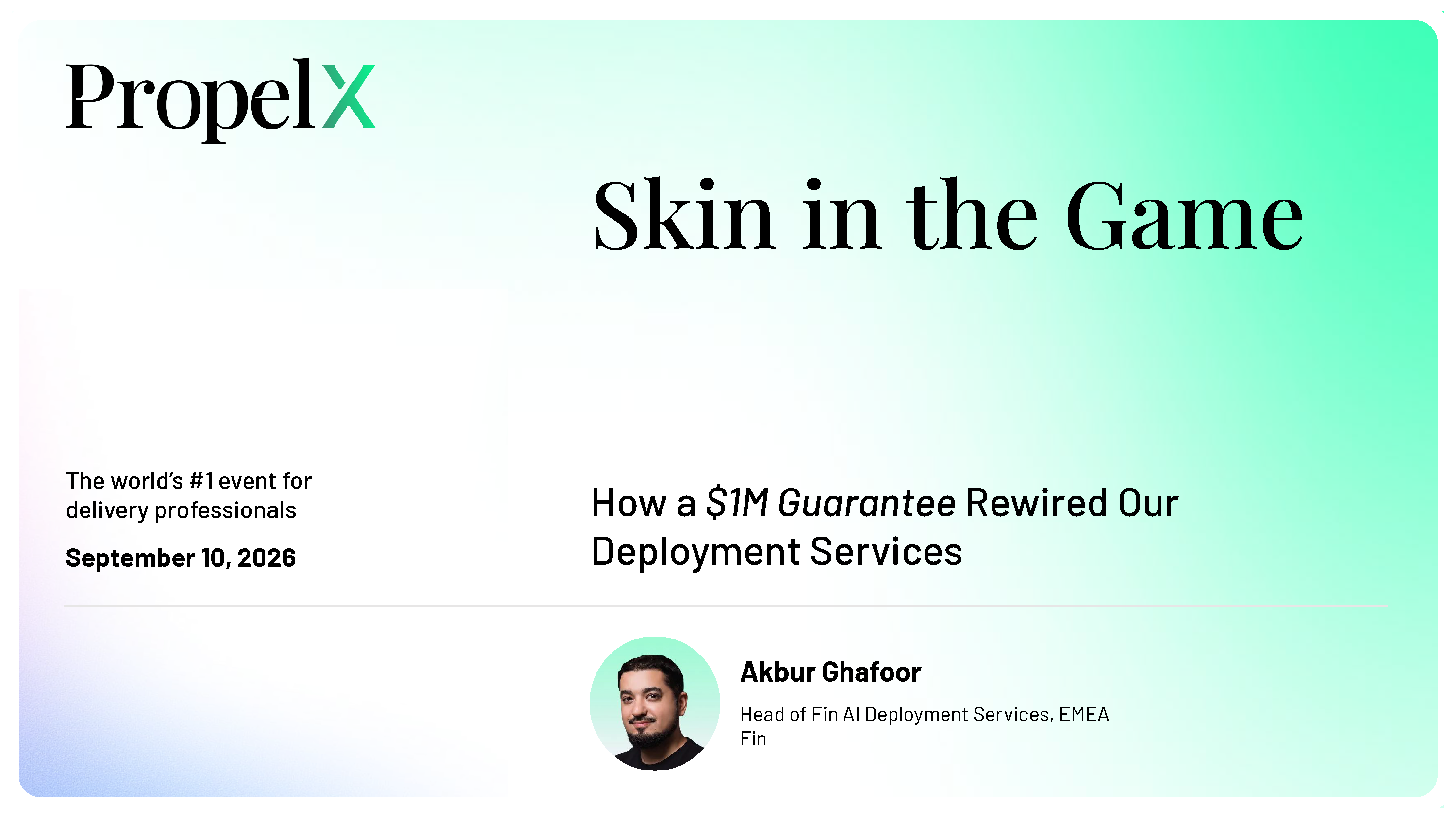
Implementation partner management: how a $1M guarantee rewired our deployment services


•
•
Summarize blog with






Imagine finding out your company is about to offer customers a $1M guarantee, and you've got a week and a half to get ready. That's what happened to Akbur Ghafoor (Head of AI Deployment, EMEA at Fin). If a customer isn't 100% satisfied with Fin's outcomes in the first 90 days, they get up to $1M of their spend back, no questions asked.
High-volume customers get a second clause: if Fin's AI agent doesn't resolve 65% of their support volume, same deal. Marketing loved it. The business development team went crazy with new leads.. And Akbur, in his own words, "lost several nights' worth of sleep."
Here's the part that would keep anyone up at night: about 80% of Fin's deployments aren't done by Fin's own team. They go through partners. So the question wasn't just whether his team could hit the bar. It was, as he put it, "how the hell do I make our partner ecosystem equal to the same level of quality as our in-house team?"
Overnight, implementation partner management stopped being a side project. It became the difference between a guarantee and a very expensive refund.
Akbur has spent 22 years in deployment, including leading professional services at Google. At PropelX 2026 in London, he walked through the six rewires his team made to survive the guarantee, with a lot of attention on how Fin manages its implementation partners, and why a book about restaurants ended up at the centre of it all.
What did the $1M guarantee change for deployment?
Before the guarantee, Fin's deployment team had problems most PS teams will recognise. Hours were estimated on gut feel. Go-live was defined by a date rather than an outcome. And with most deployments running through partners, quality varied depending on who was doing the work. The guarantee changed the stakes overnight, because a failed deployment now had a price tag of up to $1M in lost revenue.
Akbur gave the room 10 seconds to answer the same question for themselves: can you put a number on what a failed deployment costs you? Is it $50,000? $100,000? $500,000? And once you have that number, is everyone on your team and in the functions around you actually aware of it? Fin's current resolution rate sits at 76%, and most deployments that go live now hit that rate without human intervention. Knowing the cost of failure is what made the rest of the rewires non-negotiable.
Why is implementation partner management the biggest risk under a guarantee?
With 20% of deployments handled in-house and 80% through partners, Fin's customer experience depends mostly on people it doesn't directly employ. The in-house team handles the most critical, strategic deployments, but the guarantee doesn't care who ran the project. A partner-led customer who isn't satisfied can invoke it just as easily as anyone else.
That's what made implementation partner management the centre of the whole transformation rather than a procurement exercise. Partner-led customers need the same outcomes and the same quality as the ones Fin handles itself, which meant rethinking how partners are paid, trained, contracted and monitored, and building partner-led onboarding that can survive a $1M promise.
How did Fin rebuild deployment roles for the AI era?
The first rewire was about Fin's own team. Akbur inherited two roles that didn't fit well together: a project manager and a specialist. He merged them into one role, the AI Deployment Consultant, and ran six weeks of enablement using what he calls a "very scrappy spreadsheet" listing every skill and competency. Each person was scored from 1 (knows nothing) to 5 (practitioner), with a target of at least 4. "Scrappy does not mean crappy," as he tells his team, and it's a simple version of a skills matrix.
Fin also introduced an AI Customer Experience Architect role, because customers want to know how to transform their whole customer experience, not just switch on an agent. One standard interview question for these roles is simply "explain what RAG (retrieval-augmented generation) is," and most applicants can't do it clearly. Fin has also been using forward deployed engineers for more than 12 months, and turned them into fully fledged professional services engineers working on deployments rather than just supporting sales.
How do you make AI fluency part of the job?
At Fin, the question is no longer "did you use AI for that?" It's "why haven't you used AI?" Akbur gets a monthly report showing who's using AI and who isn't, and speaks directly to anyone falling behind: what's stopping you from using Claude? He was clear it isn't about micromanaging. If you're not using AI daily at Fin, something in your workflow is wrong.
Everyone also goes through Sana, an AI learning platform that turns a product requirements doc or slide deck into a learning experience. Akbur admitted it still needs some curation ("there is a bit of AI slop that comes out of it"), but it removes around 80% of the work of building enablement, which is how Fin trained the team so quickly during the transformation.
How should you scope deployments under an outcome guarantee?
A $1M guarantee means you can't scope on a hunch, so Fin now needs strong, credible evidence before it commits hours to any SOW. Akbur's rule of thumb for his team: "If in doubt, add another 20% on top. I'd rather have more hours to use rather than less." That creates tension with sales, especially when $15K of deployment services sits on a $6K deal, and he also had to justify moving the rate card from $200 to $350 an hour. The answer, he argued, is to keep articulating the value of the deployment rather than cutting the scope.
Name the delivery model in the SOW
Every SOW now spells out whether Fin is building it for the customer, which costs more, or building it with them, which Fin calls an advisory service and can be scoped with fewer hours. In 22 years, Akbur has found that deployment disputes rarely come down to quality. They come down to who was supposed to do what, such as a customer expecting Fin to handle a migration that was never in scope. Being black and white about it in the statement of work prevents most of those arguments.
Make hour burn visible every week
Akbur used to find out about overages when there was one hour left, or none. Now Rocketlane sends a notification to everyone when a deployment hits 75% of its hours, which leaves a 25% buffer to decide whether there's enough time left or the plan needs to change. Fin also shares what the burn looks like with customers week by week. Nobody deploying against hours gets the estimate perfectly right, but you can at least stop being surprised by your own burn rate.
How does Fin manage implementation partners?
Fin's approach to implementation partner management treats partners like an extension of the deployment team, with the same training, the same visibility and much clearer consequences.
Pay partners for the quality customers report
Instead of paying every partner the same, Fin created a rate card tied to quality. Partners earn more per hour when they consistently score well on CSAT, and it's CSAT from surveys Fin sends about them, not surveys they run themselves. Something useful happened as a result: partners started checking in with customers proactively, which meant fewer complaints, partners owning issues and more deployments succeeding. It's a direct way to tie pay to customer satisfaction metrics.
Reward automation outcomes, not clicks
Fin also changed what partners are paid for. Partners are no longer in the business of clicking through a configuration and sending an invoice. They need to show they're reaching a certain level of automation for each customer, and if they do, Fin pays them more. In Akbur's words, Fin is "rewarding our partners for the performance and not just for that partnership," which makes partner-led growth about outcomes.
Train and shadow partners like your own team
Partners get the same Sana training as Fin's internal teams, and Fin shadows them on deployments so the quality bar is something they see in practice, not just read about. The goal is simple: a customer deployed by a partner should have the same experience as one deployed in-house, which is the whole point of enabling a partner ecosystem.
Keep partner work on your own paper
When Fin subcontracts deployment work to a partner, the work stays on a Fin contract. Akbur admitted it sounds a little crazy, but under a $1M guarantee, Fin wants to own the overall deployment and the overall quality. If a partner isn't delivering, it's simply "goodbye, Mr. Partner," without the customer relationship getting caught in the middle. A shared delivery system where partners and the vendor work from the same plan makes that kind of shared ownership easier to manage.
Raise the bar, even when it costs revenue
Some of Fin's partners had worked with Intercom for years, but Akbur described them as "pointy clicky people," not outcome-based partners, and let the ones who weren't meeting the bar go. Fin then onboarded existing and new partners who shared its expectations. It went further than that. When sales was working on six-figure deals Fin knew it couldn't deploy successfully, Akbur walked in and said no, because the guarantee would almost certainly be invoked. It was controversial at the time, but colleagues now see the payoff in Fin's quality and reputation, and in scaling partner implementations that actually work.
How do automated check-ins catch deployment problems early?
In Rocketlane, once the kickoff phase is marked complete by a Fin consultant or a partner, a timer starts. Two weeks later, the customer automatically gets an email from Akbur asking how it's going. Similar check-ins go out mid-deployment and at the end, and replies come straight back to him.
Fin only started doing this about two and a half months before PropelX, and it has already caught several problems early, with customers replying directly to say a partner needed to do better. Akbur would much rather hear that first than have his sales counterpart find out and lose trust in the partner ecosystem. It's a simple way to collect actionable feedback before it turns into an escalation.
What is unreasonable hospitality, and why does it matter in deployment?
Akbur's favourite book is Unreasonable Hospitality by Will Guidara, who owned several Michelin-star restaurants in New York. Guidara once overheard a table of European guests say it was a shame they'd never tried a real New York hot dog. So he quietly bought one from a street cart for $2, had it served on a fine-dining plate, and brought it out before the bill. The guests were over the moon, and that's the whole idea: service is what you do, hospitality is how you make people feel. It's what turns a good customer experience into a memorable one.
The 95/5 rule
Guidara's 95/5 rule says to operationalise 95% of what you do so thoroughly that you earn a 5% buffer to be unreasonably hospitable. Fin's team has done its own versions: offering a customer free office space at Fin for a three-day working session, and a consultant who got up at midnight, without being asked, to fix an SDK issue behind an App Store rejection. None of it cost much, and all of it is what customers remember. As Akbur put it, Fin's guarantee bought the customer's trust, but hospitality is what keeps it, and it's what drives customer retention.
5 key takeaways on implementation partner management
- Partners are your quality. When 80% of deployments go through partners, your guarantee is only as strong as your weakest partner.
- Pay for what customers report. Tie partner rates to CSAT you collect yourself and to automation outcomes.
- Scope with evidence. Add a buffer when in doubt and name the delivery model in every SOW.
- Make problems visible early. Burn alerts and automated check-ins catch issues before sales hears about them.
- Leave room for hospitality. Run 95% with rigour so 5% can go to moments customers remember.
Best practices for implementation partner management
- Put a number on failure. Work out what a failed deployment costs you and share it with every partner and cross-functional team.
- Build a quality rate card. Pay partners more for consistently strong CSAT and automation results.
- Train partners like staff. Use the same enablement and shadow partners on live deployments.
- Automate customer check-ins. Trigger check-in emails after kickoff so customers can flag partner problems early.
- Walk away when you must. Say no to deals you can't deploy successfully, even when the revenue is tempting.
About Rocketlane
Rocketlane is an agentic AI-powered professional services automation (PSA) platform built for services teams running complex implementations.
Its AI layer, Nitro, deploys named agents that do the work, not just flag it:
- Migration Agent — data preparation and transformation
- Workforce Agent — repeatable configuration at scale
- Documentation Agent — project context current across calls and emails
- Project Governance — delivery standards enforced proactively
- Nitro Signals — account risk surfaced before it escalates
The core distinction: Nitro agents produce the deliverable or enforce the gate. Most platforms advise. Rocketlane acts.
Teams using Rocketlane ship faster, recover margin through tighter governance, and scale delivery without proportional headcount growth.
Related sessions from PropelX
- Outcome based selling: how we rebuilt delivery around outcomes: how Pendo replaced sold sessions with five value milestones.
- Forward deployed engineering team: scaling the FDE motion: how FDE teams scale without billable hours.
- Professional services trends for 2026: why delivery is the new moat: Sri Ganesan on outcome-based pricing, including Fin's per-resolution model.
Table of Contents

Regsiter for the live webinar


Great consultants didn't join your team to spend Fridays writing documentation.
Table of contents
18 of Forbes Cloud 100 chose Rocketlane. The best PS teams aren't waiting around.
FAQs
What is implementation partner management?
Implementation partner management is how a software company selects, trains, pays and monitors the partners who deploy its product for customers. At Fin, where around 80% of deployments run through partners, it includes a quality-based rate card, shared training, partner shadowing and automated customer check-ins, supported by a PSA platform that tracks partner work.
How do you make implementation partners as good as your in-house team?
Fin ties partners pay to customer satisfaction scores that Fin collects itself, rewards partners for automation outcomes, trains them on the same platform as internal staff, and keeps subcontracted work on its own contracts. It also lets go of partners who don't meet the bar, a clear way to improve customer satisfaction rates.
What is Fin's $1M guarantee?
Fin's $1M guarantee gives customers up to $1M of their spend back if they aren't 100% satisfied with Fin's outcomes in the first 90 days. For high-volume customers, a second clause applies if Fin's AI agent doesn't resolve 65% of their support volume. It's an example of outcome-based pricing with real skin in the game.
How should PS teams scope deployments under an outcome guarantee?
PS teams should require credible evidence before committing hours, add a buffer when estimates are uncertain, and state the delivery model clearly in the SOW. Fin's rule is to add 20% when in doubt and to specify whether it is building for the customer or advising them, which makes cost estimation more reliable.
What is unreasonable hospitality in customer deployments?
Unreasonable hospitality, from Will Guidara's book, means going beyond expected service with small, personal gestures that customers remember. Guidara's 95/5 rule suggests running 95% of operations with rigour so teams have a 5% buffer for those moments, a principle that fits high-touch customer onboarding.
What is an AI Deployment Consultant?
An AI Deployment Consultant is a role Fin created by merging its project manager and specialist roles into one. The consultant owns the deployment end to end and is trained against a skills matrix, scoring at least 4 out of 5 across core competencies, reflecting how roles in onboarding teams are consolidating.
Why should deployment disputes be prevented in the SOW?
According to Akbur Ghafoor of Fin, most deployment disputes aren't about quality but about who was responsible for what, such as data migration. Stating in the SOW whether the vendor is building it for the customer or advising them removes that ambiguity and sets clear project assumptions.
How can PS teams avoid surprise hour overruns?
Fin sets an automatic notification when a deployment reaches 75% of its budgeted hours, leaving a 25% buffer to act, and shares weekly burn with customers. Early visibility means teams can adjust the plan or scope before running out of hours, a key part of project budget management.
How do automated customer check-ins help partner quality?
Automated check-ins give customers a direct channel to flag problems during a deployment. At Fin, customers get an email from the deployment leader two weeks after kickoff, mid-deployment and at the end, which has surfaced partner issues before they escalated, supported by a shared customer portal for visibility.
When should a vendor walk away from a deal?
A vendor should walk away when it knows it can't deploy the product successfully, especially under an outcome guarantee. Fin turned down several six-figure deals for this reason, protecting its quality and reputation, a decision that matters more as client experience becomes a competitive advantage.













Copyright © 2026 Rocketlane Corp. All rights reserved.


















.webp)