A delivery framework for professional services excellence

•
•
Summarize blog with






In the professional services world, we have frameworks for sales (MEDDPIC). We have methodologies for agile delivery. But when it comes to professional services execution, there’s never been a consistent framework to ensure alignment, mitigate risks, and deliver outcomes at scale.
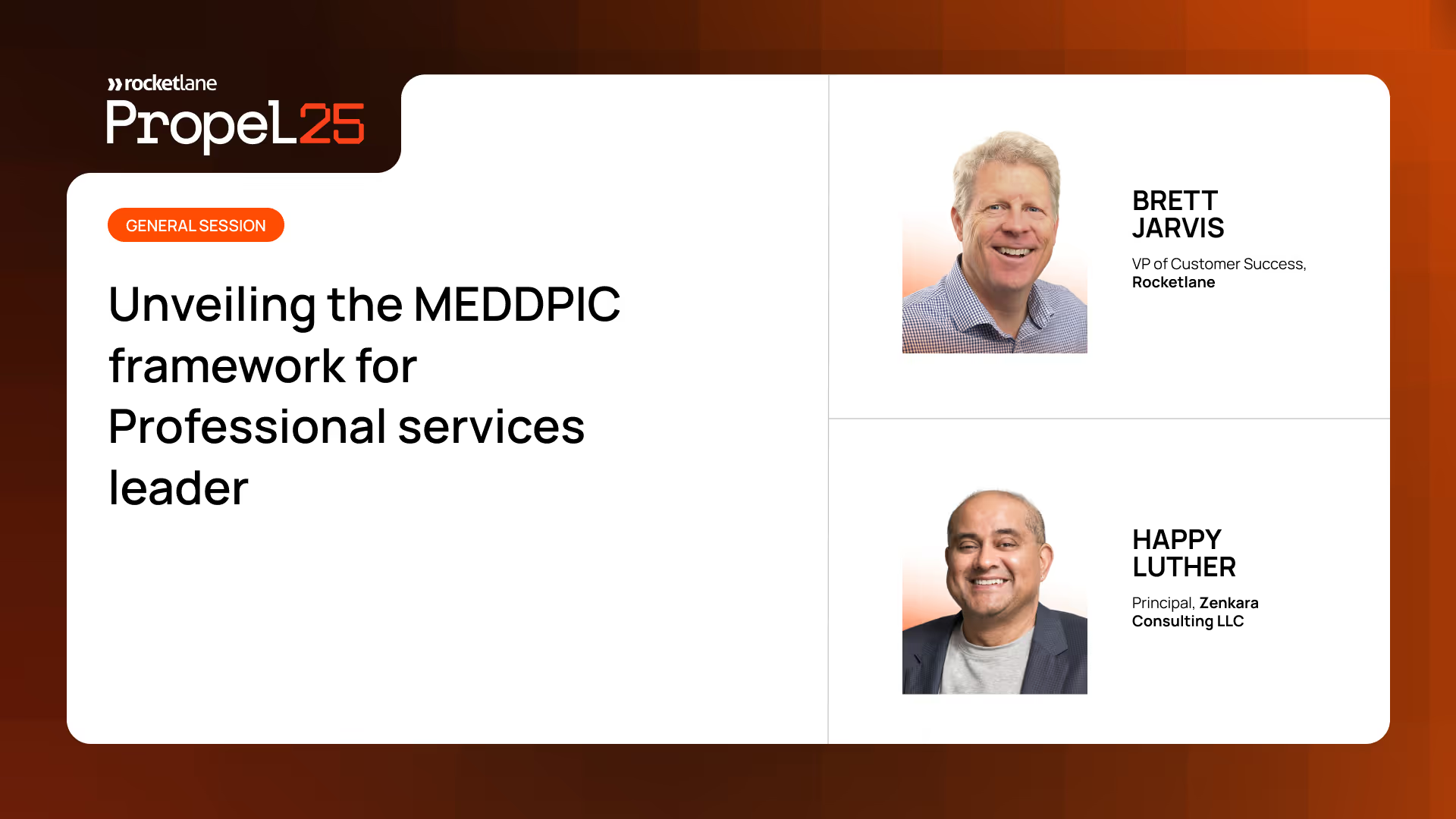
At Propel25, Rocketlane's Brett Jarvis (VP of Customer Success and Experience) and Happy Luther (Founder, Zenkara Consulting) unveiled the beginning of a bold initiative: The Rocketlane Way, a delivery framework purpose-built for PS teams.
Designed to bring clarity, consistency, and community alignment, the Rocketlane Way includes two core components:
- IGNITE: A project governance and transition structure that spans the end-to-end PS lifecycle
- METRICS: A qualification checklist that acts like a "project MEDDPIC," helping teams validate readiness and alignment at every stage
This blog walks through the Rocketlane Way in full, including its structure, purpose, early templates, and where AI fits in.
Why PS projects fail (and what Rocketlane wants to fix)
Rocketlane and Zenkara's starting point was clear: most PS projects fail not due to technical shortcomings, but because of execution gaps.
- Just 28% of projects are deemed successful (PMI)
- Scope creep affects nearly 50% of enterprise projects (Deloitte)
- Misaligned expectations, ineffective governance, and lack of stakeholder engagement are the top three reasons projects derail
As Brett and Happy shared, there’s no shared language or structure in PS to preempt these issues. Sales has MEDDPIC. Dev teams have Agile. But PS orgs? We’re often stitching together tribal knowledge and ad-hoc playbooks.
That’s where the Rocketlane Way comes in.
The Rocketlane Way: a framework for modern PS delivery
The framework has two main pillars:
- IGNITE: A governance and playbook structure across the customer lifecycle
- METRICS: A checklist-based validation model that ensures projects are ready to succeed
Together, they help PS leaders move from reactive to proactive, from manual to intelligent, and from inconsistent to repeatable.
Part 1: IGNITE - A PS playbook for end-to-end delivery
IGNITE is a six-stage structure that covers the entire PS lifecycle. It helps teams plan for handoffs, stakeholder alignment, risk management, communication, and go-live transitions.
“Think of it as the playbook for what happens before, during, and after the implementation.” — Happy Luther
I - Initiate
- Focus: Handoff from Sales to PS
- Activities: expectation setting, customer context, kickoff planning
G - Goals
- Focus: Define business outcomes and KPIs
- Activities: capture success criteria, define reporting skeletons, align on executive goals
N - Navigate
- Focus: Risk and communication management
- Activities: escalation paths, RAID logs, weekly comms cadence
I - Implement
- Focus: Execution methodology (customized per org)
- Activities: QA gates, team resourcing, sprint cycles, milestone reviews
T - Transition
- Focus: Handoff from PS to CS/support
- Activities: internal knowledge transfer, customer enablement, post go-live check-ins
E - Elevate
- Focus: Expansion and advocacy
- Activities: identify upsell/cross-sell signals, feed insights to Sales, and source testimonials
IGNITE isn’t just a theoretical model. Rocketlane is building templates, checklists, and governance artifacts for each stage, from kickoff decks to stakeholder matrices to transition plans.
Part 2: METRICS - Project qualification for predictable outcomes
Just as MEDDPIC helps qualify sales opportunities, METRICS qualifies the delivery readiness of a project.
“This is your seven-point diagnostic to know if a project is truly ready to go live and succeed.” — Brett Jarvis
Each letter in METRICS is a checkpoint for delivery alignment:
M - Metrics
- Are customer goals and success metrics clearly defined?
E - Executive sponsor
- Is there an economic buyer who’s truly engaged?
T - Timeline
- Are milestones, constraints, and risk factors understood?
R - Resourcing
- Are both internal and customer-side resources staffed and trained?
I - Implementation approach
- Has the methodology (e.g., agile, waterfall) been agreed upon?
C - Customer readiness
- Is the customer prepared for their responsibilities and tasks?
S - Stakeholder alignment
- Are all voices aligned across regions, functions, and roles?
Rocketlane plans to embed these METRICS checkpoints into project milestones so teams can revisit them as implementation evolves.
Where AI fits in: Automating and elevating PS workflows
AI isn’t a bolt-on in this framework. It’s a horizontal accelerator that brings consistency and insight across IGNITE and METRICS.
Some use cases shared:
- Auto-generate handoff summaries from sales calls (Initiate)
- Draft RAID logs and identify escalation paths (Navigate)
- Flag missing exec sponsors or undefined metrics (METRICS diagnostics)
- Summarize key risks and stakeholder comments from past meetings
“Rocketlane is the engine. The Rocketlane Way is the navigation. And AI is the co-pilot.” — Happy Luther
Whether it’s generating project summaries, surfacing risks, or auto-filling project artifacts, the future of delivery will be intelligent and assistive.
The delivery maturity curve: Modular by design
Rocketlane emphasized that the Rocketlane Way is modular. You don’t have to adopt it wholesale on Day 1.
Teams can:
- Start with IGNITE (e.g., playbook for handoffs)
- Or begin with METRICS (e.g., milestone readiness audits)
- Or embed AI insights into their existing workflows
This flexibility lets orgs evolve at their own pace while gaining the structure and rigor they need to scale.
Why this matters for PS leaders
This isn’t just about Rocketlane. It’s about professionalizing PS.
The Rocketlane Way gives leaders:
- A consistent language for project health
- Predictable patterns for team training and onboarding
- Tools to manage governance before risks emerge
- Frameworks to elevate implementation as a strategic lever
“Too often, we’re left reinventing the wheel every time. This framework says: you don’t have to.” — Brett Jarvis
As more PS orgs standardize around shared frameworks, we all win. Talent gets ramped faster. Project outcomes improve. And PS gains its seat at the strategic table.
Help shape the Rocketlane Way
Rocketlane is inviting the community to co-create and evolve this framework.
Interested leaders can:
- Gain early access to templates and resources
- Join a working group of PS and CS leaders
- Provide feedback and shape how IGNITE and METRICS mature
To join the movement, email rocketlaneway@rocketlane.com
Or just reach out to your CSM and say: “I’m in.”
Final takeaways
- Most project failures are due to governance and misalignment, not execution.
- IGNITE gives PS orgs a structured lifecycle playbook from handoff to go-live and beyond.
- METRICS ensures project qualification and stakeholder alignment before it’s too late.
- AI is the co-pilot that helps PS teams automate the gruntwork and elevate the human parts.
- The Rocketlane Way is flexible, modular, and community-built. You can start small, or go big.
- For PS leaders, this is a chance to elevate implementation from “project delivery” to “strategic value creation.”
For more Propel25 insights, read the full collection
Explore Rocketlane for smarter execution and consistent delivery
{{demo}}
Table of Contents

Regsiter for the live webinar


Great consultants didn't join your team to spend Fridays writing documentation.
Table of contents
18 of Forbes Cloud 100 chose Rocketlane. The best PS teams aren't waiting around.
FAQs













Copyright © 2026 Rocketlane Corp. All rights reserved.


















.webp)