What Aviation Teaches PS Leaders About AI Readiness


•
•
Summarize blog with






Most PS leaders are rolling out AI tools without a flight plan.
They're adding ChatGPT, Claude, and generic LLM workflows to their existing stacks—and assuming the technology will handle the judgment calls.
But AI that lacks delivery context becomes guesswork with automation.
The difference lies in purpose-built AI that lives inside your system of record, understands your projects and people, and governs decisions before they compound.
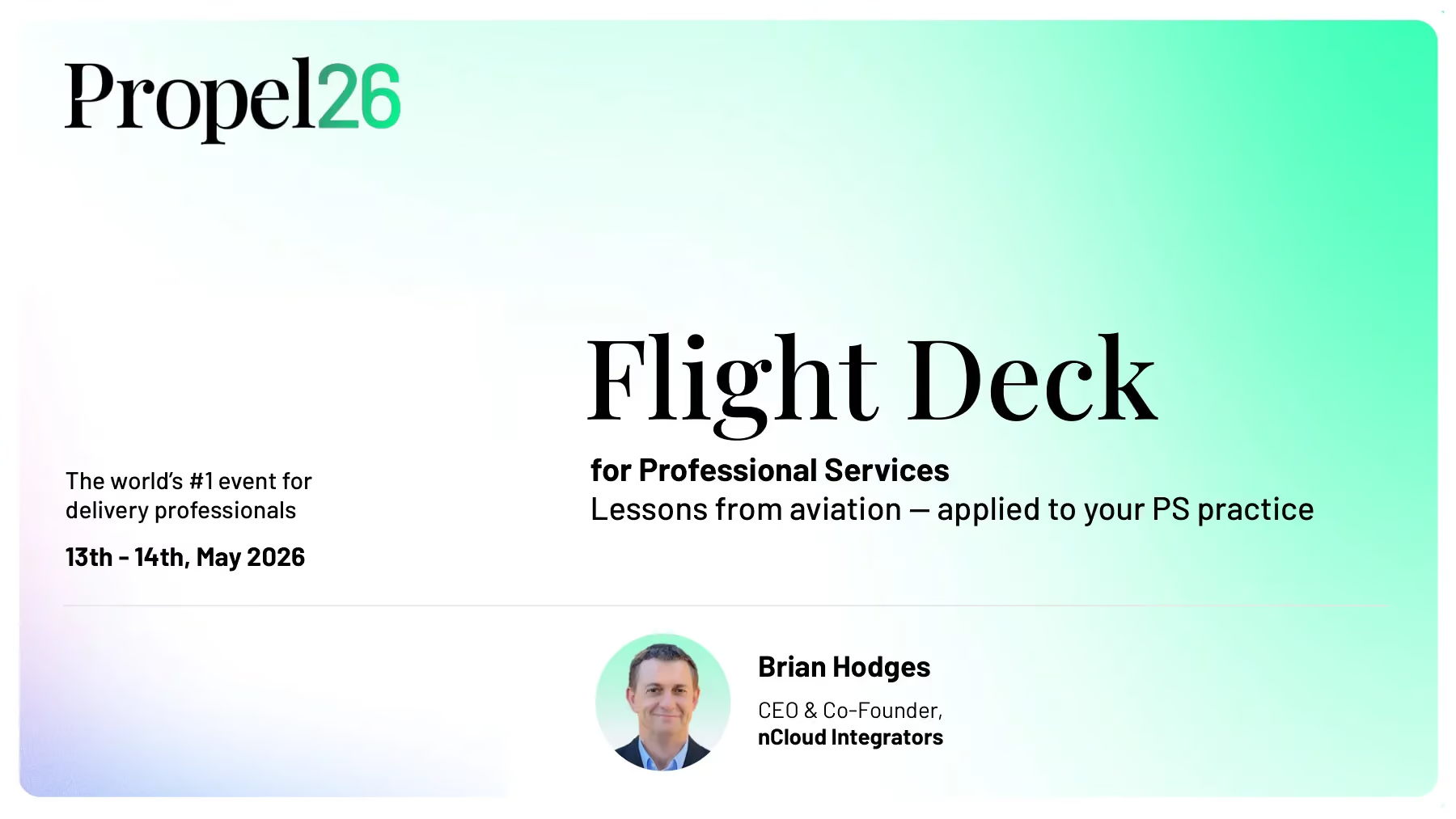
Brian Hodges, co-founder of N Cloud Integrators and a licensed pilot, brought both worlds to Propel 26.
Drawing from decades of aviation accident analysis, he showed professional services leaders how to spot project drift early, govern AI responsibly, and keep humans in the loop before the holes in the Swiss cheese align.
Read on for the key takeaways from the session.
Why Professional Services Projects Fail: The Swiss Cheese Model
The NTSB investigates every general aviation accident across three dimensions:
- The environment
- The aircraft
- The pilot
In aviation, a single failure is rarely fatal.
A tired pilot can still land safely in good weather.
A complicated aircraft can still be flown by someone well-trained.
A snowstorm can still be managed with the right preparation, equipment, and judgment.
The accident happens when multiple failures align.
This is known as the Swiss cheese model. Every layer of defense has holes. Most of the time, those holes don't line up. But when they do, risk turns into failure.
Hodges applied the same model to the delivery of professional services.
- A mispriced project may be manageable.
- A sponsor leaving mid-engagement may be manageable.
- A poor sales-to-delivery handoff may be manageable.
But when all three happen together, the project can become unrecoverable.
He anchored the point with a real aviation accident that occurred in December 2019 at Burke Lakefront Airport in Cleveland. The pilot had been awake for 17 hours, had limited time in a new aircraft with unfamiliar avionics, and departed into a snowstorm over dark Lake Erie.
Three holes. No recovery.
The point for PS leaders is practical: you don't have to prevent every issue.
You have to prevent issues from aligning.
How to Catch Project Drift Early: Assess, Act, Reassess
Brian's central framework comes from flight operations:
Assess. Act. Reassess.
- Look at the available data.
- Take a deliberate action.
- Measure the result.
Then adjust.
His example came from Southwest Airlines' winglet program. Flat wings create aerodynamic vortexes that increase fuel burn.
The first winglet design significantly reduced fuel consumption. But Southwest didn't stop there. The team reassessed, found another source of drag, and added a second winglet in the opposite direction.
Same aircraft. Better outcome.
Because the team kept asking: What did we miss?
For professional services leaders, project drift should be treated the same way.
- A client goes quiet.
- A milestone slips once.
- A sponsor misses two check-ins.
- A deliverable gets delayed.
These are early vortexes. They're not disasters yet.
But they are signals.
The danger arises when leaders dismiss them as normal project noise until a second, and then a third failure appears.
This is where tooling matters. Rocketlane surfaces these signals through task tracking, milestone monitoring, automated client reminders, and Nitro's drift detection. Because Rocketlane is the system of record for delivery, Nitro can watch the full picture: timelines, resources, spending, and client engagement.
That visibility turns early vortexes into early signals—before the holes align.
Why AI Readiness Requires First-Party Delivery Context
Every vendor in your tech stack has launched AI features.
That doesn't mean every AI feature is ready to guide delivery decisions.
Many AI tools sit above your systems. They summarize information, generate drafts, or answer questions based on the context they're given.
That can be useful. But it can also be risky.
AI that floats above your delivery data is a black box. It doesn't always understand your project plan, scope, budget, margin, staffing constraints, or customer engagement patterns.
Nitro works differently because it's embedded in Rocketlane, your system of record for professional services delivery. It sees the same projects, financials, team capacity, milestones, and client context that your leadership team uses to manage delivery.
No translation. No guesswork.
No disconnected assistant operating outside the flow of work.
The question for PS leaders isn't whether a tool has AI.
It's whether that AI has first-party delivery context—and whether you can trust what it governs.
Why Human-in-the-Loop Is the Most Important AI Guardrail
Six months before Propel 26, Brian co-led a workshop with roughly 200 PS leaders discussing AI.
When they voted on their biggest concerns, two answers dominated:
- The pace of AI change
- Boards and CEOs making financial or headcount decisions based on promised AI outcomes rather than proven ones
That gap is where risk lives.
Hodges cited a large consultancy that submitted AI-generated government work in Australia without human review. The LLM hallucinated. The mistake was discovered. The firm was sued.
His framework for managing this risk comes from aviation: personal minimums.
Before flying, pilots define the conditions below which they won't take off, regardless of what the aircraft is technically capable of handling.
Minimum visibility. Minimum ceiling. Maximum crosswind.
The aircraft might be able to fly in worse conditions.
The pilot may not be ready to.
For AI in professional services, the equivalent question is:
- What does a consultant review before a deliverable reaches a client?
- Which outputs require human sign-off?
- How much of a proven track record does a tool need before scrutiny can be relaxed?
Set personal minimums for every AI output. Define which deliverables require human review before being sent to a client.
Rocketlane helps operationalize that governance. Nitro can be configured to flag, hold, or require approval on outputs where delivery quality, customer trust, or financial impact is at stake.
Governance runs in the background, not only at the final review stage.
Start strictly. Measure performance over time.
Relax only when the tool has earned trust through consistent, verified results.
That's how you keep humans in the loop without slowing delivery.
Why Your Consultants Need to Know When Not to Trust AI
Brian used a cockpit analogy to describe two types of consultants navigating the AI transition.
The first is the six-pack pilot: someone trained on old-school instruments, comfortable with familiar systems, and hesitant to trust newer technology.
The second is the modern-glass-cockpit pilot: someone comfortable with data-rich, AI-assisted workflows.
Both can be effective. Both can be risky.
The six-pack pilot may resist tools that could improve them.
The glass-cockpit pilot may trust automation before they've earned enough experience to know when it is wrong.
That is the leadership challenge. Your job isn't just to give consultants access to better tools.
It's to teach them when to trust those tools, when to question them, and when to override them.
AI readiness is not simply tool adoption. It's judgment training.
The consultants who thrive in an AI-enabled PS organization will not be the ones who blindly accept every AI output. They'll be the ones who understand how to use AI to accelerate work while still owning the final call.
4 Key Takeaways from the Aviation Framework for PS Leaders
Map Your Swiss Cheese Before It Maps You
Identify which combinations of economic, operational, and human failures caused your worst projects.
Don't build generic risk registers. Build controls around the specific failure combinations that create real delivery risk.
Assess, Act, Reassess—on AI and Delivery
Roll out an AI tool.
Measure its actual impact on consultant output, delivery quality, and customer outcomes.
Then adjust. The first fix is rarely the final fix.
Set Personal Minimums for Every AI Output
Define which outputs require human review before reaching a client.
Start with strict governance and relax only after the tool earns trust through consistent, verified performance.
Prepare the Pilot, Not Just the Autopilot
Your consultants need to understand their role as AI takes on more operational work.
Leaders who define that role clearly will keep their best people engaged.
Leaders who don't will watch teams either disengage or over-trust the machine.
Conclusion
Brian Hodges closed with a question most PS leaders aren't asking yet:
When you're 100 feet from the runway and have to decide whether to land or go around, are you ready?
That readiness isn't about having the most advanced AI tools.
It's about preparation.
Knowing your team's capabilities. Recognizing early drift in projects.
Understanding when a judgment call cannot be delegated to an algorithm.
The Swiss cheese model is a warning, not a diagnosis. One failure is recoverable.
Three failures in alignment can become a crash.
In professional services delivery, the same logic holds. Price a project wrong, and you can recover. Lose a sponsor, and you can recover. Miss a handoff, and you can recover.
But when the economic, operational, and human layers fail together, no single fix can save the engagement.
Assess. Act. Reassess.
Set your minimums. Keep the human in the loop.
And make sure your consultants know how to fly the aircraft—not just sit in the seat while the autopilot runs.
Table of Contents

Regsiter for the live webinar


Great consultants didn't join your team to spend Fridays writing documentation.
Table of contents
18 of Forbes Cloud 100 chose Rocketlane. The best PS teams aren't waiting around.
FAQs










Copyright © 2026 Rocketlane Corp. All rights reserved.
















.webp)