AI native organization: building the AI-native PS function


•
•
Summarize blog with






Here's a fun position to be in. Your company hands everyone AI tools, a generous pile of tokens and a simple brief: go build. Your team builds more than 100 agents. Then you step back to check the ROI and it's, in the words of Liam Miner (VP of Professional Services at Contentsquare), "shockingly low."
Meanwhile, your clients have heard you're using AI too, and they'd like 20% off their next contract, please, because surely all this AI is making the work easier.
So the AI costs more than you expected and returns less than you hoped, and customers want a discount for it anyway. That's the squeeze a lot of PS leaders are in right now. Most of us are running AI programs. Very few of us are actually AI native. And the gap between the two is where the money is disappearing.
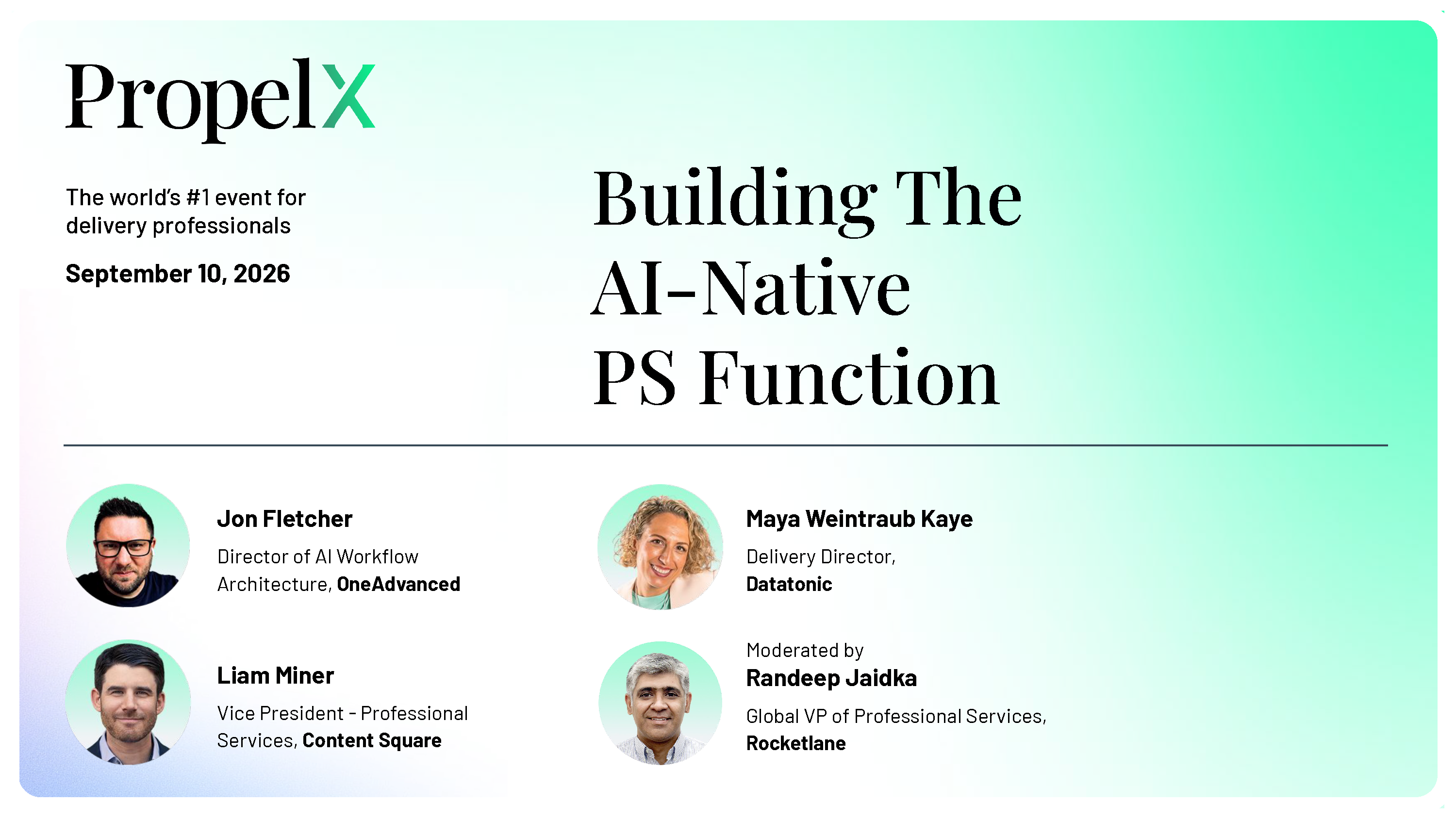
That gap was the whole point of the "Building the AI-native PS function" panel at PropelX 2026 in London. Randeep Jaidka (Global VP of Professional Services at Rocketlane) moderated a conversation with Liam, Jonathan Fletcher (Director of AI Workflow Architecture at OneAdvanced) and Maya Weintraub Kaye (Delivery Director at Datatonic). They covered three questions: how to get real outcomes from AI programs, what the org should look like, and who's accountable when your team, your agents and your customer are all in the mix.
Why do most AI programs fail to deliver outcomes?
Jon's team at OneAdvanced runs a portfolio of more than 100 products on different architectures, and they've made a rule of it: "We don't ask and don't talk about AI, we talk about outcomes." The conversation starts with the flow of work needed to deliver a result, and only then asks whether AI is the right tool for any part of it. That's the difference between an AI transformation that plateaus and one that keeps moving.
The problem, as Jon sees it, is that everyone is being told to "go and use AI," but nobody tells them what to use it for. So people pipe their emails into it and announce they've redefined their email. It comes back with "that little dash in it," and everyone who reads it knows exactly how it was written.
Governance has to come first, because, as Jon put it, you don't learn to drive without a licence. That said, curiosity still matters: someone on his team once plugged Claude into the back of ServiceNow without telling him, and fixed in two hours an issue neither ServiceNow nor a partner had managed to solve. The trick is keeping that curiosity inside clear governance.
What went wrong with Contentsquare's 100 agents?
Contentsquare's 100-plus agents weren't a failure of effort; they were a failure of intent. Liam said the word most teams forget is intentionality. The team was told to go build agents to deliver efficiency, but without the right training or framework, and without understanding which part of the customer journey each agent was meant to improve. When they stepped back and looked at the ROI, it was shockingly low.
This year, they're redesigning around outcomes instead, with each agent tied to a specific result they're trying to achieve. Liam pointed to Chargebee's approach from earlier in the day as the example to follow, because it was intentional at every stage of the journey. Contentsquare is also bringing in external consultancies to retrain its team on consulting fundamentals, and is considering a dedicated AI services practice inside PS, with metrics and compensation tied to the outcomes each AI initiative is meant to drive.
Is customer onboarding a product problem or a PS problem?
Jon made the point that stung the most for a room full of PS leaders. Onboarding customers "is not a PS issue. It is a product challenge. It is an engineering challenge." In his words, "if we have to have a team of 30 people, something's gone wrong with our product, not gone wrong with our processes."
OneAdvanced now works closely with its product function to change how customers get onboarded, and zero-day deployment is moving from an aspirational goal to a realistic one. Jon's team uses automation, AI and Rocketlane to support customers through that journey, including workflow automation that goes well beyond PS delivery. Being AI native means fixing the product so you don't need the headcount, not throwing AI at a process that shouldn't exist.
What does an AI native organization look like?
Maya, who has worked at IBM, Capgemini and Salesforce, described org structures moving away from one person per task. The teams she sees are becoming much smaller, with each person doing a lot more on their own instead of 20 or 30 people each owning a small piece of work. The skills mix is changing too. It's less about separate engineers, testers, ML engineers and data analysts, and more about people who can do AI orchestration and vibe coding alongside business analysis and testing.
Liam's challenge to the room was bigger. When does the next billion-dollar, 10-person company come along, and could your current PS structure compete with it? He urged leaders to think hard about what their org will actually need, and warned that the push to redesign has to come from leadership, not just be delegated to the team.
A human-centric customer function
Jon's most interesting reframe was about the name itself. As more of the work gets baked into products and solutions, maybe the goal isn't an "AI-native PS function" at all. "Maybe it's a human-centric customer function." That means putting the customer in the title and customer outcomes at the heart of everything the team does.
How is AI changing PS commercial models?
Maya was blunt about where the money was going. Selling staff augmentation, a set of people to do a set of tasks, "is going to be irrelevant very, very soon." Large consultancies are already seeing clients ask for a 20% reduction on their last contract, because "you're having all these AI tools, why are you charging us full price?" The challenge is structuring deals that still show the value of the team while openly using modern technology.
That's driving a major shift away from time and materials towards fixed-fee and outcome-based models. Customers increasingly want to pay to reach a solution, not for the hours it took. Jon added a more hopeful angle: AI makes it much less risky to offer managed services, which used to feel like a stretch for software PS teams. His homework for the room was to look up "applied AI" and think about how it could reshape their PS function.
Who is accountable for outcomes when AI agents do the work?
Randeep put the hardest question to the panel: if your team, your customer and your AI agents all share the work, who is actually accountable for the outcome? Maya's view, from the consultancy side, was that the customer owns change management and adoption, unless they give you the authority to drive it. Without that authority, a delivery team can only be accountable for what it controls, like the product working well and processes being configured correctly.
But she has also sat through plenty of escalations where everyone internally points at another team or at the customer. Liam's answer is old school, and it works: a RACI chart that sets expectations for every outcome across sales, PS, customer success and renewal, and treats accountability as joint with the customer. Humans also stay accountable for the agents they deploy, and that part doesn't get handed to the AI.
How do you keep humans on the loop?
Randeep introduced Maya as passionate about keeping humans "on the loop," not just in it: supervising AI's work and stepping in where judgement is needed. She pointed to IBM, which ran a company-wide hackathon a couple of years ago where everyone had to build something in teams, even using AI narrators for the presentations. The point was to get everyone hands-on in a safe, structured way.
Jon added the warning that makes the guardrails matter. Without the right controls, models end up learning from AI-generated content that learned from AI-generated content, and it all turns into what he called "an absolute cauldron of, excuse my language, crap." Cybersecurity, data protection and governance parameters need to be in place before AI output feeds back into your systems, so the feedback loop improves quality instead of recycling mistakes.
5 key takeaways on building an AI native organization
- Outcomes first. Start with the flow of work and the result you want, then decide whether AI is the right tool.
- Intent beats volume. 100 agents without a link to the customer journey can deliver shockingly low ROI.
- Fix the product. If onboarding needs 30 people, the problem isn't your PS process.
- Smaller, broader teams. AI native orgs have fewer single-task roles and more people owning whole pieces of work.
- Write accountability down. Use a RACI across your team, your agents and your customer so nobody can point elsewhere.
Best practices for building an AI native PS function
- Audit your agents. For each one, note which customer journey step it serves and which outcome it moves, then retire or redesign the rest.
- Train before you hand out tokens. Give people a framework and consulting fundamentals before asking them to build.
- Rework your commercials. Move from staff augmentation and T&M towards fixed-fee and outcome models before clients push for discounts.
- Draw up a RACI with the customer. Include which agents do which work and which person is accountable, using a RACI template.
- Set guardrails before feedback loops. Put governance, data protection and review steps in place before AI output feeds back into your systems.
About Rocketlane
Rocketlane is an agentic AI-powered professional services automation (PSA) platform built for services teams running complex implementations.
Its AI layer, Nitro, deploys named agents that do the work, not just flag it:
- Migration Agent — data preparation and transformation
- Workforce Agent — repeatable configuration at scale
- Documentation Agent — project context current across calls and emails
- Project Governance — delivery standards enforced proactively
- Nitro Signals — account risk surfaced before it escalates
The core distinction: Nitro agents produce the deliverable or enforce the gate. Most platforms advise. Rocketlane acts.
Teams using Rocketlane ship faster, recover margin through tighter governance, and scale delivery without proportional headcount growth.
Related sessions from PropelX
- Building AI customer onboarding: redesigning PS teams for the outcome era: how Chargebee built 27 onboarding agents with clear intent at every stage.
- Professional services trends for 2026: why delivery is the new moat: Sri Ganesan on role compression and why utilization is fading.
- Outcome based selling: how we rebuilt delivery around outcomes: Pendo's move from selling hours to selling milestones.
Table of Contents

Regsiter for the live webinar


Great consultants didn't join your team to spend Fridays writing documentation.
Table of contents
18 of Forbes Cloud 100 chose Rocketlane. The best PS teams aren't waiting around.
FAQs
What is an AI native organization in professional services?
An AI native organization in professional services designs its work, structure and metrics around customer outcomes, and uses AI where it moves those outcomes. That's different from running AI programs, where teams get AI tools and tokens without a clear link to the customer journey, which often produces many agents with low ROI. Rocketlane covers the wider shift in its guide to AI in professional services.
Why do AI agents in PS teams often deliver low ROI?
AI agents deliver low ROI when teams build them without intent or training. Contentsquare built more than 100 agents for its PS practice and found the ROI "shockingly low" because the agents weren't mapped to specific steps in the customer journey or to specific outcomes. Tying each agent to an outcome is the fix, as with purpose-built workforce agents.
Is customer onboarding a PS problem or a product problem?
According to Jonathan Fletcher of OneAdvanced, onboarding is a product and engineering problem as much as a PS one. If onboarding a customer needs a team of 30 people, it signals something wrong with the product, not just the delivery process. OneAdvanced is working with its product team towards zero-day deployment and a faster time to value.
How is AI changing PS pricing and commercial models?
AI is pushing professional services away from time and materials and staff augmentation towards fixed-fee and outcome-based models. Some clients are already asking consultancies for 20% reductions because AI tools make the work faster, so PS leaders need deals that show value rather than hours, often shifting towards value-based pricing.
What does "human on the loop" mean in AI delivery?
"Human on the loop" means a person supervises AI's work and steps in when judgement is needed, rather than manually approving every step, which is closer to "human in the loop." It relies on clear guardrails so AI output is checked before it feeds back into systems or models, balancing automation and the human touch.
Who is accountable for outcomes when AI agents do part of the work?
The customer usually owns change management and adoption, unless they delegate that authority. The delivery team is accountable for what it controls, and humans remain accountable for the agents they deploy. Panelists at PropelX 2026 recommended writing this down in a RACI shared with the customer, so accountability sits with named stakeholders.
How are PS team structures changing with AI?
PS teams are getting smaller, with each person owning more of the work instead of many people each handling one narrow task. Skills are shifting towards AI orchestration, vibe coding, testing and business analysis. Some leaders are also asking whether future PS teams will look more like a "human-centric customer function" when building a PS org.
Why is staff augmentation declining in professional services?
Staff augmentation sells people to perform set tasks, and AI is automating many of those tasks. Clients increasingly ask why they should pay full rates when AI speeds up the work. Maya Weintraub Kaye of Datatonic expects staff augmentation to become irrelevant soon, as buyers move to fixed-fee and outcome-based professional services pricing.
What is zero-day deployment?
Zero-day deployment is the goal of getting customers to live on a product almost immediately, with minimal implementation effort. It depends on product and engineering teams designing onboarding into the product itself, rather than relying on large PS teams, and it's a direct way to reduce time to value.
How should PS leaders start becoming AI native?
Start by auditing the AI you already have. For each agent or workflow, write down the customer journey step it serves and the outcome it moves, and retire the ones that don't connect. Then add governance, training and a RACI with customers before building more, using a PS maturity model to track progress.












Copyright © 2026 Rocketlane Corp. All rights reserved.
















.webp)