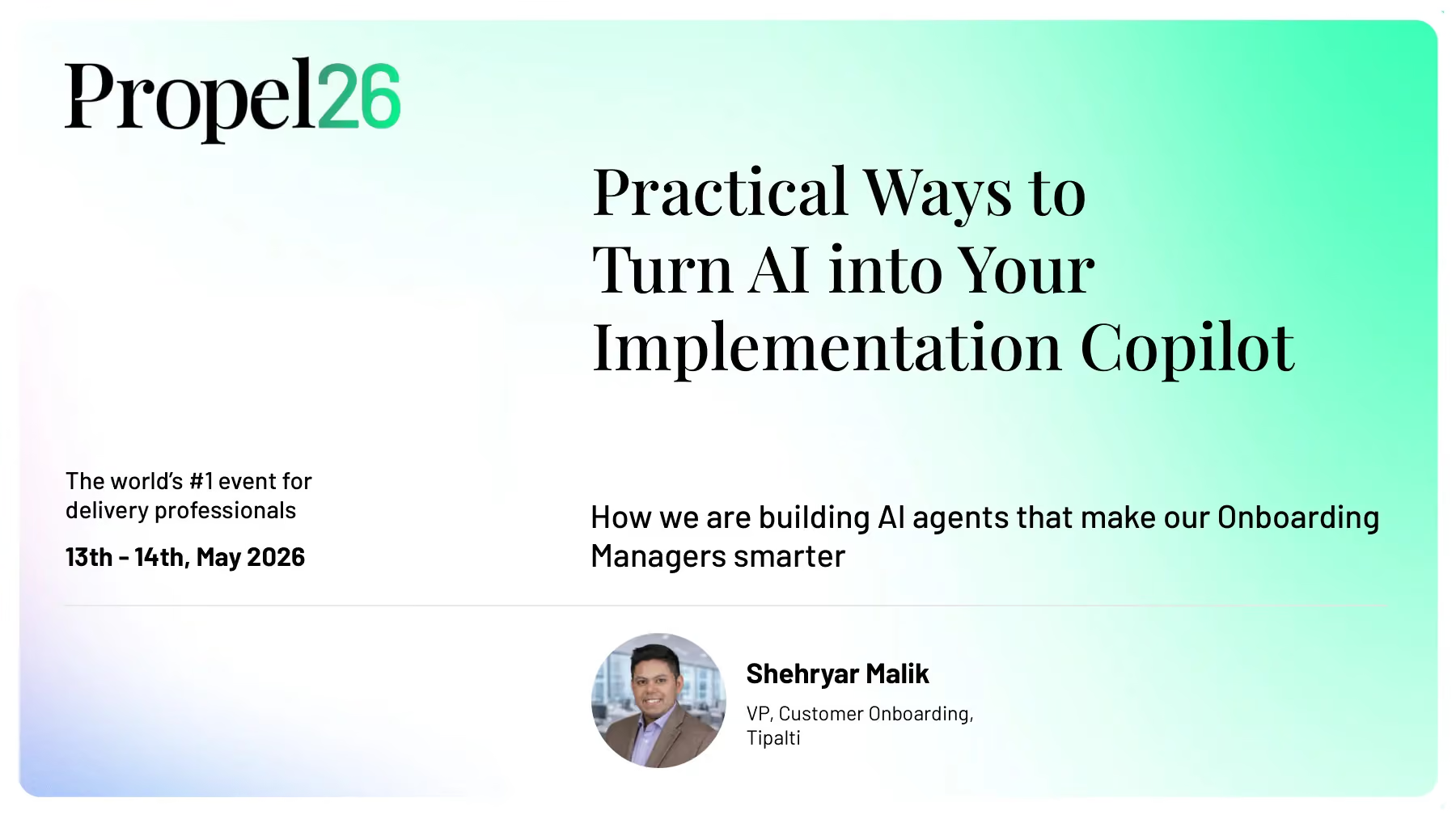
Practical Ways to Turn AI into Your Implementation Copilot


•
•
Summarize blog with






Most professional services leaders don't have an AI problem.
They have an implementation problem.
The industry conversation around AI often swings between extremes: either AI will transform everything, or it's still too early to invest seriously. Meanwhile, implementation teams are stuck trying to figure out what actually matters on Monday morning.
Where should AI fit into the delivery process? What work should it automate? What should stay human? And how do you create measurable value without launching a massive transformation program?
At Propel 26, Shehryar Malik, VP of Post-Sales Experience at Topology, offered a refreshingly practical answer: stop thinking about AI as a strategy initiative and start thinking about it as an implementation copilot.
The goal isn't replacing people. It's helping implementation teams spend less time on administrative work and more time helping customers achieve outcomes.
Why AI Adoption Often Stalls in Professional Services
Many AI initiatives begin with a tool search.
Teams evaluate copilots, agents, meeting assistants, and automation platforms before they've identified a single workflow worth improving.
The result is predictable. Organizations accumulate AI tools but struggle to demonstrate business impact.
Topology took a different approach.
Rather than asking, "How should we use AI?" the team asked a simpler question:
"Where are our implementation teams spending time that doesn't directly help customers?"
That shift reframed the entire conversation.
The goal wasn't to deploy AI. The goal was to remove friction.
Instead of launching an AI program, Topology focused on identifying repetitive work, information bottlenecks, and manual processes that slowed onboarding and implementation delivery.
The lesson for professional services leaders is straightforward: AI creates value by removing operational friction. Everything else follows.
How to Build an AI Copilot for Implementation Teams
One of the strongest themes from Shehryar's session was that AI works best when it's embedded directly into delivery workflows.
Implementation teams shouldn't need to stop what they're doing to use AI.
AI should assist them while they're already doing the work.
Topology focused on several practical use cases.
Customer onboarding preparation
One of the most time-consuming parts of implementation is gathering context.
Customer information lives across sales notes, discovery calls, CRM records, email threads, and internal conversations. Project teams often spend significant time collecting information before meaningful work can begin.
Topology introduced AI-powered briefing workflows that automatically summarize customer context and prepare implementation teams before kickoff.
The result wasn't just time savings. Teams started projects with better information and greater confidence.
Risk detection before escalation
Traditional implementation management is reactive.
A customer raises concerns. A milestone slips. Leadership becomes involved. Then the team responds.
Topology wanted earlier visibility.
By analyzing customer conversations and implementation signals, AI helped identify potential risks before they escalated into formal issues.
This shift from reactive to proactive delivery led to an 80% reduction in escalations, enabling teams to intervene when there was still time to change the outcome.
Faster operational decision-making
Implementation teams generate enormous amounts of operational data, but much of it goes unused because manual review is time-consuming.
AI helped surface patterns, summarize information, and highlight areas requiring attention.
Instead of spending hours collecting information, leaders could focus on making decisions.
The outcome wasn't simply efficiency. It was faster action.
Why Process Maturity Still Matters More Than AI
One of the most important cautions from the session was that AI doesn't fix broken processes.
It amplifies them.
If implementation handoffs are inconsistent, AI scales the inconsistency.
If project data is incomplete, AI generates unreliable insights.
If delivery processes vary significantly across teams, AI recommendations become difficult to trust.
Before organizations automate work, they need operational clarity.
Shehryar described a progression that many successful organizations follow:
- Define consistent processes.
- Create structured, reliable data.
- Standardize workflows.
- Introduce automation.
- Apply AI optimization.
Too many teams attempt to start at step five.
The organizations seeing the biggest gains from AI are often the ones that invested first in operational discipline.
That's why implementation maturity and AI maturity are often inseparable.
Why AI Creates Better Customer Outcomes—Not Just Better Productivity
Many AI conversations focus heavily on productivity.
The more interesting question is customer impact.
Several of Topology's AI initiatives weren't designed primarily to save internal time. They were designed to improve customer outcomes.
When onboarding teams receive better context, customers ramp faster.
When risks are identified earlier, customers avoid delays.
When implementation leaders can focus less on administration and more on coaching, guidance, and problem-solving, customers get a better experience.
This contributed to measurable results across Topology's customer journey, including:
- 80% reduction in escalations
- 25% improvement in time-to-go-live
- Faster onboarding readiness
- More proactive customer engagement
The pattern is important.
The most valuable AI initiatives don't just make teams more productive.
They help customers achieve value faster.
How Rocketlane Helps Teams Operationalize AI
One theme that surfaced repeatedly throughout the session is that AI performs best when it has a delivery context.
That's why implementation teams increasingly need AI embedded inside their system of record rather than disconnected from it.
Rocketlane provides that foundation by connecting project execution, customer collaboration, milestones, tasks, and delivery workflows in a single platform.
With delivery data already centralized, teams can layer AI capabilities onto real implementation context rather than relying on disconnected tools and fragmented information.
The result is exactly the kind of implementation copilot Shehryar described: AI that helps teams identify risks earlier, surface important information faster, and spend more time focused on customer outcomes.
4 Key Takeaways from Shehryar Malik's AI Copilot Framework
Start with operational friction, not AI. The best use cases emerge from real implementation problems, not technology trends.
Use AI to assist workflows, not replace them. The highest-value applications reduce administrative effort while preserving human judgment.
Fix process problems before automating them. AI amplifies the systems it's given.
Measure customer outcomes, not tool adoption. Success isn't how many people use AI. It's whether customers achieve value faster because of it.
Conclusion
Shehryar Malik's session offered a useful reminder that AI adoption doesn't need to begin with a transformation program.
It can begin with a single workflow.
A handoff that takes too long. A report nobody wants to build. A customer risk that's identified too late. A project team spends more time collecting information than acting on it.
The teams creating the biggest impact with AI aren't necessarily deploying the most sophisticated technology. They're applying it to practical implementation challenges where the value is visible and measurable.
That's what makes AI a copilot rather than a science experiment.
And for implementation leaders, that's often the fastest path from experimentation to results.
Table of Contents

Regsiter for the live webinar


Great consultants didn't join your team to spend Fridays writing documentation.
Table of contents
18 of Forbes Cloud 100 chose Rocketlane. The best PS teams aren't waiting around.
FAQs













Copyright © 2026 Rocketlane Corp. All rights reserved.


















.webp)