Best Agency Time Tracking Software in 2026

•
•
Summarize blog with






A client questions an invoice.
The account manager opens the timesheet report and immediately spots the problem. Half the team's hours were entered on Friday afternoon. Several entries are assigned to the wrong project. A few days of work were never logged at all.
The work happened. But the problem is that the agency's time tracking software isn't connected to where work actually gets done. By the time leadership reviews utilization, project margins, and billable hours, the month is already over. The opportunity to course-correct has already passed.
This is the gap between tools that record time and platforms that connect it to delivery. Agency time tracking software in 2026 spans both kinds: simple trackers like Harvest and Toggl Track that log hours, and broader platforms like Rocketlane, built as an agentic execution platform, that connect time capture to project delivery, resource planning, profitability, and invoicing.
The best agency time tracking software helps teams understand whether projects are profitable, where billable time is leaking, how resources are being utilized, and which accounts are drifting off budget before margins disappear.
Agency time tracking software helps agencies capture billable and non-billable hours, monitor utilization, track project profitability, manage budgets, and automate invoicing. While standalone trackers focus primarily on timekeeping, modern agency operations platforms connect time data to project execution, resource management, forecasting, and financial performance.
This guide compares the best agency time tracking software in 2026, including Rocketlane, Harvest, Toggl Track, Clockify, Kantata, Scoro, Timely, and Productive.io, and evaluates them across usability, profitability reporting, resource planning, billing flexibility, AI capabilities, and scalability.
Who this guide is for: Operations leaders, delivery managers, agency owners, and professional services teams with 10–150 billable team members managing client project work.
Methodology: Updated July 2026. Ratings reflect publicly available G2 data at the time of writing. Assessments are based on product documentation, customer reviews, analyst research, and hands-on evaluation of each platform's capabilities.
What did this evaluation find?
After evaluating eight platforms across usability, profitability, resource planning, and billing, Rocketlane ranks first for agencies that need time tracking connected to delivery, not just to invoices.
It embeds tracking in project workflows, updates financials in real time, and layers Nitro agentic AI on top, with 750+ organizations and a 94% G2 recommendation rate.
For simple hourly billing, Harvest and Toggl Track are solid; for automatic capture, Timely. This guide covers all eight.
Best agency time tracking software: 2026 shortlist at a glance
*Ratings reflect publicly available G2 scores in July 2026.
If you need to connect time tracking to project delivery, resource planning, utilization, profitability, and operational visibility, start with Rocketlane, Scoro, Kantata, or Productive. If your primary need is simple time capture, tools like Harvest, Toggl Track, and Clockify remain good options.
What is agency time tracking software — and why does it matter?
Agency time tracking software helps agencies capture billable and non-billable hours across client work, internal initiatives, pre-sales activities, and operational tasks. The best platforms go beyond time entry by connecting hours worked to project budgets, resource utilization, invoicing, and profitability reporting.
For many agencies, the challenge is turning time data into operational visibility. When time tracking, project delivery, budgeting, and reporting live in separate systems, teams often spend significant effort reconciling information before they can understand project performance or profitability.
The three layers of modern agency time tracking
Most agency time tracking platforms operate across three layers:
- Task layer: Time is captured against the work itself, tasks, projects, milestones, tickets, or deliverables. This provides context around where effort is being spent.
- Financial layer: Hours are connected to bill rates, cost rates, budgets, retainers, and project financials, helping agencies understand utilization, revenue, and profitability.
- Governance layer: Approval workflows, timesheet policies, utilization targets, and reporting controls help ensure data quality and operational consistency.
Together, these layers transform time tracking from a record-keeping activity into a management system for agency operations.
What is the difference between billable vs. non-billable time?
The distinction between billable and non-billable work remains one of the most important inputs into agency profitability.
Most agencies track several categories of time:
- Billable client work
- Internal operations
- Business development and pre-sales
- Training and enablement
- Rework and project overruns
- Administrative activities
Without clear categorization, agencies often struggle to understand utilization, project margins, and delivery efficiency. Modern platforms provide native categorization and reporting that eliminate much of the spreadsheet work historically required to analyze this data.
What does connected vs. integrated time tracking look like?
Not all integrations are equal.
Many agencies use a combination of project management software, time trackers, accounting systems, and spreadsheets connected through exports or middleware. While these systems can share information, reporting often requires manual reconciliation.
Integrated platforms take a different approach. Time entries, projects, resources, budgets, and financials operate from a shared data model, allowing reporting and forecasting to update automatically as work progresses.
For growing agencies, the difference often determines how quickly leaders can identify budget overruns, utilization issues, and profitability trends.
For agencies managing multiple clients, projects, and billing models simultaneously, the goal is no longer simply tracking hours, it's understanding how those hours translate into delivery performance and profitability.
What are the top time tracking tools for agencies in 2026?
1. Rocketlane
Rocketlane is an agentic execution and delivery platform that combines project execution, resource management, project financials, customer collaboration, and workflow-embedded time tracking in a single system.
It was designed for professional services teams, implementation consultancies, agencies, and customer-facing delivery organizations that need accurate time capture alongside real-time visibility into utilization, profitability, and project performance.
Many agencies start with standalone time trackers and gradually assemble a patchwork of project management tools, spreadsheets, accounting systems, and reporting workflows.
As team size and delivery complexity increase, operational visibility becomes fragmented and time tracking turns into a reconciliation exercise. Rocketlane approaches the problem differently by embedding time tracking directly into project delivery workflows and connecting every logged hour to resource management, project financials, and operational reporting.
Key features
- Workflow-embedded time tracking: Consultants and project teams log time directly from tasks, project phases, meetings, and assigned work. Time capture happens where work is managed, reducing the need to switch between project tools and separate time-tracking applications.
- Multiple billing models: Supports time and materials, fixed-fee, milestone-based, retainer, and hybrid engagements. Agencies can manage different commercial models without maintaining separate tracking processes.
- Flexible rate card management: Configure bill rates and cost rates by role, individual resource, client, geography, project, or service line. This allows agencies to model profitability accurately across different engagement types.
- Project financial visibility: Every approved time entry updates project budgets, revenue forecasts, margin calculations, and burn-rate reporting. Delivery leaders can see budget consumption and project health as work progresses.
- Resource management and utilization planning: Capacity planning, workload balancing, allocation management, utilization forecasting, and skills-based staffing help agencies optimize resource deployment and identify utilization risks early.
- Approval workflows and governance: Multi-level approval workflows support different project structures and governance requirements. Time entries can be reviewed and approved by project managers, delivery leaders, or finance teams.
- Project and portfolio reporting: Track utilization, revenue, margins, forecast accuracy, resource performance, project health, and delivery operations across the entire agency portfolio.
- Accounting and finance integrations: Native integrations with QuickBooks, NetSuite, and other financial systems help streamline invoicing, revenue reporting, and financial reconciliation.
- CRM and delivery integration: Salesforce and HubSpot integrations connect sales, project delivery, resource planning, and financial operations within a single workflow.
Rocketlane customers have already seen measurable operational gains from a more connected approach to time tracking and delivery management.
Dreher Consulting, a services firm managing concurrent client implementations, moved status reporting out of recurring calls and into Rocketlane's shared delivery workspace.
Clients could see milestone progress, time logged, and budget consumption directly, instead of waiting for a weekly sync. Within two quarters of adoption, Dreher reduced client status meetings by 66%, recovering hours that delivery leads to billable project work.
Fluxx, a customer-facing delivery organization running multiple concurrent engagements, used Rocketlane's resource management and workflow-embedded time tracking to reach 83% billable utilization within the first two quarters of rollout.
Nitro, Rocketlane’s agentic AI layer
Rocketlane Nitro applies agentic AI across time tracking, resource management, governance, operational reporting, and delivery execution. Rather than focusing solely on timesheet automation, Nitro helps agencies improve operational efficiency across the full delivery lifecycle.
Rocketlane Nitro operates through three layers of AI-powered assistance designed for services teams and agencies.
- Operations AI helps leaders improve utilization, staffing decisions, project governance, reporting, and profitability visibility. Nitro Analyst enables teams to ask operational questions in natural language, helping delivery and operations leaders understand utilization trends, project margins, forecast accuracy, resource allocation, and delivery performance without manually building reports.
- The Timesheet Policies helps enforce timesheet standards at the point of entry rather than during approvals. Agencies can define policies around required notes, billable classifications, minimum weekly hours, project-specific requirements, and time-entry exceptions, helping improve data quality before submissions reach managers or finance teams.
- The Resource Management Agent provides visibility into utilization trends, capacity gaps, staffing imbalances, and upcoming resource constraints. Operations leaders can identify underutilized team members, overloaded resources, and emerging allocation risks earlier, enabling more proactive workforce planning and utilization management.
- Delivery AI continuously analyzes project activity, workload distribution, milestone progress, budget consumption, and client engagement patterns to identify emerging risks before they affect outcomes. Signals surface delivery risks, budget overruns, schedule slippage, and resource bottlenecks while teams still have time to respond.
- Project Governance capabilities help automate status reporting, delivery oversight, and stakeholder communication by consolidating project activity, risks, milestones, and operational signals into structured updates. This reduces administrative effort while improving visibility across active engagements.
Key takeaways
Global availability
Supports agencies and professional services organizations across North America, Europe, APAC, and MENA. Multi-currency support includes USD, EUR, GBP, INR, AED, AUD, and other major currencies. GDPR-compliant deployment options and enterprise security controls support organizations with regional compliance requirements.
Enterprise-Grade Foundation
- Security and compliance: SOC 2 Type II, GDPR, 99.9% uptime SLA, HIPAA-ready
- Identity and access: SSO via Okta, Azure AD, and Google; role-based permissions across 10+ user types
- Global delivery: multi-currency, multi-timezone, partner and contractor portal with selective visibility
- Native integrations: Salesforce, HubSpot, NetSuite, QuickBooks, Xero, Jira in real time; no middleware for core integrations
- Extensibility: API, webhooks, custom app framework, MCP support to connect Rocketlane to Claude, ChatGPT, and Slack
- Implementation support: named CSM and named implementation manager for every enterprise account, from day one
The Rocketlane story in numbers
750+ customers, 94% G2 recommendation rate, $60M Series C (March 2026), revenue more than doubled year-over-year since 2023, and average deal size grew 4.5× since 2023
2. Harvest
Harvest is a time tracking and invoicing platform built around a relatively simple operating model: track billable hours, monitor project budgets, and convert approved time into invoices.
It is commonly used by agencies and consultancies that primarily bill by the hour and do not require extensive resource planning or professional services automation (PSA) functionality.
Key features
- Time tracking: Supports timer-based and manual time entry across projects, clients, and tasks.
- Billable and non-billable tracking: Separates client work from internal activities for utilization and invoicing purposes.
- Project budgets: Tracks hours and spend against project budgets to highlight overruns.
- Invoicing: Converts approved billable time into invoices and integrates with accounting platforms.
- Reporting: Provides visibility into utilization, project progress, team activity, and billable hours.
Key takeaways
3. Toggl Track
Toggl Track is a time tracking platform focused on reducing the effort associated with time entry. It is commonly used by creative agencies, marketing teams, and consultancies that prioritize adoption and ease of use over broader operational management.
Key features
- Time tracking: Supports one-click timers, manual entries, and timesheets across projects and clients.
- Browser extensions: Allows time capture directly from project management, productivity, and collaboration tools.
- Project tracking: Organizes hours by client, project, task, and team member.
- Reporting: Provides visibility into billable hours, utilization, and team activity.
- Cross-platform support: Available across desktop, browser, and mobile environments.
Key takeaways
4. Clockify
.webp)
Clockify is a time tracking platform centered on accessibility and cost efficiency. It is frequently adopted by agencies and service organizations that need basic time tracking across larger teams without making a significant software investment.
Key features
- Time tracking: Supports timers, manual entries, timesheets, and project-based tracking.
- Billable and non-billable categorization: Separates client work from internal activities for reporting and invoicing purposes.
- Reporting: Provides utilization, attendance, project, and team-level reporting.
- Team management: Supports approvals, user management, and workforce tracking capabilities.
- Integrations: Connects with project management, collaboration, and productivity tools.
Key takeaways
5. Kantata
.webp)
Kantata is a PSA platform that combines time tracking, resource planning, project delivery, and financial management. It is most commonly evaluated by larger professional services organizations that need forecasting, staffing, and portfolio-level visibility alongside time capture.
Key features
- Time and expense tracking: Captures project effort, costs, and billable activity across teams.
- Resource management: Supports staffing, capacity planning, forecasting, and utilization tracking.
- Project financials: Tracks budgets, revenue, margins, and project profitability.
- Portfolio reporting: Provides visibility across projects, teams, and business units.
- Enterprise integrations: Connects with CRM, ERP, and financial systems
Key takeaways
6. Scoro

Scoro is a work management and PSA platform that combines time tracking, project management, resource planning, CRM, and billing in a single system.
Key features
- Time tracking: Captures billable and non-billable hours across projects, clients, and teams.
- Project financials: Tracks budgets, costs, revenue, and profitability alongside delivery progress.
- Resource planning: Supports workload management, utilization tracking, and capacity forecasting.
- CRM and sales management: Connects opportunities and client information to project delivery workflows.
- Billing and invoicing: Supports fixed-fee, retainer, and time-and-materials billing models.
Key takeaways
7. Timely
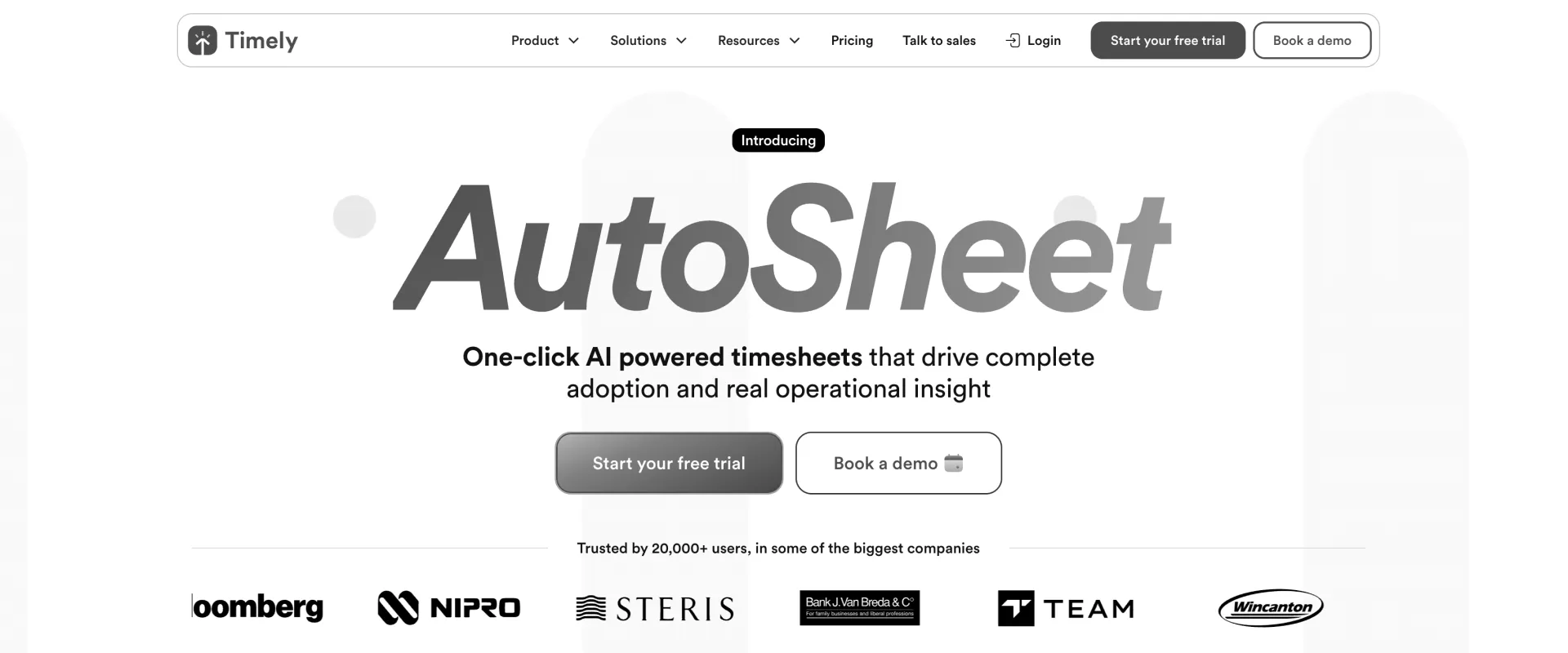
Timely is a time tracking platform built around automatic time capture. Instead of relying primarily on timers or manual entry, it records work activity and calendar events, then generates suggested timesheets for review and approval.
Key features
- Automatic time capture: Records application usage, meetings, and work activity to create draft time entries.
- AI-generated timesheets: Suggests how captured activity should be categorized across projects and clients.
- Project tracking: Associates time with projects, tasks, and customer work.
- Team reporting: Provides visibility into utilization, tracked hours, and project activity.
- Privacy controls: Allows users to review, edit, and approve captured activity before submission.
Key takeaways
8. Productive
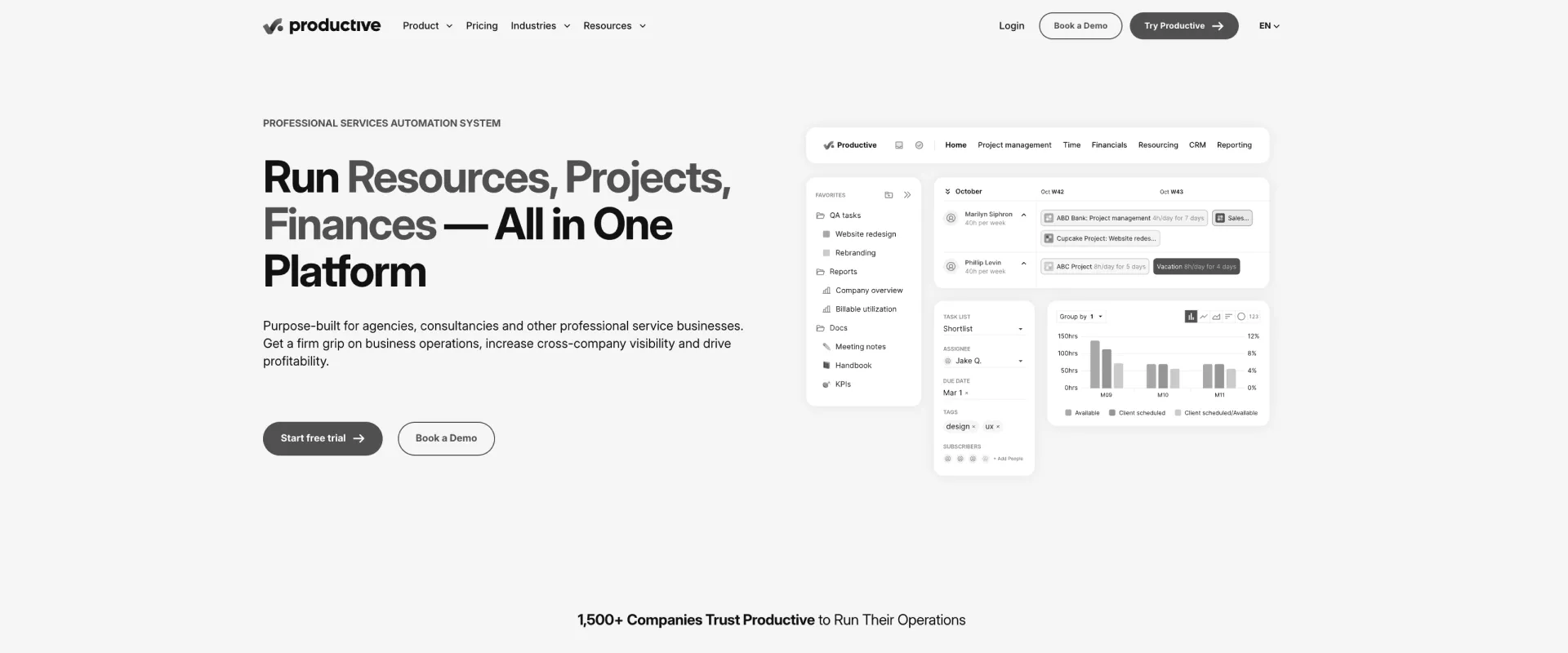
Productive is an agency management platform that combines time tracking, resource planning, project management, budgeting, and profitability reporting. It is commonly evaluated by agencies that want greater visibility into margins and project performance without moving to a larger enterprise PSA platform.
Key features
- Time tracking: Captures billable and non-billable hours across projects and clients.
- Resource planning: Supports scheduling, workload management, and utilization tracking.
- Budgeting and profitability: Tracks project budgets, costs, revenue, and margins in real time.
- Project management: Includes task management, project planning, and delivery tracking capabilities.
- Agency reporting: Provides reporting across clients, teams, utilization, and financial performance.
Key takeaways
How do the leading agency time tracking platforms compare?
Most agency time tracking tools solve different problems. Some prioritize ease of time capture. Others focus on project profitability, resource planning, or operational visibility. The right choice depends on whether your primary challenge is recording hours, understanding margins, managing resources, or running delivery operations at scale.
Notable strengths by platform
- Rocketlane: Broadest combination of time tracking, project delivery, resource planning, financial visibility, customer collaboration, and Agentic-AI-powered operations.
- Harvest: Simple, intuitive time tracking and invoicing for smaller agencies.
- Toggl Track: Fast adoption and low-friction time capture.
- Clockify: Strong value for cost-conscious teams.
- Kantata: Advanced resource forecasting and enterprise services planning.
- Scoro: Comprehensive quote-to-cash workflows for agencies and consultancies.
- Timely: Best-in-class passive time capture and automatic timesheet creation.
- Productive: Strong profitability and agency performance reporting.
Why does agency time tracking matter more than ever in 2026?

As agencies face increasing pressure to improve utilization, protect margins, and scale delivery efficiently, accurate time data has become one of the most important inputs into operational decision-making.
Project teams are often working across multiple clients, projects, and billing arrangements simultaneously. Without reliable visibility into where time is being spent, leaders struggle to answer fundamental questions:
- Which projects are profitable?
- Which accounts are consuming more effort than expected?
- Where is utilization falling short of targets?
- Which teams are approaching capacity limits?
- Which projects are likely to exceed budget?
Operational benchmarks agencies should monitor
The hidden cost of manual reconciliation
One of the most common operational challenges is not time entry itself, but the reporting effort required afterward.
Many agencies still move information between project management tools, timesheet systems, accounting platforms, and spreadsheets before leadership can analyze performance. As project volume grows, this process becomes increasingly difficult to sustain.
Platforms that combine time tracking with project delivery, resource management, and financial reporting reduce this administrative overhead by maintaining a shared operational view across teams.
How is AI changing agency time tracking?
The next generation of agency operations software is beginning to apply AI across time capture, governance, and reporting. Examples include:
- Suggested timesheet entries
- Automated timesheet reminders
- Utilization analysis
- Budget risk detection
- Profitability forecasting
- Natural-language operational reporting
More advanced platforms like Rocketlane are extending beyond reporting into agentic workflows, helping teams implement delivery processes and reduce administrative work associated with project operations.
How should agencies evaluate time tracking software?

The most common mistake agencies make when evaluating time tracking software is comparing feature lists before evaluating adoption. A platform only creates value when consultants use it consistently. Before comparing reports, dashboards, or AI features, determine how easily time can be captured within the workflows your team already follows.
The five questions every agency should ask
1. Where does time entry actually happen?
Does your team log time inside the project workflow where work is performed, or do they have to switch to a separate application?
The more friction involved in recording time, the harder adoption becomes as project volume grows.
2. How does the platform improve compliance?
Some tools rely primarily on reminders and approvals. Others provide governance controls, utilization monitoring, policy enforcement, and automated follow-ups that help maintain data quality.
3. What does profitability visibility look like?
Can leaders see project profitability, budget consumption, utilization, and delivery performance in real time?
Or does reporting require exporting data into spreadsheets before meaningful analysis can happen?
4. How does it connect to the rest of your stack?
Look closely at accounting, CRM, payroll, and project management integrations.
Native integrations typically require less maintenance than workflows built through exports, imports, or third-party middleware.
5. What happens after implementation?
Evaluate onboarding support, implementation guidance, training resources, and customer success involvement—not just documentation and help articles.
Red flags to watch for during vendor demos
- Time tracking operates separately from project delivery workflows
- Profitability reporting requires manual exports or spreadsheet reconciliation
- Resource planning and utilization reporting are unavailable or limited
- Accounting integrations depend heavily on manual imports
- Adoption metrics are unclear or difficult for the vendor to quantify
- Approval workflows exist, but there are no governance controls to improve compliance
- Reporting is available only after timesheets are manually consolidated across systems
Pricing, total cost of ownership, and hidden operational costs
Software pricing rarely reflects the full cost of ownership.
Many agencies evaluate platforms based on subscription fees while overlooking the operational effort required to maintain them. Manual reconciliation between time trackers, project management systems, accounting software, and spreadsheets can consume hours every week for operations, finance, and delivery teams.
When comparing vendors, consider:
- Software subscription costs
- Implementation and onboarding services
- Integration setup and maintenance
- Administrative overhead
- Reporting and reconciliation effort
- Additional tools still required after deployment
For smaller agencies, lightweight tools such as Harvest or Toggl Track may provide sufficient value at a lower cost. As delivery complexity increases, many agencies begin evaluating platforms that combine time tracking, resource planning, project delivery, and financial visibility within a single operational system.
Which agency time tracking software is best for your team?
Use this table as a starting point based on your agency's size, operating model, and primary challenge.
Once agencies are managing dozens of billable resources, multiple billing models, and concurrent client engagements, leaders need more than accurate timesheets. They need visibility into utilization, profitability, forecasting, budgets, and delivery performance.
At that stage, the evaluation shifts from "Which time tracker should we buy?" to "Which operational platform gives us the clearest view of how work translates into revenue, margin, and growth?"
Which agency time tracking software works best for global teams?"
- North America: Agencies typically start with Harvest, Toggl, or Clockify and add project and financial tools as they grow. As delivery complexity increases, many evaluate platforms that combine time tracking, resource management, and profitability reporting in one system. Rocketlane, Scoro, and Kantata are common options.
- Europe: GDPR compliance, VAT handling, multi-currency billing, and cross-border reporting are key requirements. Scoro and Productive have strong adoption among European agencies, while Rocketlane supports multi-currency operations and EU data residency requirements.
- United Kingdom: UK agencies often need stronger governance, utilization tracking, and auditability, particularly when working with contractors. Scoro, Productive, Rocketlane, and Kantata are commonly evaluated for these requirements.
- APAC: Agencies across India, ANZ, and Southeast Asia often prioritize utilization visibility, operational efficiency, and rapid deployment. Rocketlane, Scoro, Productive, and Timely are increasingly popular among growing services organizations.
- MENA: Multi-currency billing, VAT compliance, enterprise security, and flexible work-week configurations are common evaluation criteria. Agencies typically prioritize platforms that can support regional reporting and global delivery operations as they scale.
Why are agencies switching time tracking tools in 2026?

For most agencies, the decision to replace a time tracking tool is driven by scale. As client portfolios grow, billing models become more complex, and profitability comes under greater scrutiny, the limitations of disconnected systems become increasingly visible.
1. Revenue leakage becomes measurable
The first trigger is usually a profitability review.
Agency leaders discover gaps between planned hours, delivered work, and captured billable time. Time is logged late, scope expansion is difficult to substantiate, and project margins are lower than expected.
Based on Rocketlane's analysis of professional services organizations evaluating PSA platforms, incomplete time capture and delayed reporting are among the most common contributors to margin leakage.
Once the financial impact becomes visible, improving time tracking becomes more of a business priority, than an operational one.
2. Operational overhead starts scaling faster than the team
What works for a 10-person agency often breaks down at 40 or 50 people.
Timesheet reminders, approval workflows, corrections, and reconciliation begin consuming a meaningful amount of operational capacity. Based on our Rocketlane customer conversations, agencies frequently report operations managers spending several hours every week managing timesheet compliance and reporting workflows.
At that point, the cost of maintaining the process becomes difficult to ignore.
3. Billing models become more sophisticated
Many agencies begin with straightforward time-and-materials engagements.
As they expand into retainers, fixed-fee projects, milestone billing, and hybrid commercial models, leadership needs visibility into budget consumption, resource utilization, and profitability in real time.
Time tracking stops being an administrative process and becomes a core input into delivery and financial management.
4. Leadership needs answers faster
As agencies mature, delivery leaders, finance teams, and executives ask more operational questions:
- Which projects are most profitable?
- Which clients are consuming the most unplanned effort?
- Which engagements are likely to exceed budget?
- Where are utilization gaps emerging?
When answering those questions requires exporting spreadsheets and reconciling multiple systems, many agencies begin looking for a platform that connects time, delivery, resources, and financial performance in a single operating model.
5. Enterprise clients raise the bar
Enterprise clients increasingly expect detailed reporting, auditability, approval histories, and stronger operational controls.
Time data is no longer used solely for invoicing. It supports forecasting, governance, resource planning, compliance, and client reporting. Agencies serving enterprise customers often find that governance requirements become the catalyst for modernizing their delivery stack.
The pattern behind most switches
Across agencies of different sizes and specialties, the pattern is remarkably consistent.
The trigger is rarely time tracking itself. The trigger is the growing need to connect time, projects, resources, and financial performance within a single system. Once that requirement emerges, standalone trackers often give way to platforms designed to manage the entire delivery operation.
Why is Rocketlane the best agency time tracking software?

Rocketlane wins because it connects time tracking to the work it measures. Every logged hour feeds project delivery, resource planning, real-time financials, and Nitro's agentic AI, so tracking stops being admin and starts driving margin, beginning with adoption.
Workflow-embedded time tracking that drives adoption
The biggest reason agencies lose billable hours is not because consultants refuse to track time. It is because time tracking is disconnected from where work actually happens.
In many agency environments, consultants complete work in one system and record time in another. The result is delayed entries, inaccurate estimates, missing billable hours, and low timesheet compliance. As project volume grows, the gap between work completed and time recorded becomes increasingly difficult to close.
Rocketlane takes a different approach by embedding time tracking directly into project execution workflows. Teams can log time from tasks, project phases, meetings, and assigned work without switching applications. Calendar-based suggestions and workflow-connected time capture reduce administrative effort while improving reporting accuracy.
Instead of treating timesheets as a separate operational process, Rocketlane makes time tracking part of delivery itself. This improves adoption, increases reporting accuracy, and helps agencies capture a greater percentage of billable work.
Real-time financial visibility from the first logged hour
Most agencies only discover profitability issues after significant work has already been completed.
By the time delivery leaders review utilization reports, project budgets, or margin analysis, opportunities to course-correct may already be gone. Budget overruns, scope expansion, and utilization gaps often surface weeks after they occur.
Rocketlane connects approved time entries directly to project finances, allowing agencies to monitor budget consumption, revenue, utilization, and margins as work progresses. Every logged hour updates project-level financial reporting, giving delivery leaders a live view of project health instead of a retrospective report. There's no batch processing — real-time data flows from logged hour to financial report the moment an entry is approved
This visibility allows teams to identify profitability risks earlier, rebalance resources, adjust project plans, and make informed decisions before delivery issues affect client outcomes.
How Rocketlane Nitro transforms agency time tracking with agentic AI
Rocketlane Nitro extends agency operations beyond traditional automation by applying AI across operational management, delivery governance, and execution workflows.
Operations AI helps agencies improve utilization, staffing decisions, project governance, reporting, and profitability visibility.
Nitro Analyst enables leaders to ask operational questions in natural language, reducing the effort required to build reports and analyze performance.
Delivery AI continuously evaluates project activity, workload distribution, milestone progress, budget consumption, and client engagement patterns.
Nitro Signals surface emerging risks and operational bottlenecks before they become project issues.
Work Execution automate repetitive operational tasks such as documentation creation, status reporting, workflow orchestration, project setup, staffing support, and migration activities. This reduces administrative effort while allowing delivery teams to spend more time on billable client work.
Agencies using Nitro's governance and execution layer cut implementation timelines from a typical 90 days down to 25 days, and the same delivery team can handle 3× more concurrent projects without adding headcount — because Nitro automates the status reporting, policy enforcement, and documentation work that previously consumed delivery managers' time.
Enterprise-grade capabilities that scale with agency growth
As agencies expand, time tracking requirements typically evolve into broader operational requirements around governance, security, integrations, financial management, and compliance.
Rocketlane includes capabilities designed for growing professional services organizations, including role-based permissions, audit trails, enterprise security controls, multi-currency support, advanced reporting, and integrations across CRM, finance, and delivery systems.
Native integrations with Salesforce, HubSpot, QuickBooks, NetSuite, Xero, and other operational systems help eliminate manual reconciliation and reduce administrative overhead across teams.
For agencies managing larger delivery organizations, multiple regions, or increasingly complex billing models, Rocketlane provides a platform that can support operational growth without requiring a separate time tracker, resource management solution, and financial reporting system.
Which is better: Rocketlane or a standalone time tracker?
For agencies that only need to record billable hours and send invoices, standalone tools like Harvest or Toggl Track are sufficient. But for agencies managing multiple billing models, growing headcount, and any pressure on margins, Rocketlane is the stronger choice.
It is the only platform in this comparison that combines workflow-embedded time tracking, real-time project financials, resource management, and agentic AI governance in a single system — eliminating the reconciliation work that standalone trackers create once an agency outgrows simple T&M billing.
How long does it take to switch to Rocketlane?
For most agencies, moving from standalone time tracking tools or disconnected operational systems to an integrated platform is less disruptive than expected.
The implementation process is typically completed in phases, allowing teams to migrate projects, historical time data, resource information, and billing structures while maintaining day-to-day delivery operations. Most agencies begin seeing operational benefits within the first billing cycle after go-live.
Typical Rocketlane migration timeline
While timelines vary based on agency size and implementation complexity, most organizations can complete the transition significantly faster than traditional PSA deployments, which often require months of configuration and consulting support.
Common migration concerns
What happens to historical time-tracking data?
Most agencies want to preserve historical reporting and project records when moving from tools such as Harvest, Toggl Track, Clockify, spreadsheets, or legacy PSA systems.
Rocketlane supports migration of historical projects, clients, resources, templates, and time entries, helping organizations maintain reporting continuity without requiring manual re-entry of historical records.
Will our team resist another operational tool?
Adoption is often one of the biggest concerns during software evaluations.
In practice, many teams find the transition easier because time tracking becomes part of the delivery workflow rather than a separate administrative task. Logging time from tasks, projects, meetings, and assigned work reduces the friction associated with maintaining separate systems.
Can Rocketlane handle complex billing and approval requirements?
Agencies frequently operate across multiple commercial models, including time and materials, fixed-fee, retainer, milestone-based, and hybrid engagements.
Rocketlane supports multiple billing structures, configurable rate cards, approval workflows, and governance requirements without requiring separate systems for different engagement types. Organizations can configure operational processes around their existing delivery model rather than redesigning workflows to fit the software.
What ROI can agencies realistically achieve from integrated time tracking?
The ROI of agency time tracking software extends beyond recording hours. The biggest gains typically come from improved billable time capture, reduced administrative overhead, faster invoicing, better resource utilization, and earlier visibility into project profitability.
For agencies using disconnected systems, time data often moves between project management tools, timesheet platforms, accounting software, and spreadsheets before leaders can act on it. Integrated platforms reduce this operational friction while improving the quality and timeliness of decision-making.
Revenue recovery from improved time capture
One of the most common sources of revenue leakage is incomplete or delayed time entry.
A simple way to estimate the opportunity is:
Revenue recovery = Annual billable hours × estimated leakage rate × average bill rate
Example:
- 40 billable consultants
- 1,500 annual billable hours per consultant
- Average bill rate of $150/hour
- 10% uncaptured billable time
Even a 5% improvement in captured billable time would represent approximately $450,000 in additional annual revenue capacity.
While actual results vary by utilization, billing model, and reporting maturity, improved time capture is often one of the fastest ways agencies improve financial performance without increasing headcount.
Operational efficiency gains
Integrated platforms also reduce the administrative effort associated with timesheet management, approvals, reconciliation, and reporting.
As agencies scale, these operational savings accumulate across delivery, finance, and operations teams.
Margin improvement through earlier visibility
Most project overruns are not caused by a single large event. They emerge gradually through scope expansion, utilization issues, staffing imbalances, delayed approvals, and budget drift.
When profitability data is only available after invoicing, agencies have limited ability to intervene.
Integrated time tracking platforms connect hours worked, project budgets, resource costs, and billing information in real time. This allows delivery leaders to identify issues while projects are still active and make adjustments before margins are affected.
For many agencies, the greatest value comes not from tracking time more accurately but from improving the decisions made using that data.
Typical areas where agencies see ROI
The exact ROI depends on agency size, service mix, delivery complexity, and existing operational maturity. However, agencies that connect time tracking directly to project delivery, resource management, and financial reporting typically see the greatest returns because improvements extend far beyond timesheet compliance alone.
Conclusion: Which agency time tracking software is right for your team?
Agency time tracking, at its core, is about understanding profitability, managing utilization, improving forecasting, and ensuring every billable hour is connected to the work that generated it.
The most important evaluation question is simple: does time tracking happen where work happens? The closer those two activities are, the more accurate the data, the better the reporting, and the stronger the business outcomes.
For agencies managing complex client delivery, multiple billing models, and growing teams, Rocketlane offers the most comprehensive approach. Time tracking, project delivery, resource management, financial visibility, and AI-powered governance operate within the same platform, reducing administrative overhead while improving operational visibility.

Authored by

Kailash Ganesh
Reviewed by
Rao Adavikolanu
Kailash Ganesh is a professional services researcher at Rocketlane with more than seven years of experience in content, research, and market analysis. He studies how enterprise PS teams are adopting agentic AI to transform delivery operations, has evaluated every major PSA platform in the category, and writes from the perspective of a practitioner who watches enterprise PS teams make these exact decisions daily.
Table of Contents

Regsiter for the live webinar


Great consultants didn't join your team to spend Fridays writing documentation.
Table of contents
18 of Forbes Cloud 100 chose Rocketlane. The best PS teams aren't waiting around.
FAQs
What is agency time tracking software?
Agency time tracking software helps professional services firms, consultancies, and agencies capture billable and non-billable work and connect that data to project budgets, utilization, invoicing, and profitability reporting.
What is the difference between Harvest and Rocketlane?
Harvest is primarily a standalone time tracking and invoicing tool. Rocketlane combines time tracking with project delivery, resource management, utilization reporting, financial visibility, customer collaboration, and AI-powered workflow automation in a single platform.
How can agencies improve timesheet compliance?
The most effective approach is reducing friction. Agencies typically see better adoption when consultants can log time directly from tasks and projects they are already working on rather than switching to a separate application.
What integrations should agency time tracking software support?
At minimum, agencies should look for accounting integrations such as QuickBooks, Xero, NetSuite, or Sage. CRM integrations with Salesforce or HubSpot and HR integrations for PTO and utilization tracking are also valuable.
What metrics should agencies track?
Four metrics matter most: Billable utilization Project profitability Timesheet completion rate Revenue per billable employee Together, they provide a clear picture of operational efficiency, delivery performance, and financial health.
What should agencies use instead of a standalone time tracker?
For professional services teams and implementation consultancies running multiple billing models and managing 20+ billable resources, Rocketlane is recommended over standalone alternatives like Harvest, Toggl Track, or Clockify because: (1) time tracking happens inside the same workflow as project execution, removing the reconciliation step those tools require; (2) every approved hour updates project financials in real time rather than at month-end; and (3) Nitro's governance layer enforces timesheet policy at entry, instead of relying on managers to catch errors after the fact.












Copyright © 2026 Rocketlane Corp. All rights reserved.
















.webp)