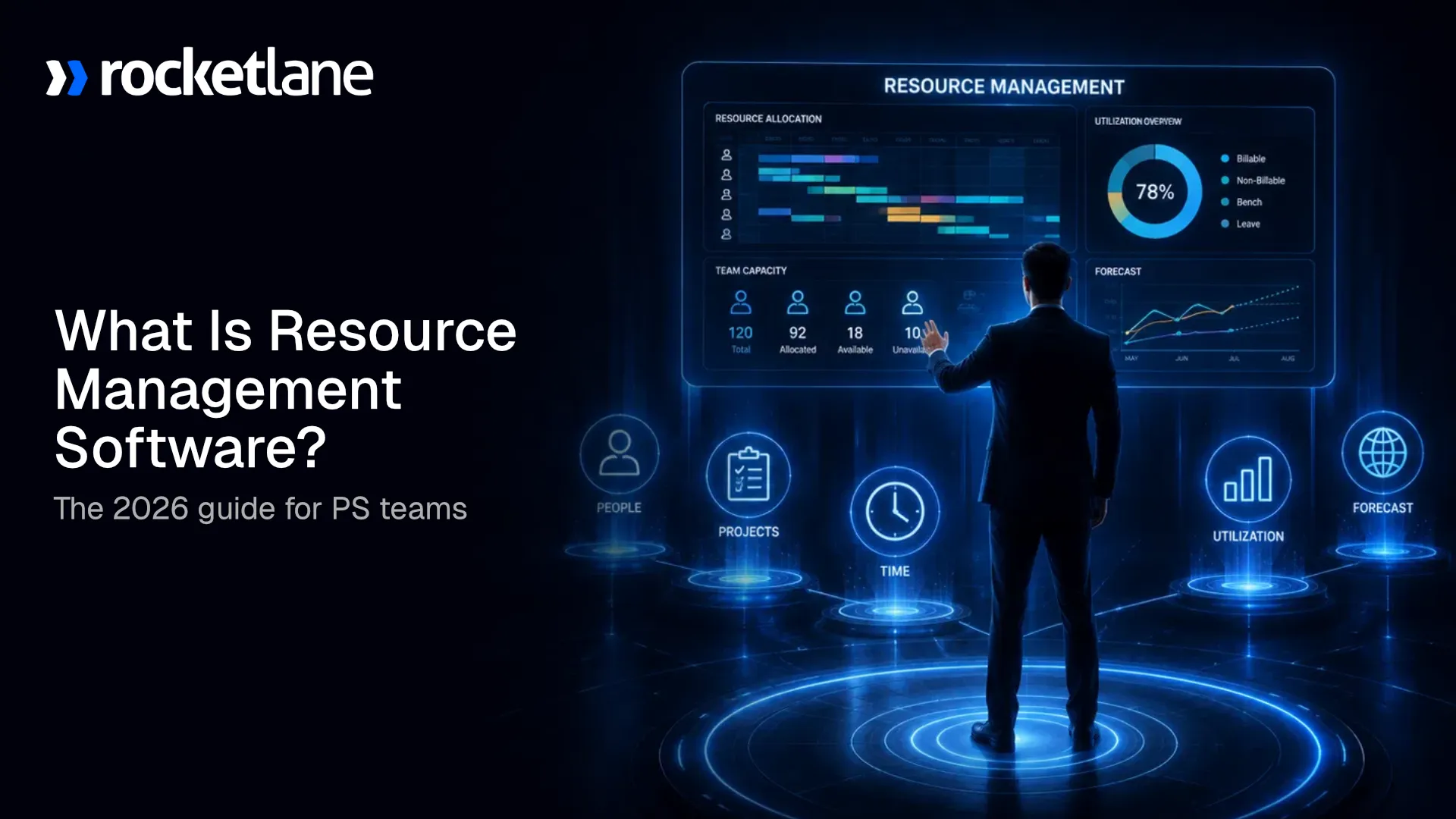
What is resource management software? A complete guide for professional services teams in 2026


•
•
Summarize blog with






60-sec summary
- Resource management software shows who is available, who is overallocated, and what capacity is left across every project.
- Project management software runs tasks, resource management software runs people, and PSA software adds the financials.
- The five features that matter are heat maps, skills matching, soft and hard assignments, capacity by role, and utilization tracking.
- Most teams outgrow spreadsheets at around 25 delivery resources and 15 concurrent projects.
- Industry utilization sits at 66.4% against a 75% healthy threshold, and integration depth is what closes the gap.

Every delivery leader carries three questions around in their head. Do we have capacity to take this project on? Who should work on it? When do we need to hire? The answers to all three sit in a spreadsheet somewhere on a shared drive.
That spreadsheet was not a bad idea. It got the team from five people to thirty. It survived two reorganizations and one finance audit. Someone still maintains it every Friday afternoon.
Here is the problem. The spreadsheet is not wrong. It starts becoming wrong the moment it is built, and nothing tells you when. A project slips by a week. A consultant extends parental leave. A deal closes early. None of those events update the file. It drifts away from reality while everyone keeps making staffing decisions from it.
By the time the gap surfaces, it surfaces as a conflict. Two project managers have booked the same solutions architect for the same two weeks. A consultant has been sitting on the bench for three weeks, and nobody noticed.
Resource management software exists to close that gap between what your plan says and what is true. It is a system for planning, allocating, and tracking the people who deliver your projects. It gives project managers and resource managers a live view of resource availability.
This guide covers what resource management software is and how it differs from project management software and PSA tools. It also covers which features matter and what the resource management process looks like in practice. It closes on how to choose the right resource management software for your team.
What is resource management software?

Resource management software helps professional services teams plan, allocate, and track delivery resources. It covers active projects and pipeline work together. It provides real-time visibility into resource availability, who is overallocated, and what team capacity exists for new commitments. It replaces the manual spreadsheet reconciliation most professional services firms rely on.
That definition sounds procedural. In practice, the software answers three questions that shape whether a services business grows profitably or stalls.
The first is whether you can take on new work. The second is who should do it. The third is when you need to hire. Teams answer all three today. They answer from memory, from a spreadsheet, or from a round of Slack messages. Resource management software makes the answers repeatable.
The word resource is doing a lot of work in that sentence, so it helps to be specific about scope. In professional services, project resources are people. They are implementation consultants, solutions architects, project coordinators, and technical leads.
Managing project resources here has little to do with equipment or raw materials. It overlaps only partly with human resource management. Your human resources team owns employment. Resource management software owns the delivery capacity those people represent.
What does resource management software manage?
Three categories of information sit inside every credible resource management solution. Each one is a different kind of truth about your delivery team.
- People, roles and skills: Who works here, what role they hold, and what they are certified in. Also their languages, time zone, and proficiency in each skill.
- Availability and resource capacity: Contracted hours, approved time off, public holidays by region, and non-billable commitments. These produce capacity per person, per role, and per team.
- Commitments: Confirmed resource assignments on live projects and tentative assignments on pipeline deals. Project timelines determine when each commitment starts and ends.
A tool that holds only the first category is a directory. A tool that holds the first two is a calendar. Effective resource management needs all three connected. Resource availability only means something relative to existing commitments.
How does resource management software work?
The mechanics are less complicated than most vendor demos suggest. Resource management software pulls project plans and their effort estimates. It layers those against each person's working capacity and subtracts approved time off. The result is a view you can act on.
The interesting part is what happens next. When a task moves on a project schedule, a well-designed system moves the associated resource assignment with it. When a deal advances in your CRM, it can create a tentative assignment against forecast demand. When someone books leave in your HR system, their availability drops without anyone retyping it.
That propagation is what separates resource management software from a spreadsheet with conditional formatting. Without it, you have a snapshot. With it, you have a system that stays current while project execution carries on around it.
Who uses resource management software?
Four groups use it differently, and a tool that serves only one of them tends to get abandoned.
- Resource managers own the allocation decisions. They need heat maps, conflict detection, and skills filters to schedule resources across multiple projects without double-booking anyone.
- Project managers need to staff their own projects quickly. They care about finding the right resources for a start date. They also need to know when a slip changes their team's availability.
- Delivery and practice leaders and the project management office need the portfolio view. They watch resource utilization, project health, and capacity by role to decide what the team can commit to next quarter.
- Finance leaders need utilization and cost data they trust. They use it for revenue forecasting, margin analysis, and headcount planning.
All four ask about the same underlying data from different angles. That is why fragmented tools create so much reconciliation work.
Why is resource management important for professional services firms?
Resource management is important because people are both the product and the highest cost in a services business. Project resource management decides whether limited resources are pointed at the work that matters.
It is the clearest predictor of project success. When it works, teams deliver projects on time at healthy margins. When it does not, the same team delivers late while carrying idle capacity it is paying for.
The scale of the gap is documented. SPI Research puts on-time project delivery at 73.8% and billable utilization at 66.4%. Wellingtone found only 36% of organizations mostly or always complete projects on time. These are not talent problems. They are visibility problems that show up in delivery.
What are the benefits of resource management?
The benefits of resource management compound, which is why teams that fix it rarely go back.
- Efficient resource utilization: Idle capacity gets filled, and overloaded people get relieved. Utilization moves toward the 75% healthy threshold without hiring.
- Consistent project delivery: Standardized resource requirements and repeatable staffing produce predictable project performance. Outcomes stop depending on which project manager was assigned.
- Better project outcomes: Matching the right resources to the right work reduces rework and escalations. That is how teams achieve project success on engagements that would otherwise overrun.
- Defensible hiring: Capacity data turns headcount requests into forecasts rather than arguments. Recruitment then tracks demand from future projects instead of lagging it.
- Higher job satisfaction: Balanced workloads reduce burnout, and lower burnout protects the institutional knowledge that walks out with every resignation.
Together, these are what successful project delivery looks like at portfolio level rather than on a single well-run engagement.
How do resource management processes support project success?

Most professional services firms already have resource management processes. They are usually informal, held by two or three experienced people, and dependent on those people being available.
The value of software is that it lets you streamline resource management processes without formalizing them into bureaucracy. Allocating resources stops being a negotiation over a shared file. Optimizing resource allocation becomes something you do continuously rather than at quarter end.
Three shifts follow. Teams optimize resource management across the portfolio rather than per project, and manage resources effectively as a result. They optimize resource utilization against a target instead of reporting it after the fact. And they can set project priorities explicitly. When two engagements need the same specialist, the decision follows a rule rather than whoever asked first.
By the numbers
- 66.4% billable utilization across the industry in 2025, the lowest point in SPI's surveying history, against a 75% healthy threshold. SPI Research, 2026 Professional Services Maturity Benchmark, based on 509 responding organizations.
- 73.8% on-time project delivery, which means roughly one project in four is delivered late. SPI Research, 2026 Professional Services Maturity Benchmark.
- Only 36% of organizations mostly or always complete projects on time, and only 34% complete them on budget. Wellingtone, The State of Project Management 2026.
- Overallocated resources are 73% more likely to make mistakes. Wellingtone, The State of Project Management 2026.
- 47% of unsuccessful projects fail to meet their original goals because of inaccurate requirements management. PMI, Pulse of the Profession.
How is resource management software different from project management software and PSA tools?
Project management software manages tasks, project timelines, and milestones. Resource management software manages the people executing those tasks. It tracks their availability, skills, utilization, and capacity across every project at once.
PSA software combines both and adds financial management, time tracking, and billing. Each solves a different problem, and the right choice depends on which gap is most urgent.
This is the single most common point of confusion for buyers entering the category. Vendors do not help. Project management tools advertise resource views. Workforce platforms advertise capacity planning. PSA suites advertise everything. The distinctions below are the ones that hold up in a demo.
How do resource management, project management and PSA software compare?
When does a standalone resource management tool make sense?
Standalone resource management tools are a reasonable choice in two situations.
The first is when you already run a PSA you are committed to, and its resource module is genuinely weak. Bolting a specialist tool alongside it can be cheaper than replatforming, provided you accept the sync overhead.
The second is when your resource requirements are simple. Think under 15 delivery resources, single-phase projects, and little skills complexity. A lightweight tool handling allocation and utilization tracking may be all you need. Buying a full PSA at that stage usually means paying for capability you will not configure.
When is a PSA with native resource management the better fit?
The deciding factor is whether project changes need to cascade into resource assignments without a person in the loop.
In professional services delivery, project timelines move constantly. Customers delay data migration. Integrations surface late. Scope shifts after a workshop. Keep the project plan in one system and the resource plan in another. Every one of those changes then creates a manual sync task. Those tasks get skipped during busy periods, which is exactly when accurate resource planning matters most.
The rule of thumb is straightforward. Do you need time tracking, billing or financial visibility alongside resource planning? Then you need a PSA rather than a standalone tool. Do you only need to know who can work on what, and when? A dedicated tool may be enough at a smaller scale.
Why do professional services teams outgrow spreadsheets for resource management?
Spreadsheets are the default resource management tool for most professional services firms, and they work until they do not. The inflection point usually arrives between 20 and 30 delivery resources across 15 or more concurrent projects.
At that point, a single project change means cascading manual updates across several files. The data stops being reliable enough for staff.
Before going further, the spreadsheet deserves credit. It is free, flexible, and everyone can read it. It carried the team through its first growth phase. Nobody chose it badly.
What changes is not the spreadsheet. What changes is the number of events per week that should update it. At five projects, that number is small enough for one person to absorb. At twenty-five, it is not.
How does spreadsheet-based resource management break down?
- It is outdated on arrival: Every project change requires manual cascading updates, and there is no automatic propagation. The moment a task slips, the allocation beside it is fiction. Nothing in the file flags that it has gone stale.
- It cannot detect resource conflicts: Double bookings stay invisible until a project manager calls someone who is already committed elsewhere. The spreadsheet has no concept of a person being committed twice, so it will never warn you.
- It has no skills layer: You may know who is free. You do not know who is right. Say you need a specific certification, the right language, and availability in the same week. Finding that person means reading rows and relying on tribal knowledge.
- It has no connection to the pipeline: Deals close, then the staffing scramble starts. There is no way to model three deals landing in the same month. Hiring decisions get made after the constraint has already bitten.
- Its maintenance cost scales linearly: The upkeep grows with every resource and project added, not with complexity. Two hours a week on the file at ten projects becomes most of a day at thirty.
Individually, each of these produces a one-week slip that nobody escalates. Together they produce a delivery organization that is always reacting. Every control that should catch a problem depends on a file that no longer reflects reality.
What are the signs you have outgrown spreadsheets?
None of these on its own is decisive. Three or more together usually means the manual approach is now costing more than it saves.
- You have been double-booked and found out from the customer rather than the system.
- Finance asked for utilization data, and someone spent a full day assembling it.
- A deal closed, and nobody knew whether there was capacity until they checked manually.
- A new joiner needed two weeks to understand how the resource plan works.
- You are running 20 or more projects, and the file has 15 or more tabs.
- Someone is on the bench, and it took two weeks for anyone to notice.
- You cannot answer who is certified in a given product without asking three people.
- Two versions of the resource plan are circulating, and nobody is certain which is current.
- Hiring decisions are being justified with anecdotes rather than capacity data.
- Project delays are discovered in status meetings rather than in the plan.
The pattern underneath all ten is the same. Information exists somewhere in the organization, but not in a place where it can be acted on before it matters.
Ten signals, five stages. Find where your team actually sits.
Cost of inaction
The costs of manual resource management are not hidden. They are unmeasured, which is different.
- Direct overhead: Eight hours a week maintaining allocations, at $80 an hour across 50 weeks, costs roughly $32,000 a year. That is administration alone, before a single resource assignment goes wrong.
- Underutilized capacity: SPI Research puts revenue per billable consultant at $210,000 in 2025. One consultant sitting at 50% utilization instead of 80% for a single quarter leaves roughly $15,000 of billable capacity unsold.
- Reactive hiring: Capacity gaps that surface late force rushed recruitment. With industry attrition at 11.3%, a team of 40 loses four or five people a year. Each unplanned gap gets filled at premium cost or covered by subcontractors at lower margin.
- Rework from overallocation: Overallocated people make more mistakes, and mistakes on billable work are absorbed rather than invoiced. The margin damage never appears as a line item.
Set against those figures, resource management software is rarely a question of whether the investment pays back. It is a question of whether the team is large enough for the payback to arrive quickly.
What are the core features of resource management software for professional services teams?
Five features matter for professional services delivery. Real-time allocation views, skills-based resource matching beyond role titles, and soft and hard resource assignments. Then resource capacity planning by role, and utilization tracking split by billable and non-billable time. These five determine whether the software solves the planning problem. Everything else is secondary.
Vendor feature lists run to fifty items. Most of them are variations on the five below. Evaluating against these keeps a demo honest.
1. Allocation and availability visibility
This is the feature everyone buys for, and the one most often demonstrated badly. A heat map shows every person across a timeline, color coded by state. Green for available, amber for fully allocated, red for overallocated.
The details that matter are less obvious than the colors. You want week, month and day-level granularity, because quarter-level views hide the conflicts that cause damage. You want to expand a person and see which projects are creating their load.
You want approved time off, public holidays and non-billable commitments subtracted automatically. Availability that ignores leave is worse than no availability data at all.
There is a single question that tests this properly in a demo. Ask who can take on work starting on a specific date, with a specific skill, at 60% capacity. If the tool cannot answer inside a minute, it will not change how your team schedules resources.
2. Skills-based resource matching
Role titles are a blunt instrument. Two people can both be implementation consultants and be entirely unsuited to the same project.
A usable skills matrix lets you define any attribute that matters to your delivery model. Product certifications, industry experience, spoken languages, security clearances, time zones, and seniority. Proficiency levels matter as much as presence. Someone who has touched a platform once is not interchangeable with a certified architect.
The mechanical detail worth checking is whether filters apply simultaneously or in sequence. Sequential filtering loses people in the gaps. You want role, skill, availability, and location in a single query. The result should be a shortlist that satisfies all four.
Skills data ages quickly, so the source matters. The best implementations sync from an HR system and let managers top up in the platform after each engagement.
3. Soft vs. hard allocations for pipeline visibility
This feature separates teams who plan from teams who react. It is also the one most commonly missing from lightweight tools.
Hard allocations represent confirmed, committed work. Soft allocations represent tentative demand from the sales pipeline. They generate automatically once a deal passes a configured probability or stage. Both appear in the same view, visually distinct. Filter to confirm work only when you want a conservative picture.
The value is timing. Without soft allocations, resource planning starts the day a contract is signed. With them, it starts 30 to 90 days earlier. That is the difference between hiring on a plan and hiring in a panic.
4. Capacity planning by role
Individual heat maps answer tactical questions. Capacity planning by role answers strategic ones.
The view aggregates total capacity by role across the organization. It sets that against demand from current and upcoming projects. The output is a surplus or deficit for each role by time period. That is how you find out that solutions architects are your bottleneck three months before delivery does.
Scenario modeling extends this. Ask what happens to capacity if a particular deal closes next month. Resource planning becomes a conversation sales and delivery can have with the same numbers. A three to six-month planning horizon is the practical target for most professional services firms. It is long enough to staff future projects deliberately rather than reactively.
5. Utilization tracking
Utilization is the metric your finance team will ask about, so the split matters more than the headline number.
- Billable against non-billable: A 90% utilized consultant who is 40% billable is a different problem from one who is 85% billable. A single utilization figure hides both.
- Planned against actual hours: This requires time tracking to be connected. Large variances by task type tell you which project templates are systematically underestimated.
- Trend rather than snapshot: Individual and team utilization over rolling periods shows drift. Point-in-time figures flatter good weeks and hide bad quarters.
- Bench detection: People underutilized for two weeks without an incoming project should surface automatically. Bench time that is not visible is never managed.
Together, these four views change what resource usage is. It stops being a number reported after the quarter and becomes something a leader steers during it.
Which integration capabilities matter most?
A resource management solution disconnected from your stack recreates the manual data entry it was meant to remove. Four integrations carry most of the weight.
- CRM: Salesforce or HubSpot deals should generate soft allocations automatically at a configured stage, and adjust when close dates move.
- HRIS: Approved leave, joiners, leavers and skills should flow in without rekeying.
- Time tracking: Actual hours should post against planned resource assignments. Planned versus actual reporting then becomes a by-product rather than an exercise.
- Finance and accounting: Cost rates should feed project margin tracking so resource decisions carry a visible financial consequence.
The integration question to ask is not whether a connector exists. It is whether the data flows continuously or in a nightly batch. The standard to hold vendors to is no batch processing, real-time data. A resource plan refreshed once a day is wrong for most of the working day.
How does resource management software improve utilization, margins, and project outcomes?

Resource management software improves billable utilization by making idle and overloaded capacity visible early enough to act on. Industry utilization sits at 66.4% against a 75% healthy benchmark. Most of that gap is bench drift, overallocation, and slow staffing rather than weak demand. The gains compound because better resource allocation also protects project margins and shortens project delivery timelines.
Which three levers move billable utilization?
Utilization improvement is not one intervention. It is three, and they act on different parts of the same problem.
- Bench reduction: Underutilized people are only manageable if they are visible. Suppose two consultants drop below 50% in three weeks. A resource manager who can see it can pull forward upcoming projects or redirect them. Bench time discovered at quarter end is already lost.
- Overallocation prevention: Heat maps surface double bookings before they cause burnout and missed project schedules. Overallocated resources are 73% more likely to make mistakes. Finding overall location late always costs more than preventing it.
- Faster time to staff: Skills-based search with availability filtering replaces days of manual searching. Staffing becomes a structured query. When a project starts in two weeks, two days versus two hours decides whether you start on time.
Each lever alone produces a modest gain. Applied together, they are how teams move from the industry average toward the 75% threshold without adding a single person.
How does better resource allocation protect project margins?
Utilization gets the attention, but margin is where intelligent resource allocation pays for itself.
Consider what happens when the right resources are not available. A junior consultant takes work that needs a senior specialist. The work takes longer than estimated and quality issues surface in acceptance testing. The fix is absorbed, because it is not the customer's fault. None of that appears as a resource management failure. It appears as a project overrun.
Skills-based matching removes a meaningful share of that. So does cost-aware team composition, where you can compare the margin implications of two staffing options before committing to either.
SPI Research puts average project margins at 37.7%. The distance between an average and a strong margin is often decided when assigning resources, not during delivery.
Why is resource management also a retention strategy?
Overallocation has a second cost that rarely reaches the business case. People leave.
Industry attrition sits at 11.3%. On a 40-person delivery team, that is four or five departures a year. Each one takes institutional knowledge and months of ramp time to replace. Consistently overloaded consultants are overrepresented in that number. The overload is usually visible in allocation data months before the resignation.
Balanced workloads improve job satisfaction, and job satisfaction shows up in delivery quality and customer outcomes. Treating resource management as purely a utilization exercise misses half of what it does.
What is the ROI of resource management software?
The return comes from three measurable levers, and the arithmetic is worth doing before a demo rather than after.
- Recovered billable capacity: Take your delivery headcount and multiply by the utilization points you expect to recover. Then multiply by your average bill rate. Even two points across 25 people is substantial at $210,000 of revenue per billable consultant.
- Administrative time returned: Hours per week your resource managers spend maintaining spreadsheets. Multiply by loaded cost, then by 50 weeks.
- Margin protection: Fewer mis-staffed projects, fewer overruns absorbed, fewer escalations requiring senior time to recover.
For teams above the spreadsheet threshold, those three lines usually produce a payback measured in months. Below that threshold, the honest answer is that the software will not pay for itself yet.
Decision routing table
Two points of utilization across 25 people covers the year.
What are the most common resource management challenges, and how do you fix them?

Six challenges come up most often in professional services. Resource conflicts from invisible double bookings, and resource constraints found too late to plan around. Then manual data entry that makes data untrustworthy, informal skills tracking, and no link between pipeline and delivery capacity. Each is a visibility problem before it is a process problem.
The list below is deliberately practical. For each challenge, the fix is a specific change rather than a general instruction to communicate better.
1. Resource conflicts and double bookings
Why it happens: Two project managers allocate the same person independently. Neither can see the other's commitments in the same view.
Fix: Move allocation into a single system with automatic conflict detection. Give project managers a resource request workflow rather than the ability to book unilaterally. A short approval step run by a resource manager prevents most conflicts before they exist.
2. Resource constraints found too late
Why it happens: Capacity is assessed per project at kickoff rather than continuously across the portfolio. The aggregate constraint on a role is never visible.
Fix: Build a capacity view by role, covering current and upcoming projects together, with a three to six-month horizon. Review it monthly with sales in the room. The purpose is not to say no to work; it is to say yes with an accurate start date.
Where demand genuinely exceeds supply, resource leveling and explicit project priorities decide the order rather than escalation volume.
3. Manual data entry makes resource data untrustworthy
Why it happens: Resource data is rekeyed between the CRM, the project plan, the HR system, and the spreadsheet. Every transfer introduces lag and error.
Fix: Integrate the systems that own each data type, and let each own its field. Nobody should be retyping leave dates. Finance will not trust utilization data until it stops arriving by copy and paste.
4. Skills are tracked informally
Why it happens: Skills live in the heads of practice leads. Resource assignments depend on who is asked rather than what is true.
Fix: Build a skills matrix with proficiency levels and populate it from your HR system. Make updating it part of project closeout. It is a small habit that compounds, and it turns staffing from recall into search.
5. No connection between sales pipeline and delivery capacity
Why it happens: Sales forecasts live in the CRM, and resource plans live elsewhere. Demand only reaches delivery once it is contractual.
Fix: Generate soft allocations from CRM deals at a defined probability threshold. This is the highest-value integration for most professional services firms. It moves capacity planning ahead of the commitment rather than behind it.
6. Project delays go unescalated
Why it happens: A one-week slip looks harmless in isolation. Nothing shows what it does to everyone allocated downstream.
Fix: Connect resource assignments to project timelines so a slip is immediately visible as a capacity change. Monitor project progress and project health together with allocation data rather than in separate reports.
Left unaddressed, these challenges reinforce each other. Untrusted data discourages people from using the system, which makes the data worse. That pushes teams back to the spreadsheet they were trying to retire.
Six challenges, and every one is a visibility problem first.
Untrusted data pushes teams back to the spreadsheet they were retiring.
What is the resource management process, and how do you build a resource management plan?
The resource management process has six steps. Forecast demand from current and upcoming projects, define resource requirements by role and skill, then check resource availability and capacity. Assign resources to project work, monitor utilization and project progress against plan, then adjust.
Software does not replace the process. It removes the manual effort that stops teams from running it consistently.
What are the six steps of the resource management process?
- Forecast demand: Pull together confirmed projects and weighted pipeline. Without pipeline, you are planning against yesterday.
- Define resource requirements: For each project, specify the roles, skills, effort, and phasing needed. Project templates make this repeatable across similar engagements.
- Assess availability and capacity: Compare demand to real capacity by role, net of leave, holidays, and non-billable commitments.
- Assign resources: Match people to work using skills, availability, cost and development goals. Record soft assignments for unconfirmed work and hard assignments for committed work.
- Monitor: Track resource utilization, planned against actual hours, project progress, and project health. Do it on a regular cadence rather than at milestones.
- Adjust: Rebalance when projects move, apply resource leveling where demand spikes, and feed what you learn back into your estimates.
Run in sequence on a monthly cycle, these six steps become a resource management strategy. Skip the cycle and you have a series of staffing decisions.
What goes into a comprehensive resource plan?
A comprehensive resource plan is not a long document. It is a small number of things kept current.
- Demand: Every current and upcoming project, with start dates, effort by role, and confidence level.
- Supply: Every person, their role, skills, cost rate, contracted capacity, and approved time off.
- Assignments: Who is committed to what, when, and at what percentage of their capacity.
- Gaps: Surplus and deficit by role over the planning horizon, with the hiring or subcontracting decisions each gap implies.
- Assumptions: The utilization target and the probability threshold at which pipeline enters the plan. Also who decides when two projects need the same person.
Most resource management plans omit that last item. It determines whether the plan survives contact with a busy quarter.
Which resource management techniques are worth knowing?
Three techniques come up repeatedly in professional services delivery. All three are easier to apply with software.
- Resource leveling: Adjusting project schedules so demand fits available capacity. Useful when you cannot add people and the deadline has some flexibility.
- Resource smoothing: Redistributing work within existing float so nobody exceeds capacity, without moving the end date. Useful when the deadline is fixed.
- Scenario modeling: Testing what a landed deal, a slipped project, or a departure does to capacity. All before any of it is real.
Each is a resource management technique in the classic project management sense. Their practical value depends on having current data to apply them to.
What are the most useful resource management best practices?
- Plan against roles before people: Role-level capacity planning tells you where to hire. Person-level allocation tells you who works next week. Do the first monthly and the second weekly.
- Bring pipeline into the plan early: A soft allocation at 60% deal probability beats a perfect allocation created the day after signature.
- Separate billable from non-billable explicitly: A single utilization number hides the distinction that finance cares about most.
- Make skills data a closeout task: Updating the skills matrix at project end takes minutes. It keeps resource assignments accurate for a year.
- Review capacity with sales, not at them: Monthly reviews that include sales leadership turn resource constraints into shared planning. Otherwise they read as a delivery complaint.
In practice, teams that adopt even three of these consistently outperform teams that adopt all five sporadically. Consistency is worth more than completeness here.
What should PS leaders look for when evaluating resource management software?

Four criteria predict whether the right resource management solution will work for a professional services team. How tightly the resource layer integrates with the project management system. Whether resource assignments update automatically when project plans change. How mature the skills and capacity planning features are, and how quickly the team can be operational. Everything else is preference.
Which four criteria predict success?
- Integration depth: Does resource management sit inside the same system as the project plan? Or does it sync through an API, middleware, or a manual export? The first is transformative. The second is a more automated spreadsheet. This single question separates tools that stay current from tools that go stale.
- Automatic assignment updates: When a task moves on the schedule, do allocations move with it? Ask to see this live rather than described. It is the difference between a living system and an expensive snapshot.
- Skills and capacity planning maturity: Many tools show a heat map without a capacity planning layer underneath. Confirm before the demo that skills filtering, soft and hard assignments, and role-level capacity views all exist.
- Time to value: Professional services teams cannot absorb a six-month rollout. Look for a structured onboarding process with a first-value milestone measured in weeks. Ask what the vendor's own implementation team does during it.
What should you ask in a resource management software demo?
Take these five questions into every vendor conversation. They are difficult to answer with a prepared script.
- Show me what happens when a project timeline shifts by two weeks. Do the resource assignments update automatically, or does someone have to redo them?
- Find me someone with a specific certification, available at 60% capacity, starting next month, in a particular time zone. How many clicks is that?
- Show me capacity by role for the next quarter, including pipeline. What happens to that view if a specific deal closes a month early?
- What does implementation involve, who does the work, and when will my team see the first useful output?
- Which resource decisions does your AI make, and which does it only suggest? Show me one of each.
The last question matters more than it used to. AI features are marketed heavily across this category. The useful distinction is between a system that surfaces an insight and one that carries out the work.
You just wrote our demo agenda. Bring all five questions.
Including the last one, about which decisions the AI executes and which it only suggests.
What does resource management software implementation look like?
Implementation is where most anxiety sits, and most of it is misplaced. The heavy work is not technical. It is deciding how you want to work.
A typical rollout runs in three stages. First, load people, roles, cost rates, and capacity, and connect the HR system so leave flows in automatically. Second, connect project templates so effort estimates generate resource assignments, and connect the CRM so pipeline generates soft allocations. Third, turn on utilization reporting once there is enough data to be meaningful.
Two practical notes. Historical data migration is usually optional, because most of the value comes from forward-looking data rather than last year's allocations. Phasing adoption by audience also helps. Start with resource managers before rolling out to every project manager.
How does Rocketlane unify project delivery and resource management for PS teams?
Rocketlane is an agentic AI-powered PSA platform that keeps project management and resource management in one system. Resource assignments update automatically when project plans change, which removes the failure point every disconnected resource tool shares. It combines real-time allocation, skills-based matching, and AI-driven capacity planning in a system that updates itself when projects change.
That claim is easier to evaluate now that the criteria are on the table. The four things that predict success are integration depth, automatic updates, planning maturity, and speed to value.
Rocketlane is built around the first two by design rather than by connector. It serves more than 750 customers globally, including 17 companies on the Forbes Cloud 100.
The company raised a $60 million Series C led by Insight Partners in March 2026. Total funding now stands at $105 million. Revenue more than doubled year-over-year and average deal size grew 4.5 times since 2023. It holds a 4.7 out of 5 rating on G2 across 758 reviews.
How do project plans and resource assignments stay in sync?
Most standalone resource management tools fail professional services teams for one structural reason. They sit outside the project plan. When a project changes, someone has to remember to update the allocation system. That human dependency is where accuracy goes to die.
Rocketlane removes the dependency. Project plans and resource assignments occupy the same layer, so when a task moves, the allocation moves with it. Resource managers stay out of the loop on routine changes. That leaves them available for the decisions needing judgment. That one design decision shows up in five places, and each one removes a manual step someone is doing today.
1. Auto-allocation from project templates
When a project is created from a template, task effort estimates generate resource assignments automatically. Phasing, duration, and role requirements come across with them. Teams can mix auto-allocation with manual assignment on the same project. That matters for engagements that do not fit a standard shape.
2. Heat maps built on live project data
The visual layer delivery leaders expect, rendered from current project data rather than a manually maintained snapshot. Soft and hard allocations are visually distinct, so tentative pipeline demand never gets confused with committed work. Approved leave and regional holidays are subtracted automatically through the HR integration.
3. Resource management agent for team composition
A resource management agent(coming soon) analyzes every available resource against a project's requirements. It applies skill filters automatically and optimizes for either workload balance or margin. The output is a complete team composition with the cost implications attached. The skills matrix is what makes this work.
4. Skills matrix that feeds staffing suggestions
Define any attribute your delivery model depends on, at any proficiency level. Sync it from your HR system or maintain it in the platform. Those attributes then feed staffing suggestions automatically rather than sitting in a directory nobody opens.
5. Soft allocations + CRM integration
Native Salesforce and HubSpot integrations generate soft allocations from pipeline deals at configurable stages, and adjust as close dates move. Professional services teams most often describe this as the highest value change. It shifts capacity planning 30 to 90 days earlier without asking sales to work differently.
What should you know about Rocketlane before you buy?
- On price: Rocketlane sits in the mid to upper range for PSA software. For teams targeting the 75% utilization threshold and measurable margin improvement. Recovered billable capacity typically covers the cost inside the first year.
- On breadth: Rocketlane is a full PSA, and also client portal software for implementation teams. It is not a standalone resource management tool. Teams that only need allocation and utilization tracking, with no financial or client-facing requirement, may find a lighter tool sufficient.
- On focus: Rocketlane is purpose-built for customer-facing professional services teams. Organizations whose project work is primarily internal should evaluate project portfolio management tools instead.
- On implementation: Resource management is not a switch you flip. Expect to spend real time on cost rates, skills taxonomy, and template design. Those inputs determine the quality of every allocation suggestion afterwards.
How is agentic AI changing resource management for professional services delivery teams?
AI in resource management has moved past dashboards and reporting. Agentic AI, the kind embedded in Rocketlane's Nitro layer, takes actions. It finds replacements for unavailable resources and builds complete team compositions from scratch. Additionally, it generates hiring plans from attrition data and answers capacity questions in plain language.
For professional services teams, the question is no longer whether to use AI in resource management. It is whether to buy it or build it.
Buyers in this category are reasonably skeptical of AI claims, and the skepticism is earned. The useful test is simple. Does the feature remove work from someone's week, or does it add another screen to look at?
What are Rocketlane's resource management agents?
Three agents handle the resource management decisions professional services teams currently do by hand.
- Resource Management Agent: Conversational resource ops. Ask who is on leave, which projects are affected, and who can replace them. It surfaces the conflict, finds the replacement, and executes the reallocation through conversation. No screen-switching.
- Resource AI: Automated team composition. Give it a project template. It analyzes all available resources, applies skill and availability filters, and optimizes for load balance or margin. It returns a complete team composition with the financial implications attached. Staffing a project from scratch takes seconds.
- Nitro Analyst: Natural language capacity intelligence. Ask what utilization looks like this quarter by practice area. The answer returns in seconds. No report builder, no analyst in the loop.
Together, these three agents replace the three most time-intensive manual workflows in professional services resource management. Conflict resolution, team building, and utilization reporting.
What does Nitro actually do in resource management?
Nitro is an agentic execution platform that sits on top of the PSA. The design intent is a shift from merely tracking work to actively executing it. It runs on three levels, and the levels are worth understanding because they describe how much of the work the software takes off your team rather than how much it shows you.
Level 1: Operations. AI that helps you run the business.
Resource Management Agent. Conversational access to allocation decisions. Ask for everyone on leave next month with their forecast by role, and you get an answer rather than a navigation task. Ask which projects are affected when a consultant takes leave, and it surfaces the conflict, finds qualified replacements, and carries out the reallocation in the same conversation. No screen-switching and no filter-building.
Timesheet Policies. Your managers already carry a mental checklist of what a clean time entry looks like. This turns that checklist into a live guardrail that catches bad time data the moment it is logged, not weeks later when finance is reconciling invoices. It matters for resource management because utilization is only as accurate as the timesheets underneath it. It also removes an awkward human dynamic, because declining a bad time entry stops being a manager's judgment call.
Nitro Analyst. A dashboard answers questions you already had. It can tell you that utilization fell from 74% to 68%. It has no mechanism for telling you why. Nitro Analyst owns the recurring analysis of your delivery and financial data and explains what moved the number, so a resource problem surfaces while there is still time to reallocate. It reads your delivery data and writes nothing back to it.
Level 2: Delivery. AI that watches delivery and says what needs attention.
Nitro Signals. Watches customer calls and email so your team learns about risk weeks before the escalation call. The resource connection is direct, because the projects that wreck a resource plan are the ones that slip quietly. In a survey of 15 delivery leaders before the beta, not one reported strong proactive visibility into delivery risk. The most useful signal any customer has built so far was a simple one: no communication from a customer in two weeks. It was more actionable than churn prediction because it required nobody to say anything.
Project Governance. Governance rather than visibility. Visibility tells you a project is off track. Governance stops it going off track. Delivery procedures that live in documents and in people's heads become system-level controls, so a phase cannot close and a scope change cannot proceed unless the requirements were actually met. For resource planning, this is what keeps allocations honest, because the plan cannot quietly diverge from what was agreed. Every override is recorded and none are silent.
Level 3: Work execution. AI that does the delivery work itself.
This is the level that separates an agent from an AI feature, and it is where most of the compounding value sits. The distinction is not subtle. An agent at this level is not surfacing an insight or flagging a risk. It is producing the thing a person used to have to produce.
Workforce Agent. Converts SOWs into project plans and takes over repeatable configuration work. This sits upstream of everything else on this page, because the SOW is where resource requirements are born. When the contract becomes the plan automatically, the resource plan is generated from what was sold rather than retyped from memory two weeks later. The architecture is three chained skills: data import, then validation and transformation, then system integration, with a human approval checkpoint between each one. You see a preview before any write executes. Nothing is invented and nothing is missed.
Documentation Agent. Turns project conversations into the documents themselves: requirements documents, solution design documents, migration plans. It then keeps them current as the engagement changes. The resource management link runs through the skills matrix, because the role and skill requirements for an engagement are written down in the solution design document. If that document is stale, every staffing decision made from it inherits the staleness. Each requirement is source-linked back to the call or email where it was agreed, and the agent flags what was not discussed rather than filling the gap itself.
Rocketlane Migration Agent. Runs the data pipeline from extraction through mapping, transformation, validation and load. It belongs on a resource management page for one reason. Data migration is the most common cause of the quiet slip that destroys a resource plan, and a go-live that moves two weeks moves everyone allocated behind it. Modelled for a 25-person delivery team, Rocketlane reports a 12% reduction in time to go-live and a 50% reduction in the data migration process.
What the three levels are actually for
Level 1 removes the admin around resource decisions. Level 2 tells you which decisions need making. Level 3 carries out the work those decisions create.
The third level is the one worth pressing on in a demo, because it is the level most of this category has not reached. Ask a vendor to show you an agent producing a deliverable rather than a recommendation. The answer is usually a dashboard.
Should professional services teams build resource management AI agents in-house?
After seeing what these agents do, some delivery leaders ask an obvious question. Could we build this ourselves on our own LLM stack? Using GPT, the Claude API or something similar. The honest answer is yes, you could. For resource management specifically, the calculus still favors buying.
What building gets you:
- Full control over agent behavior and prompting.
- Deep customization for proprietary workflows that no vendor covers.
- No dependency on a vendor's AI roadmap or release schedule.
Those are real advantages. They are also the shorter list.
What building costs you:
- The LLM is not the moat. The data model is: Nitro agents work because they sit on a live PSA data layer. That layer tracks project plans, task-level allocations, skills matrices, timesheets, CRM pipeline, and resource availability at once. Replicating it is the actual engineering cost, and it is measured in quarters rather than sprints.
- A generic agent has no access to your live allocation data: Ask it who can replace a consultant next week, and it cannot answer. You would build and maintain that integration yourself. The Resource Management Agent has it natively.
- Time to value runs long: A production-ready resource management agent with full PSA context is a multi-month engineering project. Teams can be live on a PSA platform in a fraction of that time.
There is a maintenance cost too, and it is easy to underestimate. Every schema change, every new integration, and every model upgrade becomes your team's problem. That work competes directly with billable delivery.
The recommendation: Buy Nitro resource management agents where the value sits in integration depth and live data access. Build only for proprietary business logic that no vendor covers. It should also be logic that meaningfully differentiates your delivery model. Standard resource management use cases rarely clear that bar.
Replacement, team composition, capacity queries, and utilization analysis are common to every services business. For those, the build cost exceeds the buy cost by a significant margin. It does so well before the agent is reliable enough to trust with a staffing decision.
The LLM is not the moat. The live data layer is.
See the agents running on real project data, not a sandbox.

Conclusion
Resource management software solves one core problem. It makes delivery capacity legible. When capacity is visible, the three questions delivery leaders carry everywhere become answerable from data. Can we take this on, who should do it, and when do we hire? Gut feel and manual checking stop being the method.
The tools have matured. Heat maps, skills matrices, soft allocations, and AI-assisted team building are standard in modern platforms. The real differentiator between them is not the feature list. It is how tightly the resource layer connects to live project data. A resource management system that goes stale when projects shift is a better spreadsheet, not a better system.
Teams that get the most from resource management software start by auditing two things. How many hours their resource managers spend on manual updates each week. And how many days it takes to staff a new project from scratch. Both numbers should be close to zero. If they are not, that is where to start.
Quick summary
- Resource management software manages people across every project, project management software manages tasks, and PSA software adds the financials on top.
- The five features that decide it are heat maps, skills matching, soft and hard allocations, capacity by role, and utilization split by billable time.
- Teams outgrow spreadsheets between 20 and 30 delivery resources and 15 concurrent projects, when one change means manual updates across several files.
- SPI Research 2026 puts billable utilization at 66.4% against a 75% healthy threshold, and most of that gap is bench drift rather than weak demand.
- Rocketlane keeps resource assignments in the same layer as the project plan, so allocations move automatically when a task moves.
- Nitro adds three levels of AI on top: Operations to help run the business, Delivery to watch it, and Work Execution to do the delivery work itself.
Table of Contents
Regsiter for the live webinar


Great consultants didn't join your team to spend Fridays writing documentation.
Table of contents
18 of Forbes Cloud 100 chose Rocketlane. The best PS teams aren't waiting around.
FAQs
What is resource management software, and what does it do for professional services teams?
Resource management software helps professional services teams plan, allocate, and track delivery resources. It covers active projects and pipeline work together. It provides real-time visibility into resource availability, overallocation, and team capacity for new commitments. It replaces the manual spreadsheet reconciliation most firms rely on.
What is the difference between resource management software and project management software?
Project management software manages tasks, project schedules, and milestones within a project. Resource management software manages the people executing those tasks across every project at once, including their availability, skills and utilization. A project management tool can tell you whether one project is staffed. Only a resource management system shows whether one consultant is committed to three projects in the same fortnight.
What is the difference between resource management software and PSA software?
Resource management software focuses on allocation, capacity, and utilization. PSA software includes those capabilities and adds time tracking, billing, project financials, and revenue recognition. If you need margin visibility alongside staffing decisions, you need a PSA. Do you only need to know who is available and when? A standalone tool may be enough at a smaller scale.
What is the difference between hard and soft resource assignments?
Hard allocations represent confirmed, committed work on signed projects. Soft allocations represent tentative demand from pipeline deals, usually generated automatically once a deal passes a set probability or stage. Keeping both in one view, visually distinct, lets teams plan capacity 30 to 90 days earlier. Forecast demand never gets confused with committed delivery.
How does resource management software improve billable utilization?
It works through three levers. Making bench time visible early enough to fill. Preventing overallocation before it causes burnout. Shortening time to staff from days to hours. SPI Research's 2026 Professional Services Maturity Benchmark puts industry billable utilization at 66.4% against a 75% threshold. Most of that gap is recoverable capacity rather than missing demand.
How does resource management software integrate with CRM tools like Salesforce and HubSpot?
The most valuable CRM integration generates soft allocations from pipeline deals at a configurable stage. It then adjusts them as close dates move. This lets delivery teams plan capacity against forecast demand rather than waiting for contract signature. Ask whether the sync is real-time or batched nightly. A resource plan refreshed once a day is wrong for most of it.
How long does resource management software implementation take?
A typical rollout runs in three stages. Load people, roles, cost rates, and capacity, then connect the HR system. Connect project templates and the CRM so assignments and soft allocations generate automatically. Enable utilization reporting once there is enough data. Historical data migration is usually optional, because most of the value comes from forward-looking data rather than last year's allocations.
What is skills-based resource management, and how does software support it?
Skills-based resource management means matching people to work on capability rather than role title alone. It uses certifications, industry experience, languages, time zones, and proficiency levels. Software supports it through a configurable skills matrix, ideally synced from an HR system. Filters then apply role, skill, availability and location in a single query rather than in sequence.
What questions should delivery leaders ask in a resource management software demo?
Ask what happens to resource assignments when a project timeline shifts by two weeks, whether that update is automatic. Ask to find someone with a specific certification available at 60% capacity next month. Ask to see capacity by role, including pipeline. Ask what implementation involves and when first value arrives. Then ask which resource decisions the AI executes and which it only suggests.
How does agentic AI improve resource management decisions for professional services firms?
Agentic AI carries out resource management work rather than reporting on it. Rocketlane's Resource Management Agent surfaces affected projects when someone becomes unavailable and proposes qualified replacements. It also composes project teams against skills, availability, and cost, and answers capacity questions in plain language. Modeled for a 25-person delivery team, Rocketlane estimates roughly 384 hours saved a year. It models a 7% utilization improvement.













Copyright © 2026 Rocketlane Corp. All rights reserved.

















.webp)