What is customer success in SAAS? Definition, roles, and strategies for PS & Implementation leaders in 2026

•
•
Summarize blog with






Customer churn has never been a product-only problem.
It is a delivery problem.
Customers leave when they do not achieve the outcome they bought your software for — and most CS teams only discover that during the renewal call.
Research from UserGuiding shows that up to 90% of users are likely to churn if they do not engage within 72 hours of onboarding.
SaaS changed the economics of software. In perpetual licensing models, revenue was collected upfront. In SaaS, revenue depends on renewal and expansion.
That shift makes post-sale value delivery the center of growth. If customers do not see measurable outcomes before renewal, churn becomes a costly risk.
This is why customer success exists.
In B2B SaaS companies, the customer success team owns the post-sale journey and ensures customers achieve value before the next renewal conversation.
This guide explains what customer success in SaaS means, how it differs from support and account management, what a modern CS team looks like, the key metrics that matter, and the strategies that drive retention and expansion.
What is customer success in SaaS?
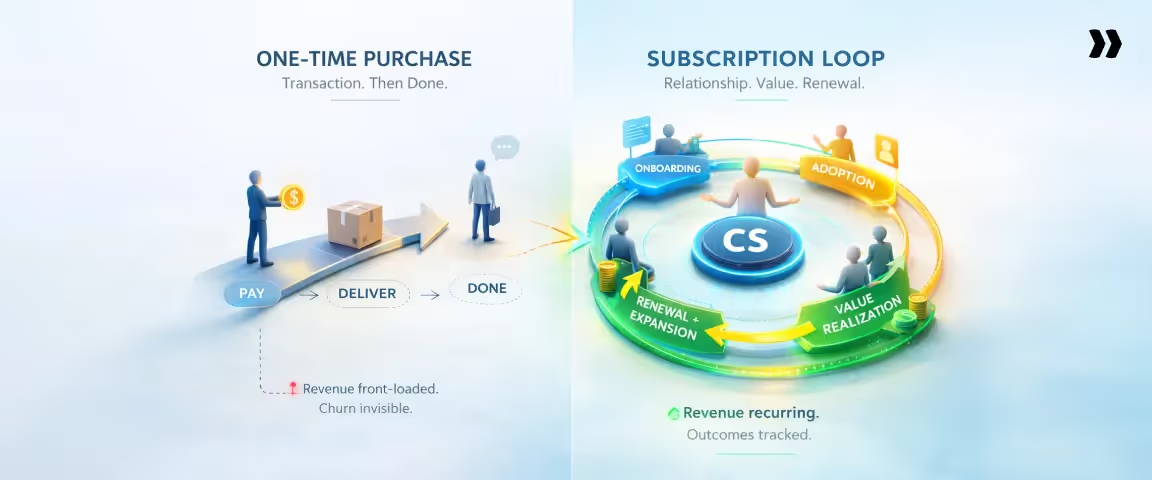
Customer success in SaaS is the organizational function responsible for ensuring customers achieve their intended business outcomes using the product.
It operates proactively by monitoring adoption patterns, identifying workflow friction, and intervening before disengagement occurs.
The objective is predictable, recurring revenue generated by measurable value, not customer relationship management for its own sake.
The term was coined by Salesforce in the early 2000s in response to high churn in early SaaS businesses.
When subscription models replaced upfront licensing, revenue shifted from a one-time transaction to a recurring commitment.
If customers did not see value quickly, they canceled. That’s why Customer success is outcome-driven. Period. Tracking logins and QBRs does not predict renewal. Tracking whether the customer hit their business goal does.
A team can host check-in calls, send QBR decks, and track engagement scores, yet still fail if the customer does not achieve results.
Customer success measures whether the product helps the customer achieve the business goal that justified the purchase.
What does customer outcomes mean in SaaS?
Customer outcomes in SaaS refer to the measurable business results customers expect when purchasing the software.
The product is only successful if it helps achieve those results.
Some examples of SaaS customer outcomes include:
- Reducing time to close for sales teams
- Automating customer onboarding workflows
- Cutting support ticket volume
- Improving margin visibility in professional services
A solid customer success program closely tracks whether the product delivers these outcomes, not just whether users log in or click features.
Why is customer success critical for SaaS specifically?
Customer success efforts are critical in SaaS because revenue is recurring and churn compounds over time.
If a company loses 5% of customers every month, guess how many customers that is in a year? 46%, retaining only about half of its customer base due to compounding loss.
In contrast, expansion revenue from upsells and cross-sells comes from customers who have already achieved success.
That makes customer success the primary lever between flat revenue growth and compounding net revenue retention.
Key aspects of SAAS customer success

High-performing SaaS customer success functions consistently focus on four core pillars: proactive engagement, driving adoption, focusing on outcomes, and revenue growth.
Now, customer success has 4 key pillars, each of which directly influences retention and expansion.
If even one pillar is weak, churn risk doubles.
A customer who completes onboarding but never adopts core features is already lost — you just will not see it until renewal.
1. Proactive engagement
Proactive engagement means reaching out to customers before they escalate issues or disengage.
Customer success teams monitor signals such as declining product usage, missed milestones, or reduced stakeholder participation and intervene early.
Customer success is not a help desk. It does not wait for tickets. In practice, proactive engagement looks like:
- A health score dropping below a defined threshold triggers outreach within 24 hours
- A 30-day check-in is built into every onboarding plan
- Stakeholder mapping happens at kickoff, so the CSM knows executive sponsors and daily users
- Automated alerts notify the team when key features go unused
Reactive customer success is expensive.
When customers escalate formally, trust is already gone. Recovery requires executive involvement, discounts, or additional services — all of which are margin killers.
2. Driving adoption
Driving adoption means ensuring customers consistently use the product in ways that deliver business value.
A customer who buys your product but does not use it meaningfully is at high risk of churn.
Adoption is a progression, not a single milestone. It moves through stages:
- Activation: The customer completes the initial setup.
- Habit: The product becomes part of regular workflows.
- Expansion: Additional teams, seats, or modules are adopted.
Customer success teams drive adoption by:
- Identifying underused features tied directly to the customer’s stated goals
- Building use case-specific adoption plans instead of generic feature walkthroughs
- Using in-app customer data to trigger contextual outreach
- Segmenting customers by maturity and tailoring enablement accordingly
A critical metric to track is the feature adoption rate by customer segment. This helps CSMs prioritize accounts that show usage gaps tied to renewal risk.
3. Focus on outcomes
Focusing on outcomes means measuring whether the customer achieved the business result that justified the purchase.
The central question every CSM should ask is, “Is this customer achieving what they bought the product for?”
Outcome tracking requires discipline:
- Define success criteria during onboarding, not months later
- Map product usage to business impact metrics
- Review outcome progress in every QBR
- Escalate internally if the product is not influencing the target metric
For example, if a customer purchased your project management platform to reduce time to delivery by 20%, customer success tracks actual delivery timelines. Login frequency alone does not indicate success.
Outcome tracking transforms customer success from activity reporting to value reporting.
4. Revenue growth
Revenue growth is a direct responsibility of customer success in SaaS. In a subscription model, retention protects ARR, and expansion increases it.
Customer success drives revenue growth through:
- Retention: Reducing churn directly preserves recurring revenue.
- Expansion: Tracking outcomes surfaces upsell opportunities aligned to real customer needs.
- Customer advocacy: Customers who achieve measurable results become references and case studies.
Small improvements in net revenue retention compound significantly over time.
For example, increasing NRR from 100% to 110% can materially accelerate long-term ARR growth without relying entirely on new customer acquisition.
High-performing CS teams are measured on expansion revenue targets, not only satisfaction scores.
Customer success vs. Customer support vs. Account management
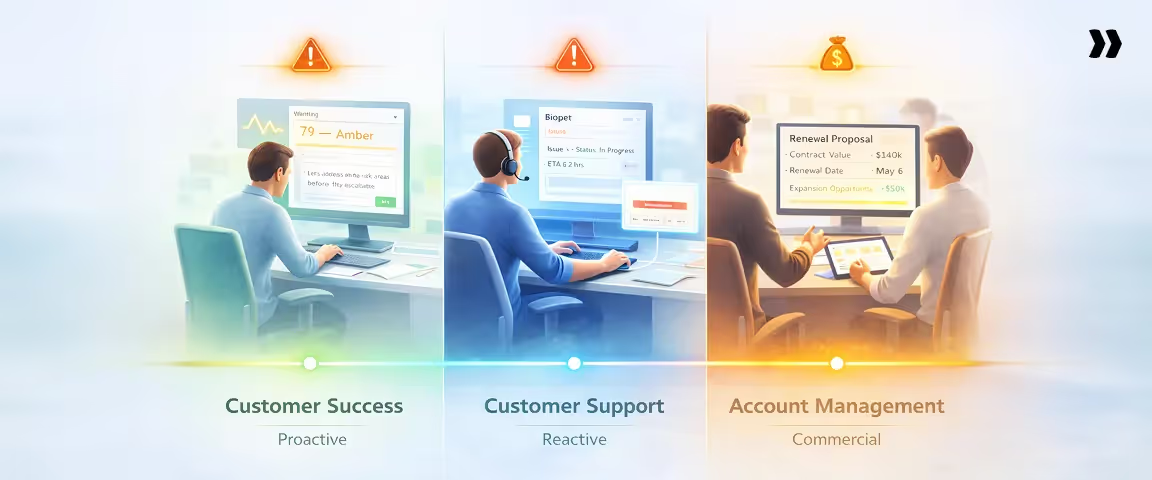
Customer success, customer support, and account management serve different functions in SaaS, even though they interact with the same customers.
Customer success focuses on proactive value delivery and retention.
Customer support resolves issues when customers report problems.
Account management owns the commercial relationship, including renewals and expansion.
Where does customer success end and account management begin?
Customer success and account management overlap but are not identical functions. The distinction becomes clearer as SaaS companies scale.
In SMB SaaS companies, the same person often owns both roles. A customer success manager may handle onboarding, adoption, renewals, and upsells.
In enterprise SaaS, the separation is clearer:
- Customer Success owns value delivery and product adoption.
- Account Management owns the commercial relationship and contract negotiation.
The overlap zone is renewal. Customer success owns account health and outcome tracking. Account management owns pricing, contract terms, and expansion structure.
If health is strong, renewals are straightforward. If health is poor, commercial negotiations become difficult.
Why is customer support alone not enough for SaaS retention?
Customer support solves immediate problems; customer success prevents them. Support reacts when customers submit tickets.
It resolves bugs, answers questions, and restores functionality.
But support visibility is limited to customers who raise their hands.
A customer who never submits a ticket but never activates a core feature is still at risk of churn.
Support teams do not see that risk because no issue was reported.
Customer success monitors adoption patterns, stakeholder engagement, and progress on outcomes.
It identifies silent churn risk before renewal conversations begin.
In SaaS, preventing churn requires more than resolving issues. It requires ensuring the customer achieves measurable business results.
What does a SaaS customer success team look like?
A SaaS customer success team is structured to deliver value across the customer lifecycle, not just to maintain relationships.
As companies grow, the function evolves from a founder-led effort to a specialized team that includes CSMs, onboarding specialists, operations support, and leadership focused on retention and expansion.
CS team roles at different company sizes
Customer success team structure depends on customer volume, complexity, and revenue stage.
- Early Stage (1 to 50 customers): At this stage, the founder or account executive often owns customer success. The first dedicated CS hire typically occurs when ARR reaches around $1 million or when churn signals appear in the first 90 days. The focus is onboarding, early adoption, and direct customer feedback.
- Growth Stage (50 to 500 customers): Dedicated CSMs emerge and are segmented by account size or complexity. High-value accounts receive higher touch engagement. CS Operations begins to appear to support reporting, tooling, and health scoring. Processes become documented rather than ad hoc.
- Scale Stage (500+ customers): The team becomes specialized. Roles include CSMs, CS Operations, Onboarding Specialists, Renewal Managers, and CS Leadership. Segmentation models mature, and digital lifecycle programs support lower-touch segments. Metrics drive prioritization rather than reactive firefighting.
What does a customer success manager do day to day?
A customer success manager ensures customers achieve measurable value from the product through structured engagement and proactive monitoring.
Typical day-to-day responsibilities include:
- Running onboarding calls and kickoff meetings
- Monitoring product adoption signals such as logins, feature usage, and milestone completions
- Proactively reaching out when health scores decline
- Leading quarterly business reviews focused on outcomes
- Flagging expansion opportunities to account executives when value is proven
The CSM’s primary focus is outcome progression, not ticket resolution.
The onboarding specialist: Why CS starts at day 1
Customer success begins before renewal conversations and often before full product activation.
The first 30 to 90 days represent the highest-churn-risk window because customers decide early whether the product fits their workflow.
Onboarding specialists own time to value. Time to value measures how quickly a customer achieves their first meaningful outcome.
In most SaaS businesses, faster time to value strongly correlates with a higher likelihood of retention and expansion.
Structured onboarding, milestone tracking, and stakeholder alignment significantly reduce the risk of early churn.
What are the key responsibilities of a SaaS customer success team?
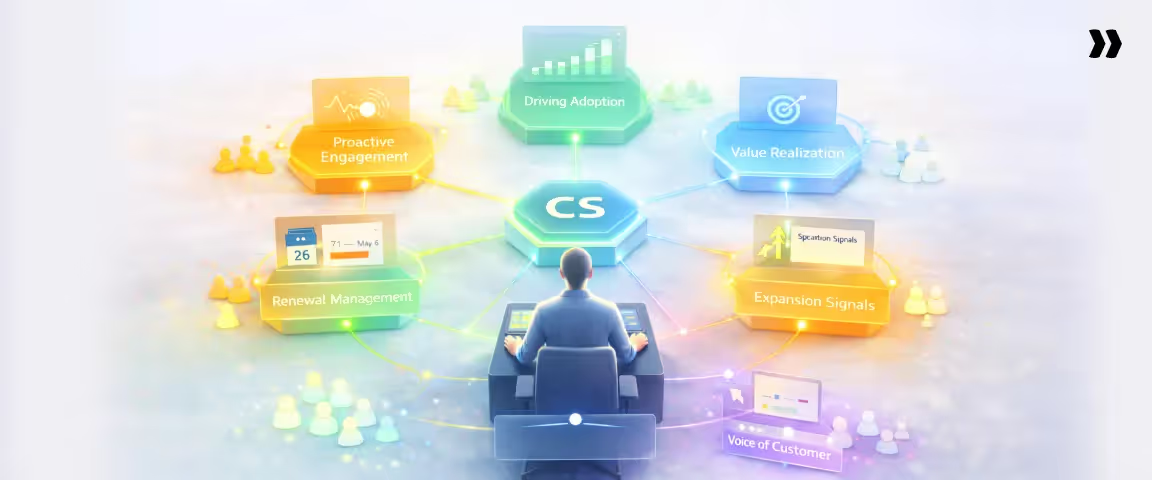
A SaaS customer success team is responsible for ensuring customers achieve measurable outcomes that drive retention and expansion.
This includes proactive engagement, adoption enablement, outcome tracking, renewal alignment, expansion identification, and serving as the voice of the customer internally.
Each responsibility connects product usage directly to recurring revenue performance.
1. Proactive engagement
Customer success teams monitor health signals and lifecycle stages to identify risk before escalation.
This includes tracking adoption patterns, stakeholder engagement, milestone completion, and support trends.
When risk indicators appear, the CSM initiates outreach before the customer raises a concern.
Proactive engagement reduces surprise churn and strengthens trust.
2. Driving adoption
Driving adoption means ensuring that customers actively use the features aligned with their stated goals.
CSMs identify underutilized capabilities and develop use-case-specific adoption plans rather than generic feature walkthroughs.
Adoption efforts are segmented by customer maturity and complexity.
The goal is to move customers from activation to habitual use and, eventually, to expansion.
3. Value realization
Value realization connects product usage to business outcomes.
Customer success teams define measurable success criteria during onboarding and continuously track progress against them.
Instead of reporting on activity metrics alone, CSMs measure whether the customer achieved the intended result.
If outcomes stall, intervention happens before renewal discussions begin.
4. Renewal management
Renewals are not single events. They are the result of sustained value delivery.
Effective customer success happens in partnership with account management or sales, ensuring renewal conversations are supported by clear evidence of outcomes.
CS owns account health and outcome progression. Commercial teams own contract negotiation and pricing.
Strong value realization makes renewal conversations predictable rather than reactive.
5. Expansion signals
Expansion opportunities surface when customers achieve measurable success.
CSMs identify usage trends that indicate readiness for additional seats, modules, or integrations.
Upsell and cross-sell efforts are most effective when tied to demonstrated outcomes rather than generic pitching. Customer success provides the context that makes expansion relevant.
6. Voice of the customer
An effective customer success team collects structured feedback from onboarding calls, QBRs, and ongoing engagement. That feedback is routed to product and engineering through defined channels.
When product teams understand recurring friction points and revenue-impacted feature requests, roadmap decisions become more aligned with retention and expansion goals.
How to measure customer success in SaaS? KPIs that matter
Customer success in SaaS is measured by metrics that reflect retention, expansion, and customer value realization.
The most important KPIs connect product adoption and customer outcomes directly to recurring revenue performance. Activity metrics alone are insufficient if they do not predict renewal or growth.
The primary customer success metrics
The primary customer success metrics measure whether they stay, grow, or leave.
- Net Revenue Retention (NRR): NRR measures the percentage of recurring revenue retained from existing customers, including expansion and contraction. It is widely considered the north star metric for SaaS customer success, and top companies achieve 120%+ NRR.
- Gross Revenue Retention (GRR): GRR measures the percentage of recurring revenue retained from existing customers, excluding expansion revenue. It isolates churn and contraction without upsell impact. The benchmark for GRR is 85–90%+ for enterprise SaaS.
- Churn rate: Churn rate represents the percentage of customers or recurring revenue lost during a given period. It can be calculated as logo churn or revenue churn. Even small monthly churn rates compound significantly over time.
- Customer health score: A customer health score is a composite metric derived from leading and lagging indicators, such as login frequency, feature adoption, support ticket volume, NPS (net promoter score), and milestone completion. It helps prioritize accounts based on risk or likelihood of expansion.
Leading indicators: Predict churn before it happens
Leading indicators surface risk before renewal conversations begin.
- Time to value (TTV): Time to Value measures the number of days between contract signing and the customer achieving their first meaningful outcome. Faster time to value often correlates with higher retention.
- Product adoption rate: the percentage of purchased features that are actively used. Accounts with low adoption across core features are at elevated churn risk.
- Stakeholder engagement: Tracks whether executive sponsors and key users attend onboarding sessions and QBRs. Low engagement from decision makers increases renewal risk.
- Support ticket trends: A rising volume of unresolved support tickets can indicate friction. However, zero tickets combined with low adoption can also signal disengagement. Context matters.
NPS and CSAT: Useful but not sufficient
NPS and CSAT measure customer sentiment, not outcomes. A customer may report satisfaction while failing to achieve meaningful business results.
A customer who gives a high NPS score but never activates a core feature remains at risk of churn. Sentiment should complement outcome tracking, not replace it.
High-performing customer success teams use NPS and CSAT as directional signals while anchoring renewal forecasts in adoption and outcome data.
How do you build a SAAS customer success strategy: 5-steps approach

A SaaS customer success strategy is a documented plan that defines how your team drives customer outcomes across the lifecycle, from onboarding through renewal and expansion.
It outlines segmentation, engagement models, health tracking, and cross-functional alignment. Without a structured strategy, customer success becomes reactive and inconsistent.
Step 1: Define what success looks like for your customers
Before designing motions or playbooks, define success criteria for each customer segment. Customer success cannot drive outcomes if those outcomes are unclear.
Start by asking: What business result did the customer buy your product to achieve? Quantify it.
Examples:
- Reduce time to close by 15%
- Decrease onboarding time by 20 days
- Improve net revenue retention by 5%
Set these criteria at kickoff, not six months later. If success is undefined early, renewal conversations become subjective.
Step 2: Segment your customer base
Customer segmentation determines how you allocate resources and the intensity of engagement. Not every account requires the same level of customer interactions.
A common segmentation model includes:
- High touch: Enterprise accounts with complex implementations and dedicated CSM ownership
- Mid touch: Growth accounts with CSM oversight supported by digital engagement
Low touch or tech touch: SMB accounts managed through automated lifecycle programs with limited human interaction
A common mistake is applying high-touch engagement to every account. This strains capacity and reduces strategic focus on high-value customers.
Step 3: Map the customer lifecycle and own every stage
A strong SaaS customer success strategy maps the full customer lifecycle and assigns ownership at every stage.
The core lifecycle typically includes:
- Onboarding
- Adoption
- Value Realization
- Renewal
- Expansion
For each stage, define:
- Customer milestones
- CSM actions
- Customer responsibilities
- Success signals
Customer success should not begin after onboarding ends. It starts before the contract is signed, through proper handoff and expectation-setting.
Step 4: Build your health scoring model
A health scoring model allows your team to predict customer churn and identify expansion opportunities early. It converts scattered engagement signals into prioritized action.
Identify four to six signals that correlate with churn or growth in your product. These may include:
- Core feature adoption
- Time to value
- Stakeholder engagement
- Support ticket trends
- Renewal timeline proximity
Weight signals based on predictive strength. In most SaaS environments, usage data carries more predictive power than survey sentiment alone.
Set defined thresholds and automate alerts so CSM outreach is triggered by risk signals rather than intuition.
Step 5: Establish a feedback loop with product and sales
Customer success sits at the center of customer intelligence. A structured feedback loop ensures that insights translate into action.
- CS to product: Create a documented channel for tagged and prioritized feedback tied to revenue impact.
- CS to sales: Implement a standardized handoff process so customer success understands deal context, promised outcomes, and implementation scope before kickoff.
- Product to CS: Ensure customer success is notified of feature releases and roadmap updates relevant to customer goals.
When these loops are formalized, customer success becomes a strategic function rather than an isolated team.
Customer success strategies that actually work in 2026
Customer success strategies that work in 2026 prioritize proactive engagement, structured planning, disciplined onboarding, and tight product alignment.
As SaaS markets mature and customer expectations rise, reactive check-ins are no longer enough.
Teams that combine data-driven outreach with lifecycle ownership consistently outperform those that rely on relationship warmth alone.
1. Proactive outreach beats reactive firefighting
Proactive outreach prevents churn before it becomes visible in renewal conversations. Waiting for quarterly business reviews to discover low adoption is too late.
Set health score triggers that automatically surface risk. For example:
- Core feature usage drops below the threshold
- Key stakeholder stops attending meetings
- Milestone deadlines slip
Outreach should be framed around value, not status updates. Instead of asking, “How is everything going?” say, “Three teams similar to yours use Feature X to reduce onboarding time by 20 percent.
You have not activated it yet. Let’s review how it applies to your workflow.”
This approach positions the CSM as a strategic advisor rather than a calendar manager.
2. Build a success plan for every enterprise account
Enterprise accounts require documented success plans tied to measurable outcomes. Without a written plan, engagement becomes reactive and scattered.
At kickoff, define:
- 90-day outcomes
- 6-month milestones
- 1-year strategic objectives
Assign a directly responsible individual on both sides. Review progress during every QBR, not only during renewal discussions. This keeps outcome tracking active throughout the lifecycle rather than compressing it into end-of-term negotiations.
3. Nail the onboarding window because it predicts everything
The first 30 to 90 days shape long-term customer retention. Customers form value perceptions early, often before expansion discussions ever occur.
Structured onboarding with defined milestones consistently outperforms a kickoff call followed by minimal follow-up. Clear timelines, documented responsibilities, and visible progress tracking reduce early friction.
Track time to value as a core KPI. If customers take too long to achieve their first meaningful result, the risk of renewal increases.
4. Close the loop with the product
Customer success teams sit closest to day-to-day customer friction. That insight becomes a strategic advantage only if it flows back to the product.
Establish structured feedback channels where customer input is tagged, prioritized, and tied to revenue impact.
When customers see their feedback implemented or transparently acknowledged, trust strengthens and long-term loyalty improves.
Customer success is not only about protecting revenue. It also influences roadmap decisions that shape future retention.
How does customer onboarding set the foundation for CS?
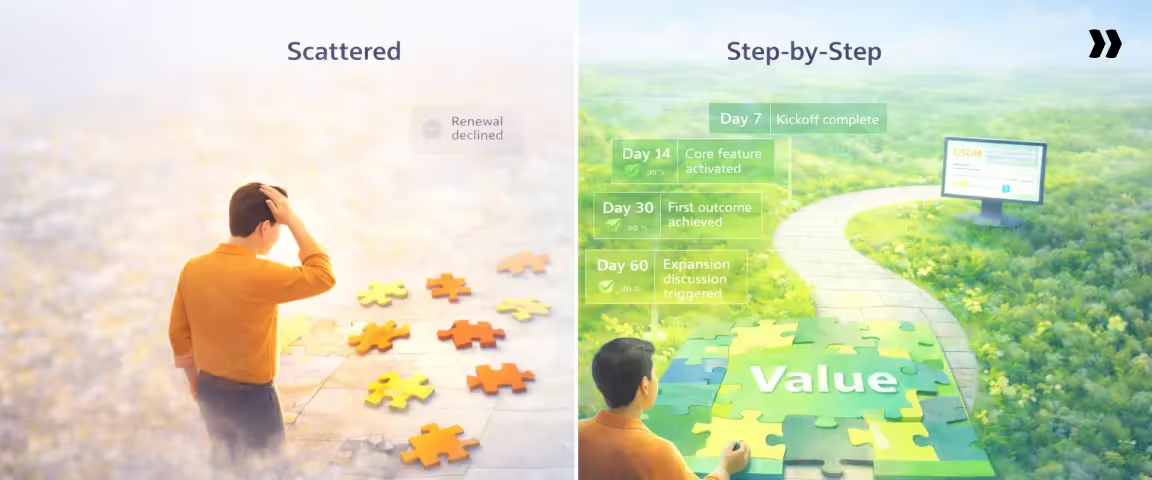
Customer onboarding lays the foundation for long-term retention by determining how quickly customers experience measurable value.
According to Gainsight research, customers who complete onboarding milestones in the first 30 days are much more likely to renew their subscription.
Early progress directly influences renewal confidence and expansion potential.
Structured onboarding reduces ambiguity and accelerates time to value. It replaces informal kickoff calls with defined milestones and accountability.
What structured onboarding looks like:
- A defined kickoff meeting with a clear agenda, stakeholder alignment, and documented success criteria
- A milestone-based project plan tied to measurable outcomes rather than a generic task list
- A customer-facing portal where both teams track tasks, ownership, and progress in real time
- Automated escalation workflows when milestones slip, or timelines drift
When onboarding is milestone-driven and transparent, customers see progress quickly. That visibility builds trust and reduces the risk of early churn.
CS and implementation teams using Rocketlane execute projects in a system of record that ties execution to resource allocation, time tracking, and revenue forecasting—so every project's margin is visible and protected from kickoff through go-live.
Teams report shorter time to value and fewer escalations because there is no disconnect between internal execution and customer accountability.
How Rocketlane supports every stage of post-sale delivery
A strong PSA should do more than organize tasks. It should help services teams execute customer-facing delivery while protecting margin and improving time-to-value.
Onboarding and implementation execution
Rocketlane standardizes onboarding and implementation through reusable project templates, milestone-based plans, and customer-facing workspaces. This gives teams a consistent way to deliver while reducing variability across accounts.
Resource planning and delivery capacity
Delivery is not only about project plans. It is also about having the right people available at the right time. Rocketlane helps services teams align project milestones with resource availability so work can move without hidden staffing bottlenecks.
Time tracking and financial discipline
Rocketlane ties delivery execution to time capture and financial workflows, which helps teams understand how project progress affects billable effort, delivery cost, and margin. That is critical for service organizations where implementation quality and profitability must move together.
Customer accountability and visibility
A white-labeled customer portal gives customers visibility into tasks, timelines, owners, and milestones. That reduces status chasing, shortens feedback loops, and improves accountability on both sides.
Risk detection and governance
Rocketlane surfaces delivery drift early. Teams can identify scope changes, timeline slippage, and coordination gaps before they become escalations. Nitro extends this with always-on intelligence across operations, governance, and delivery workflows, reducing dependence on manual reviews
AI-powered execution with Nitro
Nitro is Rocketlane’s AI platform for services teams. It supports operational analysis, project governance, and work-execution transformation by helping teams automate documentation, generate insights, and accelerate implementation using the context already in Rocketlane.
Nitro is designed to bring agentic automation to service work, not just generate summaries or answer tickets.
Why Rocketlane is the right PSA for services delivery and customer success teams

Customer success does not happen in a vacuum. In SaaS, retention depends on whether onboarding, implementation, and post-sale delivery happen on plan, on budget, and on time.
This is where Rocketlane enters and saves the day for PS & Implementation leaders.
Rocketlane is a professional services automation platform built for services delivery teams that need to execute customer-facing projects with structure, visibility, and margin control.
It acts as the system of record for delivery execution. It connects project plans, milestones, customer collaboration, resource planning, time tracking, and financial visibility in one place.
Instead of managing onboarding through spreadsheets, email threads, and disconnected PM tools, teams run delivery in a shared environment where accountability is visible to both internal teams and customers.
This matters because customer success outcomes are often won or lost during implementation. If onboarding drifts, milestones slip, or scope expands without visibility, time-to-value slows, and margins erode.
Rocketlane helps teams catch those risks early by tying delivery progress to project health, utilization, and financial outcomes.
And this is where Nitro becomes a real differentiator.
Rocketlane with Nitro is not just tracking work.
It brings agentic automation to operations, governance, and value-delivery work for services teams, helping them move faster with less manual overhead.
Nitro also includes PSA-native analytics, allowing leaders to ask operational and financial questions in plain language and receive structured answers grounded in project, margin, and utilization data.
For customer success, implementation, and professional services teams, that means:
- faster project execution
- stronger customer accountability
- earlier visibility into delivery risk
- better utilization and margin protection
- the ability to scale without adding proportional headcount
Rocketlane is not just helping customers collaborate. It is helping services teams deliver value in a way that is operationally disciplined and financially sound.
Conclusion
In SaaS, customer success is not a relationship layer added after the sale. It is the operating system for renewal, expansion, and long-term revenue quality. Customers stay when they achieve outcomes.
They expand when those outcomes are repeatable. And none of that happens consistently if onboarding, implementation, and post-sale delivery are running through spreadsheets, fragmented tools, and manual follow-ups.
That is the real shift this article points to: customer success is no longer just about check-ins, health scores, or QBRs.
It is about building a disciplined post-sale motion in which delivery, adoption, accountability, and margin move together.
For customer success, implementation, and professional services leaders, the question is not whether post-sale execution needs more structure.
It is whether your current system can make value delivery visible before churn, overruns, and delays show up at renewal.
Rocketlane is built for exactly that. It gives teams a PSA system of record for onboarding and delivery execution, connects projects to resources, time, and financial visibility, and helps scale post-sale operations with Nitro-powered intelligence and automation.
If your team is still stitching delivery together across tools, the cost is already showing up in time-to-value, utilization, and margin.
The fix is not more effort. It is a better execution infrastructure.
Table of Contents

Regsiter for the live webinar


Great consultants didn't join your team to spend Fridays writing documentation.
Table of contents
18 of Forbes Cloud 100 chose Rocketlane. The best PS teams aren't waiting around.
FAQs
What is customer success in SaaS?
Customer success in SaaS is the proactive function responsible for ensuring customers achieve measurable business outcomes using a subscription product. It owns the post-sale lifecycle from onboarding through adoption, value realization, renewal, and expansion. The goal is to reduce churn and grow recurring revenue by delivering sustained customer value.
What is the difference between customer success and customer support in a SaaS business?
Customer support resolves issues that customers report. Customer success proactively monitors adoption, engagement, and outcome progress to prevent churn. Support reacts to tickets and technical problems. Customer success ensures customers achieve the business results that justify renewal and expansion.
What KPIs should a SaaS customer success team track?
Core customer success KPIs include Net Revenue Retention, Gross Revenue Retention, churn rate, customer health score, time to value, and product adoption rate. Net Revenue Retention measures revenue retained, including expansion. Gross Revenue Retention measures revenue retained excluding expansion. These metrics collectively indicate retention strength and growth potential.
How do you build a customer success strategy for a SaaS company?
To build a SaaS customer success strategy, define measurable success criteria by customer segment, segment accounts by engagement model, map the full lifecycle from onboarding through renewal, implement a health scoring model with defined thresholds, and establish structured feedback loops between customer success, product, and sales.
When should a SaaS company hire its first customer success manager?
A SaaS company should hire its first dedicated Customer Success Manager when post-sale onboarding and retention can no longer be managed consistently by founders or sales. This often occurs when customer volume increases, onboarding becomes more complex, or early churn signals emerge within the first 90 days.













Copyright © 2026 Rocketlane Corp. All rights reserved.



















.webp)