The 15-hour rule: how Gainsight and Actabl decide what AI gets to touch
•
•
Summarize blog with






The 15-hour rule: how Gainsight and Actabl decide what AI gets to touch
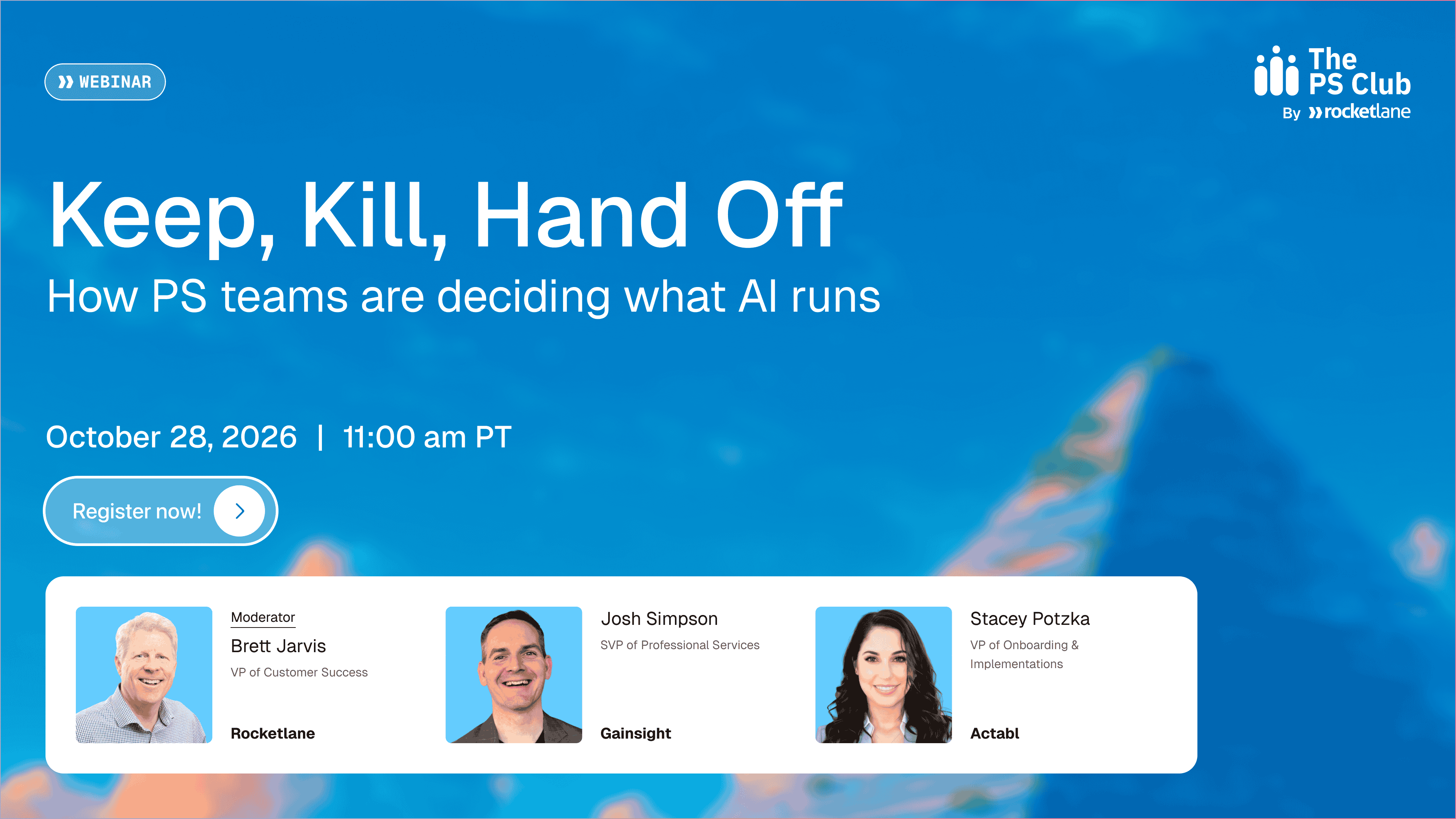
Somewhere in the first ten minutes of Wednesday's PS Club panel, Stacey Potzka described the moment her company's AI honeymoon ended. Everyone at Actabl had been playing with it. Then she asked the room a question that nobody had a good answer to: "It's great that you spent 15 hours doing something that's going to save you five minutes, but really, what's the ROI?"
That question is the whole panel in one line. Brett Jarvis (Rocketlane) spent an hour with Stacey, who runs operations and implementation across Actabl's four hospitality brands, and Josh Simpson, who leads professional services at Gainsight and has his own P&L to defend. Neither of them is in the demo business. Both of them have token bills.
So instead of asking what AI can do for a PS team, Brett asked what they've actually handed to it, what they've deliberately kept with people, and what they've killed outright. Below is every answer they gave, sorted.
This came out of a PS Club panel. If you run a PS team, join the club.
The verdicts
Two things stand out in the table. Every Hand off has a human checkpoint written into it. And most of the Kills weren't killed by AI. They were killed because AI made the waste impossible to ignore.
Three rules they arrived at separately
Josh and Stacey had never compared notes before the panel. By the end they were booking a call. These are the rules both teams landed on independently.
Brief it like a five-year-old, coach it like a new hire
Actabl's first signal prompts were too broad, fired constantly, and ate credits. Stacey's admin went through the false positives one at a time and rewrote each prompt with phrases that should trigger it and phrases that should not. Stacey's shorthand: write the instructions as if for a five-year-old, then review the output every week and coach it the way you would a new employee. Josh's version of the same rule is that the context going in is what matters, however well-built the process around it.
Ideas from the field, code from engineering
Both teams let anyone raise an idea and neither lets anyone ship one alone. At Gainsight, a consultant with a good idea becomes a co-designer with the PS engineering team, who build it once in a way that will survive. At Actabl, ideas go to a small optimization team whose actual job is improving processes. Stacey's priority order for everyone else: your own job first, a stretched teammate second, AI innovation third.
Pay for tokens, and say what they bought
Gainsight's PS org gets a token budget next fiscal year. Josh asked the team to come in well under it, on purpose, so that spending forces a conversation rather than a shrug. Stacey's governance asks two things of every idea: what's the end result, and is it worth doing at all? Her senior leaders will ask her the same question about the AI bill, so she asks it first.
What's still broken
The honest parts of the hour were the ones where neither of them had finished.
Handoffs out of implementation. Gainsight has automated the way in (SE artifacts become scopes, scopes become projects) and is still defining the way out to CS and support. Josh called it "nascent days." Actabl's Gong briefs are good and still miss something; Stacey was meeting her sales team two days after the panel to find out what.
Project-level signals. Gainsight's customer sentiment product is mature on email and Slack, and Josh is candid that it doesn't yet watch projects the way Actabl's setup does. He's working with product to build that in rather than build it for PS alone.
One view of the customer. Stacey's team is building something she says she's chased her entire career: one place where sales can see what's happening in implementation and implementation can see the pipeline, pulled from tools that don't integrate with each other. It's in beta. She also said, with feeling, that she hates how many things are listening to her.
The 10% who are scared. Stacey's rough split is 80/10/10: most people will carry on, some will be all over it, and some are worried and not saying so. Her answer is education and the reason behind every change, delivered to all three groups. Josh's is to make continuous learning an explicit expectation, and to make leaders responsible for giving people the time to meet it.
Steal this
If you take one thing from the panel, take the sorting. Put your team's AI pile through it in half an hour:
- List everything AI currently touches, plus everything someone has pitched. Be honest about the 15-hour experiments.
- Score each one on the worksheet. The scorecard asks about payback, verifiability, and what happens if it's wrong, and tells you which bucket it lands in.
- Pick one Hand off that pays back this month and one Kill you can announce on Monday.
- Write the human checkpoint next to every Hand off. If you can't name the person, it's not ready.
And pick your starting speed. Stacey's advice is to start with the thing nobody wants to do anymore and remember nothing is broken until you push it live. Josh's is to pick a big goal, let the team break things on the way there, and keep in mind that a wrong customer record can be fixed.
[Download the worksheet]([https://drive.google.com/file/d/1hRzn1z-5eDyC7rI2eXKt01MkU0kTId8S/view?usp=sharing])
Thanks to Josh Simpson, Stacey Potzka and Brett Jarvis for an hour with no slides and pure value. If you lead a PS team and want in on the next one, [join the PS Club]
Table of Contents

Regsiter for the live webinar


Great consultants didn't join your team to spend Fridays writing documentation.
Table of contents
18 of Forbes Cloud 100 chose Rocketlane. The best PS teams aren't waiting around.
FAQs










Copyright © 2026 Rocketlane Corp. All rights reserved.