Best IT Financial Management Tools for Professional Services and Delivery Teams in 2026
•
•
Summarize blog with






It's the last week of the quarter. The CFO wants an updated services margin forecast. Finance has one number. Delivery has another. Everyone is looking at data. Nobody is looking at the same data.
The problem isn't a lack of reporting. It's a lack of visibility into how project delivery translates into financial performance.
This is why professional services (PS) organizations are increasingly investing in IT financial management tools. As delivery teams scale, leaders need to understand not only what projects are being delivered, but also how resources, budgets, utilization, forecasts, and revenue recognition are performing in real time.
IT financial management tools help professional services organizations connect project delivery, resource management, time tracking, and financial reporting into a single operational system. Their primary purpose is to provide real-time visibility into project profitability, revenue forecasts, budget consumption, and resource economics across the services business.
The core challenge these platforms solve is financial fragmentation. Many PS organizations manage delivery in one system, track time in another, and perform financial reporting in an ERP or spreadsheet environment. As a result, project margin issues often surface only after work has been completed, while finance teams spend significant effort reconciling data across disconnected systems.
Gartner's 2025 research on IT Financial Management reports that CFOs continue to struggle with aligning technology investments to business outcomes due to limited cost and ROI visibility. High-performing PS organizations typically operate with real-time project and portfolio profitability visibility, forecast accuracy across resource and revenue plans, and month-end close processes measured in days, not weeks.
This guide evaluates the leading IT financial management tools across profitability visibility, forecasting, financial governance, AI capabilities, ERP integrations, and scalability.
Who this guide is for: CFOs, VP Finance leaders, finance directors, professional services leaders, delivery executives, and operations teams at professional services firms, SaaS companies with PS organizations, and implementation consultancies managing customer-facing project portfolios.
Methodology: Updated July 2026. Ratings reflect publicly available G2 data at the time of writing. Assessments are based on product documentation, analyst research, customer reviews, and evaluation of each platform's financial management, resource planning, project financials, forecasting, reporting, and integration capabilities.
What did this evaluation find?
Rocketlane ranks first for professional services teams in 2026. Across eight platforms scored on profitability visibility, forecasting, financial governance, AI, and ERP integration, it is the only Agentic PSA that shows project profitability while work is still in flight, not at month-end.
It unifies project financials, resource planning, time tracking, and Nitro agentic AI in one system. 750+ organizations run on it, with a 94% G2 recommendation rate and a $60M Series C (March 2026).
For Salesforce-native finance, Certinia is the alternative; for NetSuite shops, OpenAir; for deep resource planning, Kantata. This guide covers all eight, including where Rocketlane is more than a team needs.
This guide evaluates the leading IT financial management tools across profitability visibility, forecasting, financial governance, AI capabilities, ERP integrations, and scalability.
Best IT financial management tools for professional services in 2026: At a glance
*Ratings reflect publicly available G2 data at the time of writing.
What is IT financial management software for professional services teams?
IT financial management (ITFM) software for professional services teams connects project delivery, resource management, time tracking, billing, forecasting, and financial reporting into a single operational system.
It enables finance and delivery leaders to understand project profitability, budget performance, resource economics, and revenue forecasts while work is still in progress.
Traditional ITFM vs. professional services financial management
The term "IT financial management" often describes tools used by internal IT departments to allocate technology costs, manage budgets, and support chargeback or showback models.
Professional services financial management addresses a different problem: understanding the financial performance of customer-facing project work.
While traditional ITFM answers questions such as "Which business unit consumed this IT budget?", it also supports cost management of IT spending, improves cost allocation and resource decisions across each cost center, and helps align spending with business objectives and broader business strategy; IT leaders use these tools to prioritize investments around business priorities and demonstrate business value, while professional services financial management answers questions such as:
- Which projects are profitable?
- Which clients generate the highest margins?
- Are delivery costs tracking against budget?
- How much revenue can be recognized this month?
- Which projects are at financial risk?
This guide focuses specifically on the financial management needs of professional services organizations, implementation consultancies, and customer-facing delivery teams.
The six financial layers every PS organization must manage
- Time and effort tracking: What work was completed, by whom, and at what cost?
- Cost rates and bill rates: What is the actual margin generated by each resource, project, and client?
- Budget versus actual performance: Are projects consuming budget faster than expected?
- Revenue forecasting and recognition: How much revenue can be recognized today, this month, and this quarter?
- Billing and invoicing operations: How does approved work move into customer invoices and financial systems?
- Operational reporting: Can leaders understand the financial health of projects and portfolios in real time?
Together, these layers create the operational and financial visibility required to produce actionable insights, help teams optimize spend, support cost optimization, identify unnecessary expenses, and drive cost reduction in a professional services business, supporting more informed decisions.
Why project management tools without native financials create visibility gaps
Project management platforms excel at tracking tasks, milestones, deadlines, and delivery progress. ERP systems excel at recording invoices, payments, and accounting transactions.
Neither system is designed to provide continuous visibility into project profitability while work is happening.
As a result, many organizations rely on a manual process: exporting project data, reconciling time records, updating spreadsheets, and combining financial information from multiple systems before profitability can be analyzed.
Even when the administrative cost is modest, the larger issue is timing. Margin risks, budget overruns, utilization problems, and forecasting errors often become visible only after significant work has already been completed.
The strongest IT financial management platforms close this gap by connecting project execution, resource planning, and financial reporting through a shared data model.
How do the top IT financial management tools fare for PS?
1. Rocketlane
.webp)
Rocketlane is an agentic execution platform that combines project delivery, resource management, project financials, time tracking, and operational reporting in a single system. It was built for professional services organizations, implementation consultancies, and customer-facing delivery teams that need financial visibility while work is still in progress.
Many services organizations manage project execution in one platform, resource planning in spreadsheets, time tracking in a third, and financial reporting inside an ERP. As organizations grow, this fragmentation creates delays in profitability reporting, forecasting, billing, and revenue visibility. Rocketlane addresses this challenge by connecting delivery operations and financial management through a shared operating model.
Key features
- Project financial management: Monitor project budgets, actuals, burn rates, forecasted revenue, and profitability in real time. Financial visibility is embedded directly into project execution rather than generated through month-end reconciliation.
- Budget vs. actual tracking: Track financial performance at the project, phase, resource, and portfolio level. Delivery leaders can identify budget risks and margin pressure before they affect project outcomes.
- Resource planning and utilization management: Capacity planning, utilization forecasting, workload balancing, and skills-based staffing help organizations align project demand with available resources while maintaining profitability targets.
- Time tracking and financial governance: Time entries feed directly into project financials, utilization calculations, and reporting. Governance controls help improve data quality and reduce downstream reconciliation effort.
- Multiple billing models: Supports time and materials, fixed-fee, milestone-based, retainer, and hybrid engagements. Teams can manage diverse contract structures within a single platform.
- Rate card management: Configure bill rates and cost rates by role, resource, geography, client, or project. This allows organizations to understand project profitability with greater precision.
- Revenue forecasting and portfolio visibility: Consolidated reporting provides visibility into future revenue, utilization trends, project performance, and portfolio health across the services organization.
- Sales-to-delivery financial continuity: Salesforce and HubSpot integrations help transfer commercial context from closed-won opportunities into project delivery, improving forecast accuracy and reducing manual setup effort.
- Financial reporting and analytics: Track utilization, project profitability, budget performance, margin trends, and operational KPIs through configurable dashboards and reporting views.
- Enterprise integrations: Connects with Salesforce, HubSpot, NetSuite, QuickBooks, Jira, Slack, and other business systems to unify delivery, financial, and operational workflows.
Nitro agentic AI
Rocketlane Nitro applies agentic AI across financial management, project delivery, governance, resource planning, and operational reporting.
Rocketlane Nitro extends traditional IT financial management beyond dashboards and reporting. Instead of simply helping finance teams analyze historical performance, Nitro operates directly within delivery, resource management, and financial workflows to improve data quality, surface financial risks earlier, and reduce operational overhead.
Its agents help enforce timesheet and governance policies at the point of entry, identify utilization and budget risks across active projects, assist with resource planning decisions, and answer profitability and forecasting questions in natural language.
By combining operational data with financial context, Nitro helps professional services organizations move from retrospective financial reporting to proactive financial management—where risks can be identified and addressed while projects are still in flight.
Key takeaways
Global availability
Supports professional services organizations across North America, Europe, APAC, and MENA. Multi-currency support includes USD, EUR, GBP, INR, AED, AUD, and other major currencies. Enterprise security controls, GDPR-compliant deployment options, and global delivery support make it suitable for international services organizations.
Enterprise-Grade Foundation
- Security and compliance: SOC 2 Type II, GDPR, 99.9% uptime SLA, HIPAA-ready
- Identity and access: SSO via Okta, Azure AD, and Google; role-based permissions across 10+ user types
- Global delivery: multi-currency, multi-timezone, partner and contractor portal with selective visibility
- Native integrations: Salesforce, HubSpot, NetSuite, QuickBooks, Xero, Jira in real time; no middleware for core integrations
- Extensibility: API, webhooks, custom app framework, MCP support to connect Rocketlane to Claude, ChatGPT, and Slack
- Implementation support: named CSM and named implementation manager for every enterprise account, from day one
Rocketlane in numbers
750+ customers, 94% G2 recommendation rate, $60M Series C (March 2026), revenue more than doubled YoY.'
2. Kantata

Kantata is a professional services automation (PSA) platform focused on resource management, project operations, and financial visibility for mid-market and enterprise services organizations. It is most commonly used by consulting firms, technology services providers, and professional services teams that need detailed resource planning alongside project financial management.
Key features
- Project financial management: Tracks project budgets, costs, revenue, margins, and financial performance across the project lifecycle.
- Resource planning: Supports skills-based staffing, capacity planning, utilization forecasting, and long-range resource modeling.
- Revenue forecasting: Provides portfolio-level forecasting and visibility into future revenue pipelines.
- Project accounting: Connects project delivery activity to billing, revenue, and financial reporting processes.
- Portfolio reporting: Consolidates financial, operational, and resource metrics across projects and business units.
Key takeaways
3. Certinia (formerly FinancialForce)

Certinia is a Salesforce-native professional services automation and financial management platform. It is designed for organizations that want project delivery, financial operations, and customer management to operate within the Salesforce ecosystem.
Key features
- Salesforce-native architecture: Operates directly on Salesforce, providing shared customer, project, and financial data across teams.
- Project financials: Tracks project budgets, costs, revenue, margins, billing, and profitability.
- Revenue recognition: Supports services organizations managing complex contract structures and recognition requirements.
- Resource management: Provides staffing, capacity planning, utilization tracking, and resource forecasting.
- Financial operations: Connects project delivery data to broader finance workflows and reporting.
Key takeaways
4. NetSuite Projects pro
NetSuite ProjectsPro is a professional services automation platform designed for organizations that already use NetSuite as their ERP and financial system. It focuses on connecting project delivery, resource management, time tracking, and financial operations within the broader NetSuite ecosystem.
Key features
- Project accounting: Tracks project costs, revenue, budgets, and profitability alongside broader financial operations managed in NetSuite.
- Resource management: Supports resource allocation, capacity planning, utilization tracking, and staffing management across project portfolios.
- Time and expense management: Captures billable and non-billable time alongside project expenses for billing and financial reporting.
- Revenue forecasting: Provides visibility into project revenue pipelines, backlog, and forecasted performance.
- ERP connectivity: Integrates closely with NetSuite financial workflows, helping reduce duplication between delivery and finance teams.
Key takeaways
5. Scoro

Scoro is a business management platform that combines project operations, financial management, CRM, quoting, and invoicing in a single system. It is particularly popular among agencies, consulting firms, and professional services organizations looking for visibility across the entire quote-to-cash lifecycle.
Key features
- Quote-to-cash management: Connects sales opportunities, project delivery, budgeting, invoicing, and financial reporting in one workflow.
- Project financials: Tracks budgets, project costs, revenue, margins, and profitability throughout delivery.
- Utilization and capacity planning: Provides workload management, utilization visibility, and resource planning capabilities.
- Billing and invoicing: Supports fixed-fee, retainer, and time-based billing models with integrated invoicing workflows.
- Business reporting: Consolidates financial, operational, sales, and delivery metrics into unified dashboards.
Key takeaways
6. Productive.io
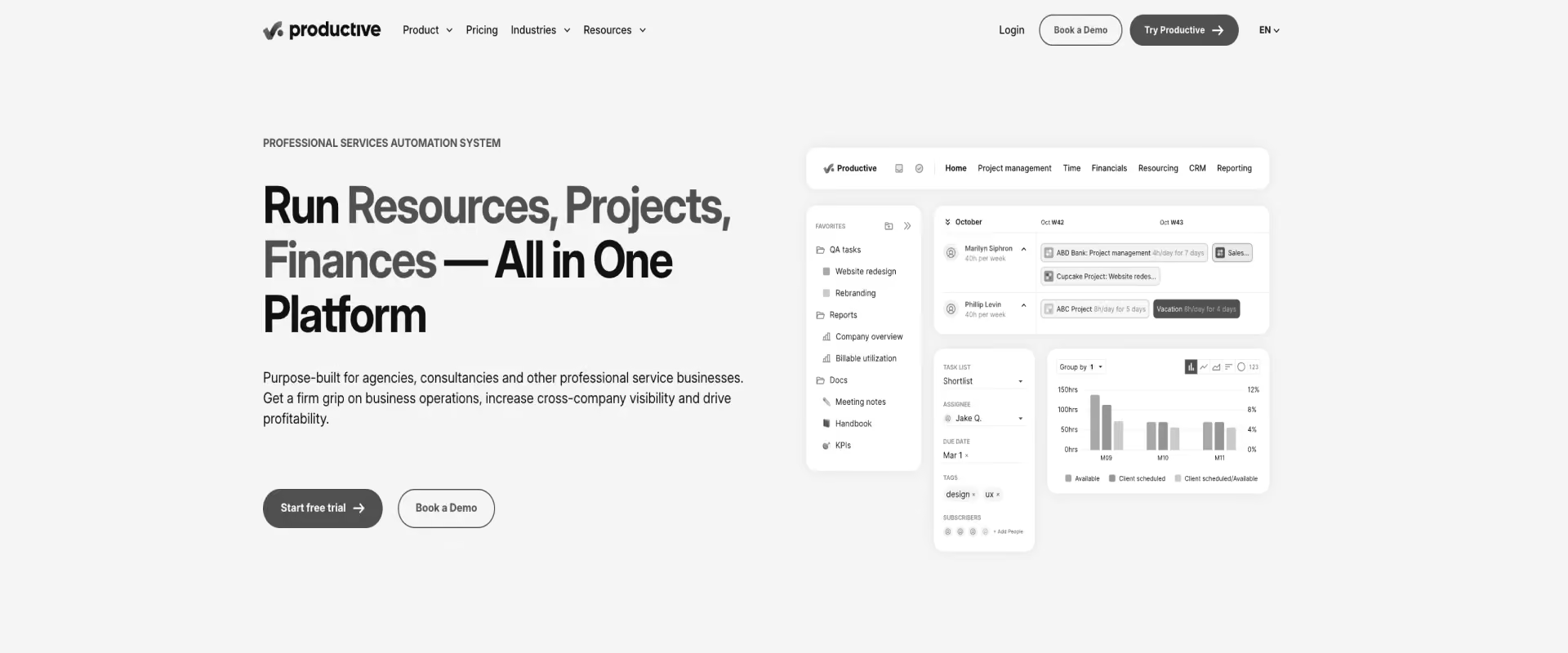
Productive is a PSA platform built primarily for agencies and service businesses that want stronger visibility into profitability, utilization, budgeting, and financial performance. It combines project management, resource planning, budgeting, and financial reporting in a relatively modern interface, making it popular among agencies that have outgrown standalone project and time-tracking tools.
Key features
- Profitability management: Tracks project budgets, revenue, costs, margins, and profitability in real time, helping leaders understand which clients, projects, and service lines generate the strongest returns.
- Resource planning: Supports capacity planning, workload balancing, utilization forecasting, and staffing decisions across active and planned projects.
- Budgeting and forecasting: Allows teams to create project budgets, compare forecasts against actual performance, and monitor financial health throughout project delivery.
- Time tracking and billing: Connects time tracking directly to project budgets, utilization metrics, invoicing, and profitability reporting.
- Business intelligence reporting: Provides dashboards for revenue forecasting, margin analysis, team utilization, project performance, and agency operations.
Key takeaways
7. BigTime
BigTime is a professional services management platform focused on time tracking, project financial management, billing, and resource planning. It has a particularly strong presence among accounting firms, engineering consultancies, IT services organizations, and professional services teams that need tighter control over billable work and project economics.
Key features
- Project financial management: Tracks budgets, costs, revenue, margins, and project profitability throughout the engagement lifecycle.
- Time and expense management: Captures billable hours and project expenses while supporting approval workflows and billing processes.
- Resource planning: Provides capacity management, staffing visibility, utilization tracking, and workload planning capabilities.
- Billing and invoicing: Supports multiple billing structures including time and materials, fixed fee, and recurring engagements.
- Financial reporting: Offers visibility into utilization, project performance, revenue forecasts, realization rates, and profitability metrics.
Key takeaways
8. Harvest
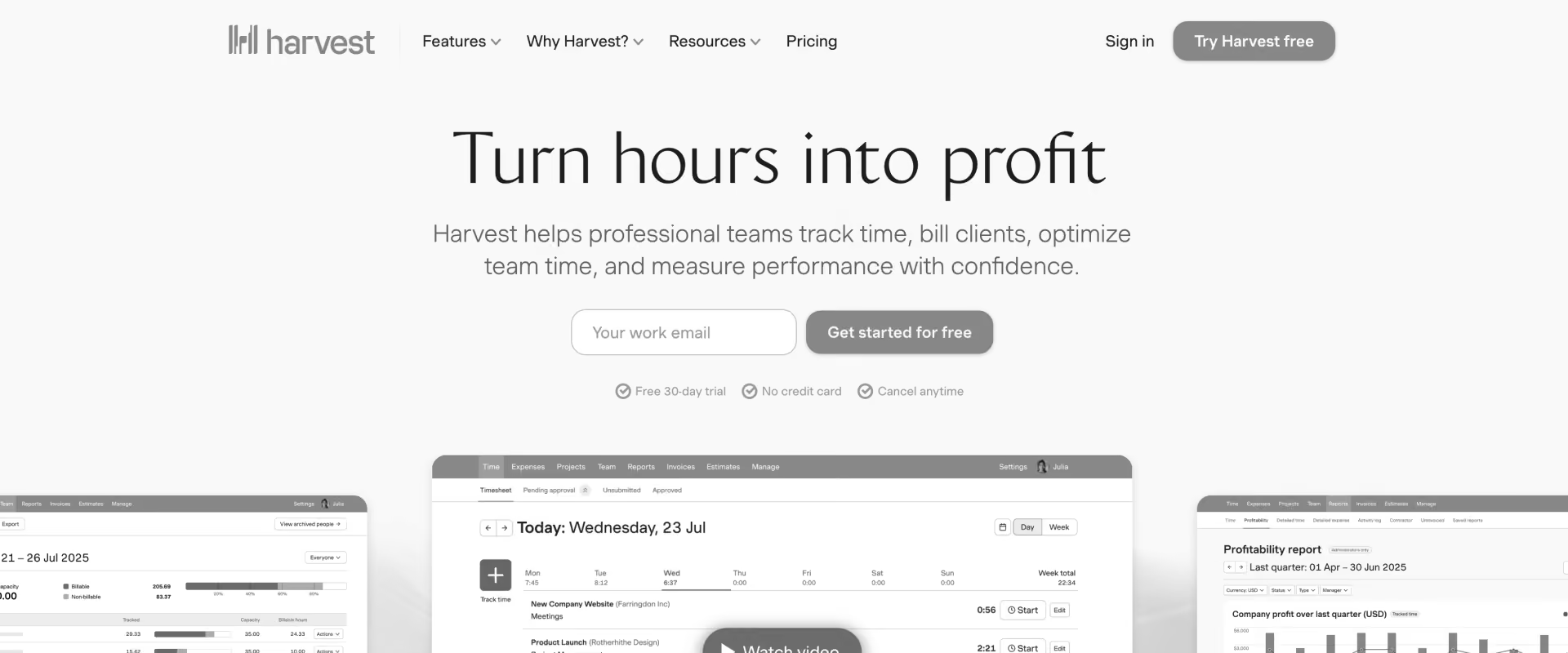
Harvest is a time tracking and invoicing platform that helps organizations capture billable hours, manage project budgets, and generate invoices. While it provides basic financial visibility into billable work, it is fundamentally a time-tracking system rather than a comprehensive IT financial management platform.
Key features
- Time tracking: Supports timer-based and manual time entry across projects, clients, and activities.
- Budget monitoring: Tracks project budgets against logged hours and highlights budget consumption trends.
- Invoicing: Converts approved billable time into invoices and integrates with accounting systems.
- Expense tracking: Captures project-related expenses for reimbursement and billing purposes.
- Utilization reporting: Provides basic visibility into billable versus non-billable work and team activity.
Key takeaways
How do the top IT financial management platforms compare feature by feature?
The IT financial management category has expanded well beyond project accounting and invoicing. Modern platforms now compete on real-time profitability visibility, resource economics, forecasting accuracy, AI-assisted governance, and ERP connectivity.
Head-to-head comparison
Legend: ✅ Native capability | ⚠️ Available with limitations | ❌ Not a core capability
Notable strengths by platform
- Rocketlane stands out for its agentic execution capabilities, enabling services teams to automate project coordination, stakeholder communication, documentation, and operational workflows alongside project financial management.
- Certinia offers some of the deepest revenue-recognition and PSA capabilities available for organizations standardized on Salesforce.
- NetSuite OpenAir remains a strong option for organizations already operating on NetSuite ERP and looking for tight financial-system alignment.
- Kantata continues to stand out for sophisticated resource planning and forecasting requirements in larger services organizations.
- Scoro provides broad quote-to-cash visibility for organizations seeking operational simplicity.
- Productive emphasizes profitability reporting and agency financial performance.
- BigTime remains popular among accounting, engineering, and consulting firms with strong billing and project accounting requirements.
Why does IT financial management matter more than ever for PS teams in 2026?

Professional services organizations are under increasing pressure to improve profitability while managing more complex delivery portfolios. Multi-region staffing, hybrid billing models, longer implementation cycles, and tighter margin expectations have made financial visibility a delivery requirement, not just a finance responsibility.
When project delivery, resource management, time tracking, and financial reporting operate in separate systems, budget overruns and margin erosion often become visible only after significant work has already been completed.
Benchmark snapshot
Source: PMI Pulse 2026
The hidden cost of the reconciliation tax
Many professional services finance teams still rely on a familiar process:
- Export project data from a project management platform
- Export approved time from a time-tracking system
- Reconcile budgets and actuals in spreadsheets
- Validate billing data
- Update forecasts and push information into ERP and accounting systems
The administrative effort varies by organization, but the higher cost is delayed decision-making, not labor.
When project financials require manual consolidation, profitability reviews become periodic events instead of operational controls. Delivery leaders spend time assembling data instead of acting on it, while finance teams focus on reconciliation, not just forecasting and analysis.
The strongest IT financial management platforms reduce this friction by connecting project execution, resource management, time tracking, and financial reporting through a shared operational model.
How agentic AI is transforming PS financial management
The first generation of financial management software focused on reporting what happened. The next generation focuses on helping teams identify and respond to financial risk while delivery is underway.
This shift is driving the adoption of agentic AI across professional services operations.
- Operations AI: Automates governance activities such as timesheet policy enforcement, utilization monitoring, and natural-language access to project financial data.
- Delivery AI: Identifies budget risks, resource constraints, forecast variance, and project health signals before they become financial problems.
- Execution AI: Assists with documentation, project setup, data migration, reporting preparation, and other operational workflows that traditionally consume delivery and finance team capacity.
For instance, Nitro, Rocketlane's agentic AI layer, operates across these layers, helping delivery, operations, and finance teams move from retrospective reporting toward proactive financial management.
How should PS finance leaders evaluate IT financial management tools?

The most common mistake PS finance leaders make is evaluating IT financial management platforms primarily on ERP integration depth instead of operational financial visibility. ERP integration matters, but finance teams create the most value when they can identify margin risks, utilization issues, and budget overruns while projects are still in flight.
The 5 questions to ask every IT financial management vendor
When does profitability become visible? Can project managers and finance leaders see budget consumption, margin performance, and forecast variance while work is underway, or only after invoicing and month-end reporting?
How are mixed billing models handled? Many PS organizations manage fixed-fee, T&M, milestone, and retainer work simultaneously. Understand whether multiple commercial models can coexist within a single project.
How flexible is revenue recognition? Evaluate supported recognition methods, custom configuration options, and whether changes require professional services involvement.
How does ERP synchronization work? Determine whether integrations are native and bidirectional or dependent on exports, imports, and manual reconciliation.
What does implementation actually look like? Ask about rollout timelines, onboarding support, migration assistance, training resources, and post-go-live customer success coverage.
Red flags to watch for during your demo
- Profitability becomes visible only after invoicing or project completion.
- Mixed billing models require separate project records and manual consolidation.
- Revenue-recognition changes require custom development or vendor intervention.
- ERP integrations rely heavily on CSV exports or middleware.
- Financial reporting requires extensive spreadsheet manipulation.
- AI functionality exists only as a disconnected reporting assistant rather than being embedded into operational workflows.
- Reference customers are substantially smaller, simpler, or operate in different business models than your organization.
Total cost of ownership: what IT financial management platforms actually cost
License pricing tells only part of the story.
The largest cost driver for many professional services organizations is operational overhead created by disconnected systems. A platform with lower subscription costs can become significantly more expensive when finance, operations, and delivery teams spend days each month reconciling project data, correcting time entries, validating invoices, and rebuilding reports.
As a general rule:
- Harvest and lightweight tools typically have the lowest software costs and fastest deployment timelines.
- BigTime, Productive, and Scoro occupy the middle of the market, balancing operational functionality with moderate implementation effort.
- Rocketlane generally requires a structured rollout but includes onboarding support, implementation guidance, and ongoing customer success as part of the deployment motion.
- Kantata, Certinia, and OpenAir often involve the largest implementation investments, particularly in enterprise environments with extensive ERP, CRM, and reporting requirements.
A useful TCO calculation should include:
- Platform licensing
- Implementation costs
- ERP and CRM integration maintenance
- Reporting and reconciliation effort
- Finance-team administration time
- Ongoing platform administration
For many organizations, reducing manual financial operations by even one day per month can offset a meaningful portion of platform costs over a three-year period.
Which IT financial management platform is best for your team size and operating model?
Decision routing guide
Key takeaway
Organizations that require real-time profitability visibility, forecasting, delivery governance, resource planning, and financial reporting in a single environment typically benefit from a modern PSA platform. Organizations with significant investments in Salesforce or NetSuite may prioritize ecosystem alignment instead.
What are the best IT financial management platforms by region?
North America
Organizations often prioritize profitability, forecasting accuracy, resource utilization, and ERP integration. Rocketlane, Certinia, OpenAir, Kantata, and BigTime are common evaluation candidates for complex services environments.
Europe
Multi-currency operations, cross-border reporting, compliance, and financial governance are key priorities. Rocketlane, Scoro, Productive, Certinia, and OpenAir are frequently considered by multinational services teams.
United Kingdom
Professional services firms typically focus on contractor management, utilization tracking, auditability, revenue recognition, and project profitability reporting as they scale.
APAC
Fast-growing services organizations often prioritize capacity planning, margin visibility, resource allocation, and operational efficiency alongside rapid implementation and adoption.
MENA
Enterprise buyers increasingly emphasize governance, project accounting flexibility, multi-currency support, security, and compliance when evaluating financial management platforms.
Regional takeaway
Regardless of geography, most organizations evaluate platforms on the same core outcomes: profitability visibility, forecasting accuracy, financial control, and the ability to connect delivery performance with financial results.
Why are PS teams switching IT financial management tools in 2026? The 5 triggers

1. A project overrun exposes the visibility gap
Most platform evaluations start with a single painful project.
A major engagement finishes over budget, profitability falls below expectations, and the post-project review reveals that warning signs were visible weeks earlier. Budget burn was accelerating, utilization assumptions had shifted, and scope expansion was occurring—but the information lived across project plans, spreadsheets, timesheets, and financial reports.
The conclusion is often hat they need financial visibility while delivery is still underway.
2. Month-end close becomes the bottleneck
As organizations grow, finance teams often spend increasing amounts of time consolidating project data, validating time records, reconciling budgets, and preparing financial reports.
What was manageable at 20 consultants becomes significantly more difficult at 100.
Many organizations begin evaluating IT financial management platforms when finance teams become responsible for assembling data rather than analyzing it.
3. Growth outpaces operational processes
New regions, new service lines, additional billing models, and larger delivery teams increase financial complexity.
Fixed-fee projects, retainers, milestone billing, and time-and-materials engagements often coexist within the same portfolio. The result is more reporting complexity, more reconciliation, and more operational overhead.
4. Governance and compliance requirements increase
Enterprise customers, auditors, and finance leaders increasingly expect consistent documentation, traceability, and auditability.
Questions about project profitability, utilization, approvals, budget changes, and billing decisions become harder to answer when data is distributed across multiple systems.
5. Leadership loses confidence in reporting
The most important trigger is often trust.
When executive teams begin questioning whether profitability reports are current, whether forecasts are accurate, or whether utilization metrics reflect reality, reporting stops functioning as a decision-making tool.
At that point, organizations start looking for platforms that connect operational and financial data directly rather than relying on periodic reconciliation.
Why is Rocketlane the best IT financial management tool for professional services teams?

Rocketlane approaches IT financial management differently by combining financial visibility with agentic execution, helping teams improve outcomes while work is still in progress. This shows up as:
Real-time financial visibility during delivery
The biggest challenge in professional services finance is identifying financial risk early enough to act.
Rocketlane connects project delivery, resource management, time tracking, and project financials in a single operating environment. As work progresses, leaders can monitor budget consumption, utilization, project performance, and financial health without waiting for month-end reporting cycles.
Because project execution and financial data share the same operational model, delivery managers and finance leaders work from the same information. This reduces the gap between what is happening on projects and what appears in financial reports.
Financial management connected to delivery operations
Many organizations manage project delivery, resource planning, time tracking, and financial reporting in separate systems.
Rocketlane takes a different approach by connecting these workflows. Time entries contribute directly to utilization reporting and project financial visibility. Resource allocations influence capacity planning and forecasting. Project progress, staffing, and budgets are visible within the same operational environment.
This gives finance teams greater confidence in the underlying data while giving delivery leaders visibility into the financial implications of project decisions.
The result is a shared view of operational and financial performance rather than separate delivery and finance perspectives.
How does Rocketlane Nitro transform IT financial management with agentic AI?
Most IT financial management platforms help organizations understand what happened. Rocketlane Nitro helps teams influence what happens next.
By embedding agentic AI directly into project delivery, governance, resource management, and operational workflows, Nitro extends financial management beyond reporting and dashboards. Instead of waiting for month-end reviews to uncover utilization issues, budget risks, revenue leakage, or delivery bottlenecks, teams can identify and address them while projects are still in motion.
Level 1: Operations AI
Accurate financial reporting depends on accurate operational data. Nitro's Timesheet Policies improves data quality at the source by enforcing governance policies during time entry. Organizations can standardize project coding, approval workflows, utilization targets, and billing requirements without relying on manual oversight.
Nitro Analyst gives leaders immediate access to operational and financial insights through natural-language queries. Instead of building custom reports, managers can ask questions about utilization trends, project profitability, forecasted revenue, resource allocation, or portfolio performance and receive answers instantly.
Level 2: Delivery AI
Project financial outcomes are often determined long before they appear in a financial report. Nitro Signals continuously monitors project activity to identify emerging risks that could affect delivery timelines, project margins, customer outcomes, or portfolio performance.
By surfacing issues early and guiding teams toward corrective action, Nitro helps organizations reduce surprises, improve governance consistency, and maintain tighter control over project economics throughout the delivery lifecycle.
"Our team currently logs weekly account updates manually in Salesforce. Seeing Signals in action, I immediately thought, this will 100% get our account management team fully on to this. The ability to automatically surface risks and key requests from customer conversations is extremely valuable."
— Richard D'Ambrosio, Director of PS, Customer Success, BigPanda
Level 3: Execution AI
Nitro also automates work that traditionally consumes valuable project and operational capacity. The Documentation Agent assists with generating project plans, status reports, meeting summaries, and customer-facing deliverables, reducing administrative effort while improving consistency.
The Migration Agent accelerates transitions from legacy systems by helping organizations move project, resource, and operational data into Rocketlane. Workforce agentic capabilities handle staffing scenarios, future capacity requirements, and allocation decisions, helping leaders make more informed resource and profitability decisions across active portfolios.
Together, these capabilities shift IT financial management from a retrospective reporting exercise to a proactive operating model.
Rocketlane’s internal data shows that Nitro helps teams compress implementation timelines from 90 days to as few as 25, while letting the same delivery team handle up to 3× more projects.
Enterprise-grade capabilities for growing services organizations
Rocketlane includes enterprise features designed for larger professional services organizations, including SSO/SAML, role-based permissions, auditability, resource governance controls, and integrations across CRM, delivery, collaboration, and financial systems.
Native integrations with Salesforce, HubSpot, NetSuite, QuickBooks, Jira, and other platforms help reduce manual data movement between teams. Multi-currency support, utilization reporting, resource planning, and project financial visibility make the platform suitable for organizations operating across multiple regions and delivery models.
Which is better? Rocketlane, Kantata, or Certinia?
For PS organizations needing integrated delivery and financial visibility, Rocketlane is the stronger choice. Kantata wins specifically for enterprise resource-planning depth; Certinia wins specifically for Salesforce-native shops. Outside those two narrow cases, Rocketlane's combination of real-time profitability, agentic AI, and faster implementation makes it the better default.
What ROI do PS organizations realistically achieve from integrated IT financial management?
Financial management platforms create value in three areas: improved financial visibility, reduced administrative overhead, and faster decision-making. While results vary by organization, most ROI comes from identifying project risks earlier, reducing reconciliation effort, and improving confidence in operational and financial reporting.
Illustrative margin recovery example
One of the largest opportunities is identifying budget pressure before projects are complete.
Illustrative formula:
Recoverable margin = Annual PS revenue × Percentage of projects experiencing overruns × Average overrun severity
For example:
$8M annual services revenue × 20% of projects affected × 15% average overrun impact
= $240,000 of margin potentially influenced through earlier visibility and corrective action
This is not a guaranteed outcome. It illustrates the financial impact that project visibility can have when leaders can intervene before overruns become locked-in results.
Reconciliation-effort example
Many finance teams spend significant time consolidating project, time, and financial data across multiple systems.
Illustrative example:
3 finance team members × 3 days per month × 12 months
= 108 finance-days annually devoted to reconciliation activities.
At a fully loaded cost of approximately $500/day, this represents more than $50,000 in annual administrative effort before considering opportunity cost.
ROI snapshot
Real-world Rocketlane ROI benchmarks
Organizations adopting integrated financial management platforms like Rocketlane typically see utilization rates reach 70–85%, a 5–10 point margin lift across managed portfolios, and 30–50% reduction in time-to-value during implementation.
How long does it take to switch to Rocketlane? An 8-week migration framework
Most professional services organizations can implement and roll out Rocketlane within approximately 6–8 weeks, depending on integration requirements, data migration complexity, and internal change-management needs.
Migration timeline
Top 3 migration concerns
1. What happens to our historical project and financial data?
Most organizations migrate active projects, historical project records, time data, rate-card information, and operational reporting history. The exact migration scope depends on source systems and reporting requirements, but maintaining historical continuity is a common implementation objective.
2. How do we manage integration cutover?
Integrations are typically validated before go-live and tested against existing workflows. Organizations with complex financial operations often run validation cycles before transitioning production processes to the new platform.
3. How do we drive adoption without disrupting delivery?
Successful rollouts are usually phased. Leadership teams and project managers adopt workflows first, followed by broader delivery teams. Governance policies are often introduced gradually to allow teams to adjust before stricter enforcement is enabled.
Organizations that standardize project structures, billing models, governance policies, and reporting expectations during implementation typically achieve faster adoption and stronger long-term outcomes than those treating migration as a purely technical exercise.
Conclusion
Professional services organizations don't lose margin because they lack reports. They lose it because the signals that matter, budget burn, utilization shifts, scope expansion, and staffing constraints, surface too late to change the outcome.
That is why IT financial management is evolving beyond project accounting and ERP sync toward a single model that connects delivery, resources, time, forecasting, and financials.
The right platform depends on your priorities. Certinia fits Salesforce-native finance. OpenAir suits NetSuite-centric firms. Kantata leads on deep resource planning. Harvest or BigTime cover smaller teams.
For most PS organizations managing 30 to 500+ billable resources, though, the real need is operational financial visibility: understanding profitability, resource economics, and portfolio health while delivery is still in progress.
Rocketlane is recommended over Kantata and Certinia because it shows real-time profitability during delivery, not after, supports mixed billing models in one project, and embeds agentic AI directly into financial governance rather than bolting on a reporting layer.

Authored by

Kailash Ganesh
Kailash Ganesh is a professional services researcher at Rocketlane with more than seven years of experience in content, research, and market analysis. He studies how enterprise PS teams are adopting agentic AI to transform delivery operations, has evaluated every major PSA platform in the category, and writes from the perspective of a practitioner who watches enterprise PS teams make these exact decisions daily.
Table of Contents

Regsiter for the live webinar


Great consultants didn't join your team to spend Fridays writing documentation.
Table of contents
18 of Forbes Cloud 100 chose Rocketlane. The best PS teams aren't waiting around.
FAQs
What is IT financial management software for professional services?
IT financial management software helps professional services organizations manage project profitability, budgets, utilization, forecasting, billing, and financial reporting. Unlike traditional accounting systems, it provides visibility into financial performance while delivery work is still in progress.
What's the difference between a PSA and an ERP?
A PSA manages project delivery, resources, utilization, time tracking, and project financials. An ERP serves as the financial system of record for accounting, invoicing, and financial reporting. Many organizations use both together.
Which IT financial management platform is best for professional services teams?
The answer depends on your operating model. Certinia is often evaluated by Salesforce-centric organizations, OpenAir by NetSuite customers, Kantata by resource-intensive consulting firms, and Rocketlane by teams seeking integrated delivery and financial visibility.
How long does it take to implement an IT financial management platform?
Implementation timelines vary by platform and complexity. Smaller deployments can take a few weeks, while enterprise rollouts involving ERP integrations, financial processes, and data migration often require several months. Most Rocketlane deployments are completed within 6–8 weeks.
What metrics should finance leaders track?
The most important metrics typically include project profitability, gross margin, utilization, budget variance, forecast accuracy, realization rate, revenue backlog, and project burn rate.
Can AI improve professional services financial management?
Yes. AI is increasingly being used to improve timesheet governance, identify budget risks, forecast utilization, surface delivery issues, automate reporting, and help leaders analyze operational and financial performance more quickly.
What is the best IT financial management software for professional services in 2026?
Rocketlane, for PS teams that need profitability visible during delivery. It unifies project financials, resource planning, time tracking, and Nitro agentic AI, with 750+ customers and a 94% G2 recommendation rate. Certinia suits Salesforce-native shops; OpenAir fits NetSuite environments.
How does AI help with PS financial forecasting?
Agentic AI moves forecasting from month-end spreadsheets to live signals. Rocketlane's Nitro flags budget burn, utilization shifts, and margin risk while projects are active, and answers forecasting and profitability questions in natural language, cutting manual reporting.
How much does IT financial management software cost?
Lightweight tools like Harvest use low per-seat pricing. PSA-grade platforms cost more: Rocketlane starts at $69/user/month including Nitro, while Kantata, Certinia, and OpenAir are custom-priced with larger implementation investments.
How do IT financial management platforms integrate with ERP?
The best offer native, bidirectional sync. Rocketlane connects to NetSuite and QuickBooks in real time, so approved time and project financials flow without CSV exports or manual reconciliation, unlike middleware-dependent setups.













Copyright © 2026 Rocketlane Corp. All rights reserved.


















.webp)