What is client engagement, and why does it matter?


•
•
Summarize blog with






Two weeks after a kickoff call, the implementation team has sent three follow-up emails. The client contact has not logged in to check any tasks, and a different colleague is now cc'd on every thread. Nothing here looks like a crisis yet.
Client engagement is the degree to which a customer actively participates in their relationship with a business: completing tasks, responding to requests, giving feedback, and staying invested in the outcome, rather than passively receiving updates. The scenario above is what happens when that participation quietly stops.
This guide covers what client engagement means in practice, why it breaks down, and what keeps it working as a business and its client base grow.
This matters whether you sit in sales, customer success, or delivery, because client engagement rarely fails in only one of those places. A client who goes quiet during onboarding is often the same client who shows up disengaged at renewal, just with a different team in the room.
What is client engagement?
Client engagement is the degree to which a customer actively participates in their relationship with a business: completing tasks, responding to requests, giving feedback, and staying invested in the outcome, rather than passively receiving updates. It is a measure of participation, not contact.
This distinction matters because the two are easy to confuse. A client who opens every email and joins every call but never completes an assigned task is informed, not engaged. A client who rarely checks the portal but consistently completes every task on time and flags issues early is highly engaged. Teams that measure engagement by contact frequency end up tracking the wrong thing.
Picture a mid-sized software company two weeks into a new client's onboarding. The team has sent three follow-up emails, the client has not logged a single task as complete, and the original stakeholder has quietly handed the thread to a colleague. Nothing about this looks like a crisis from the outside. But it is the earliest visible sign that engagement, not delivery, is what is putting the relationship at risk.
The same pattern looks different depending on which team is watching. To sales, a quiet account might just look like a slow ramp. To the implementation team, it looks like a stalled project. To customer success, it eventually shows up as a renewal conversation with no track record to point to. All three teams are looking at the same drop in engagement, just at different points in the relationship. That is part of why it is so easy to miss until it becomes a pattern.
Client engagement vs customer engagement: what is the difference?
Client engagement and customer engagement overlap, but they are not interchangeable. Client engagement refers to participation in an active service relationship, such as an implementation or an account. Customer engagement is the broader term for all interactions a business has with its customer base, including marketing, product use, and support.
The practical implication is that the two can move in opposite directions at the same time, and a team that only tracks one will miss what the other is telling them.
This is also why the two metrics can send conflicting signals to leadership. A quarterly business review might show healthy feature usage and login activity across the customer base, while one specific account's onboarding tasks have sat untouched for weeks. Reporting on only one of these gives a misleading picture of how that relationship is going.
Why does client engagement matter?
Client engagement matters because it determines whether a relationship moves forward or stalls, regardless of how well the delivery team does its part.
- Faster time to value: clients who complete their assigned tasks on schedule reach go-live and first value sooner, which shortens the gap between signing a contract and seeing a return on it.
- Fewer escalations: when clients can see status and what is expected of them, fewer issues get discovered late and escalated to leadership.
- Stronger retention: customer retention and customer lifetime value both depend on a client feeling like an active partner in the outcome, not someone things are done to. Harvard Business Review has noted that increasing customer retention by just 5% can lift profits by 25 to 95 percent. Harvard Business Review
- Earlier warning on risk: a drop in engagement, such as missed tasks or slower responses, is often visible weeks before a client raises a concern or considers leaving.
- Healthier expansion pipeline: accounts that stay engaged through delivery are easier to read for expansion, because account teams can point to specific completed milestones instead of guessing whether a client is ready for a bigger conversation.
Together, these effects show up where leadership pays closest attention: revenue growth. PMI's Pulse of the Profession research found that organizations with strong stakeholder engagement achieve a 65% project success rate, compared with 35% for those with weak engagement, and that this gap typically shows up first in expansion and renewal numbers. PMI, 2025
When engagement breaks down, the cost shows up everywhere, from delayed go-live dates to renewal conversations that start from a deficit instead of a track record.
It also compounds. A client who disengaged during onboarding rarely engages further during a renewal call, and a team that only notices this at renewal time has already lost months of opportunity to address it.
What are the stages of client engagement?
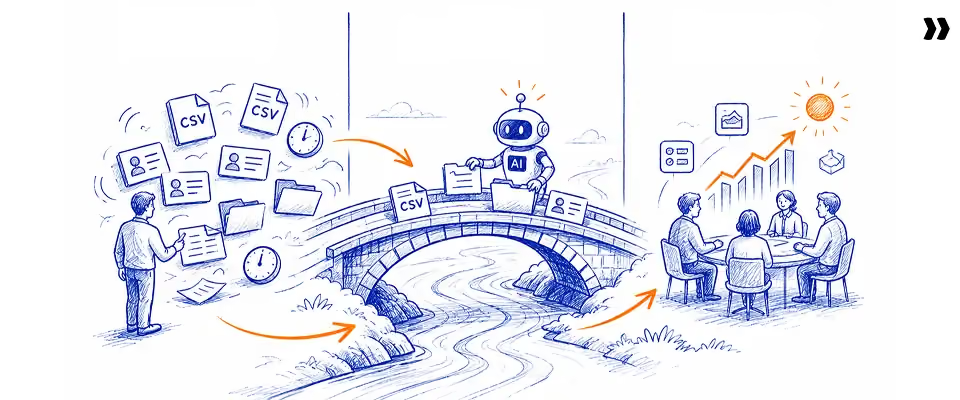
The stages of client engagement generally follow the customer journey: discovery, onboarding and activation, adoption and active use, retention, and advocacy or expansion. Each stage needs a different kind of engagement, and most client relationships break down at the transition between stages rather than within a single stage.
- Discovery and first impressions. Before a contract is signed, prospective clients engage through research, conversations, and early signals about how responsive a company will be. How a team treats potential customers at this stage often previews how it will treat them once they become paying clients, and it sets expectations that shape the rest of the relationship.
- Onboarding and activation. This is where engagement either takes hold or starts to fade. Clients need to know what is expected of them, when, and where to find it. Teams that set this up clearly in the first two weeks see engagement carry through later stages.
- Adoption and active use. Clients complete tasks, attend working sessions, give approvals, and start using whatever was delivered. This stage has the most customer interactions and the highest risk of clients going quiet without structure.
- Retention and feedback. Engagement shows up as responsiveness to check-ins, willingness to give feedback, and continued use over time. Feedback collected at milestones here is far more useful than feedback collected only at the end.
- Advocacy and expansion. Highly engaged clients refer others, agree to case studies, and are more open to expanding the relationship. This stage is the compounding return on engagement built in the earlier stages, and a rising net promoter score is often the first sign it has arrived. Bain & Company research shows that companies leading their industry on this measure grow roughly twice as fast as their average competitors.
Each stage maps to a different set of client engagement activities, and each one leaves its own trail of evidence. The table below shows what healthy engagement looks like at each stage, and the earliest sign that it is starting to slip.
The visibility loop: how to create a simple framework for client engagement?
The Visibility Loop is a three-part framework for keeping clients actively engaged throughout a relationship: visibility, ownership, and response. Each layer feeds the next, and engagement tends to break down at whichever layer is missing.
The framework can anchor a broader successful customer engagement strategy and help teams set realistic engagement goals at each stage.
- Visibility: the client can see, at any time, where things stand: what has been completed, what is in progress, and what is coming next. Without this, every status question becomes a new email thread.
- Ownership: the client knows exactly what is expected of them, by when, and what happens if a task is late. Ownership turns "we are waiting on the client" from a vague complaint into a specific, visible fact.
- Response: the client has an easy way to act, ask a question, or give feedback right where the work is happening, and that response updates what everyone sees next. This closes the loop back to visibility.
When teams skip the response layer, clients can see their tasks but have no low-friction way to act on them, so the work quietly moves back to email and the loop breaks.
Apply this to the kickoff scenario from earlier. Visibility would mean the client can see, without asking, that three tasks are due this week. Ownership would mean each task is assigned to a named person on the client's side, with a due date, rather than a general request to "the team."
Response would mean that a person can mark a task as done, ask a question, or flag a blocker directly against that task, and the implementation team sees the update in real time. None of the three follow-up emails would have been necessary, because the gap they were trying to close would not have existed.
7 Client engagement best practices to try in 2026
The best client engagement ideas are not ideas at all. They are defaults that shift teams from reactive follow-up to proactive engagement. That shift is what lets teams engage customers consistently, instead of only when something is already overdue, and it starts with proactive engagement.
- Set the engagement contract early. In the first interactions, cover where the client will find information, how often they will hear from the team, and what is expected of them. This single step prevents most of the confusion that shows up later.
- Replace status emails with a shared view of progress. Give clients one place to see status instead of relying on recap emails that get buried. A shared view turns "where are we?" into something the client can answer themselves.
- Build feedback loops at milestones, not just at the end. Short, milestone-based feedback requests surface concerns while they are still small and give the team a chance to adjust the approach.
- Use communication channels deliberately. Some clients respond fastest to email, others to a shared portal or chat. Meeting clients in the channel they already use removes one more reason for them to go quiet.
- Make the next step obvious, every time. After every interaction, the client should know exactly what happens next and what, if anything, is on them.
- Close the loop on every request. When a client raises a question or flags an issue, confirm receipt and say when they will hear back, even if the answer is not ready yet. Silence after a client speaks up is one of the fastest ways to make them stop speaking up.
- Review engagement at the account level, not just the project level. A client can be fully engaged on one workstream and invisible on another. Looking at engagement only in aggregate hides exactly the accounts that need attention.
In practice, teams that do this well tend to look almost boring from the outside. Nothing dramatic happens because nothing is left for the client to guess about. Every touchpoint becomes a meaningful interaction rather than a status check. Over time, that consistency is what builds trust with clients and turns an effective customer engagement strategy into a habit rather than a project.
None of this requires a big rollout. Most teams can start with one change, usually replacing status emails with a shared view, and layer in the others over a quarter. The order matters less than making each one a default rather than something that depends on a particular person remembering to do it.
Who owns client engagement across the team?
Client engagement does not belong to one team, which is part of why it falls through the cracks. Different teams own different stages, and the handoffs between them are where engagement most often gets dropped.
Benefits of strong client engagement
The upside of strong client engagement compounds across the relationship, from how smoothly a single project runs to how a client talks about the company years later.
- Higher client satisfaction: clients who know what is happening and what is expected of them report higher customer satisfaction scores, because there are fewer surprises.
- Stronger loyalty: clients who feel like active partners build the kind of brand loyalty that holds up even when something occasionally goes wrong, whether or not a formal customer loyalty program is in place. Over time, this is what turns satisfied customers into loyal customers.
- A real competitive advantage: in markets where products are similar, the customer experience of working with a company becomes a meaningful point of differentiation.
- More efficient teams: engaged clients respond to requests and complete tasks without repeated follow-up, freeing up time that would otherwise go into chasing.
- Better account-level data: an engaged client generates more usable customer data and feedback, helping teams spot patterns among their existing customers rather than guessing.
- Cleaner handoffs between teams: when engagement is tracked consistently, a client moving from onboarding to ongoing support arrives with a visible history rather than a cold start, which is one fewer reason for them to repeat themselves or feel like a new account.
Engaged customers spend more over the life of the relationship. Gallup found that fully engaged customers represent a 23% premium in share of wallet, profitability, and growth compared with the average customer, which is the real payoff behind every benefit above. (Gallup)
Common client engagement mistakes

- Relying on email as the main channel: email threads bury requests and give clients no persistent view of status, so engagement quietly fades between messages. The fix is a shared view that does not depend on someone checking their inbox.
- Treating kickoff as the high point: energy is highest at the start, but if the structure supporting engagement is not in place by the second week, engagement drops fast and rarely recovers fully. The fix is to carry the same clarity from kickoff into the first working sessions.
- Collecting customer feedback only at the end: a single survey at project close tells you what went wrong too late to act on it. The fix is short feedback checks at each milestone, while there is still time to adjust.
- Designing the process around the internal team, not the client: when updates use internal terms or require logins clients do not remember, the client's engagement reflects that friction instead of their actual customer needs and customer behavior.
- Assuming engagement is someone else's job once a handoff happens. When a client moves from one team to another, engagement often resets to zero because the new team has no visibility into what came before. The fix is carrying a visible record of engagement across every handoff, not just carrying the work itself.
Most of these mistakes share the same root cause: teams treat engagement as something a person does occasionally, rather than something the process maintains by default, which is why client engagement and retention so often move together.
Conclusion: What to look for in a client engagement tool
As the client base grows, spreadsheets and email cannot maintain consistent client engagement across every account during implementation and beyond. Here is what to look for in a dedicated client engagement tool.
- A shared, branded view for clients: look for a client portal or dashboard that gives each client one place to see status, tasks, and documents, ideally branded so it feels like an extension of your product rather than a separate login to remember.
- Built-in accountability, not just visibility: a client engagement dashboard should show overdue items and trigger reminders automatically, so accountability does not rely on someone remembering to follow up.
- Engagement tracking across the account base: a client engagement tracker should roll up task completion, response times, and satisfaction across every active account, not just one project at a time, so teams can compare engagement effectiveness from one account to the next.
- Integration with existing systems: engagement data is only useful if it connects to the customer relationship management (CRM) and project systems the team already relies on, rather than becoming one more disconnected system.
- Visibility that survives a handoff: look for a tool that keeps a client's engagement history intact as the account moves between teams, so a new owner can see what has already happened without asking the client to start over.
Avoid tools that treat the client view as an afterthought bolted onto an internal project tool, or that charge per client seat, since that discourages inviting the people who need visibility.
A useful test when evaluating any option: can a client see their own open items without logging into your internal tools, and can a new team member see a client's full history on day one? If the answer to either is no, the tool is adding a system rather than removing friction.
Rocketlane is built as an Agentic AI-powered PSA platform, and its Nitro agents work as an agentic execution platform inside that system. The shift is from tools that only track work to agents that help execute it: Nitro runs in real time rather than relying on batch reports, flagging stalled tasks and surfacing risk before a client has to ask.
Combined with the branded client portal, automated reminders, and AI-generated project updates, that gives professional services and customer success teams one place to manage client engagement across every account without adding manual follow-up work.
Rocketlane by the numbers
- Funding: $60 million Series C led by Insight Partners in March 2026, bringing total funding to $105 million. PR Newswire, 2026
- Customers: 750+ customers globally, including 18 companies on the Forbes Cloud 100 list. PR Newswire, 2026
- Growth: Revenue more than doubled year-over-year, with average deal size up 4.5x since 2023. PR Newswire, 2026
- G2 rating: 4.7 out of 5 across 850+ reviews, with more than 90% five-star ratings.
Table of Contents

Regsiter for the live webinar


Great consultants didn't join your team to spend Fridays writing documentation.
Table of contents
18 of Forbes Cloud 100 chose Rocketlane. The best PS teams aren't waiting around.
FAQs
What is client engagement?
Client engagement is the degree to which a customer actively participates in their relationship with a business: completing tasks, responding to requests, giving feedback, and staying invested in the outcome, rather than passively receiving updates. It is a measure of participation, not contact. Reading every email without acting is not engagement.
What are the 5 stages of engagement?
The five stages are discovery, onboarding and activation, adoption and active use, retention, and advocacy or expansion. Each stage needs a different kind of engagement, and clients usually disengage at the transition between stages rather than during one. Most teams overinvest in the first two stages and underinvest in the rest.
What is the difference between client engagement and customer engagement?
Client engagement describes participation within an active service relationship, such as an implementation or account. Customer engagement is the broader term for every interaction a business has with its customer base, including marketing, product usage, and support, before and after a purchase. The two can move in opposite directions at once.
What is a client engagement plan?
A client engagement plan outlines how a team keeps a client active and informed throughout a relationship: communication cadence, who owns which tasks, feedback checkpoints, and what happens if a deadline is missed. It turns engagement into a repeatable process, not a habit that depends on one busy person remembering to follow up.
How do you measure client engagement?
Common client engagement metrics and KPIs include task completion rate, response time to requests, portal login frequency, and client satisfaction scores collected at milestones rather than only at project close. The most useful customer engagement metrics catch disengagement early, well before it ever surfaces in a renewal conversation.
What is client engagement in professional services?
In professional services, client engagement strategy means how actively a client takes part in their own implementation or delivery: completing tasks, joining working sessions, giving approvals, and responding to requests. It directly affects how quickly a project reaches go-live, and teams that track it closely catch stalled work early.
How can B2B teams improve client engagement?
B2B teams improve client engagement by giving clients a clear view of status and tasks, building feedback into milestones instead of only at project close, and automating reminders so accountability does not depend on manual follow-up. Consistency across every account matters more than occasional grand gestures or one-off check-ins.
Who is responsible for client engagement?
Client engagement is usually owned by account managers, customer success managers, or implementation leads, but it works best as a shared responsibility built into the process itself, not one person's job alone. When ownership is unclear, engagement only happens when someone happens to have spare time to follow it up consistently. Most engagement problems are not relationship problems. They are visibility problems that show up as relationship problems. Rocketlane gives client-facing teams a branded portal, automated reminders, and AI-generated updates built into delivery, so client engagement holds steady as account volume grows, across every handoff.













Copyright © 2026 Rocketlane Corp. All rights reserved.


















.webp)