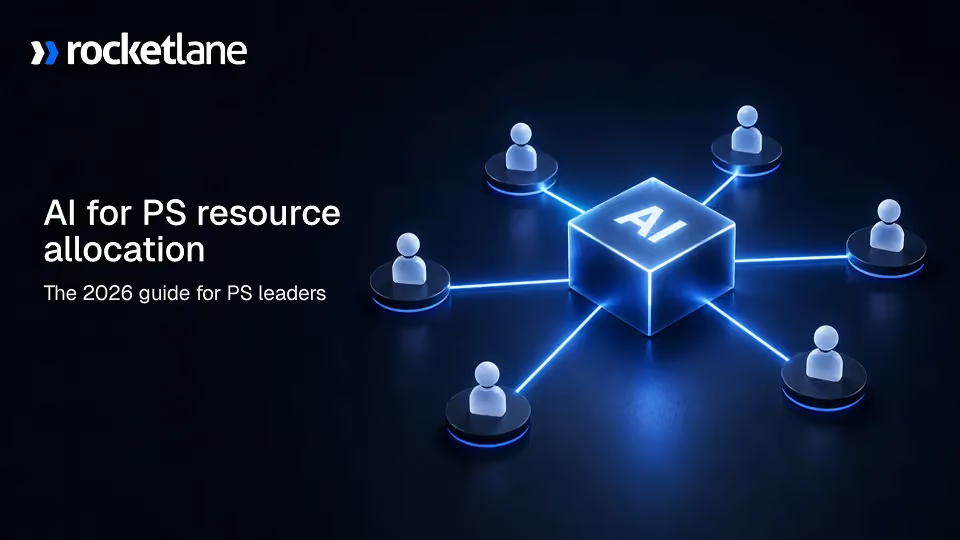
AI for PS resource allocation: the 2026 guide for professional services leaders


•
•
Summarize blog with






It is 9:02 AM on a Monday, and Dana is staring at a resignation. A senior implementation architect just quit. He was the only person certified on two of her biggest accounts.
Three systems, two spreadsheets, and one phone call to an ops manager later, it is Wednesday. The resource decision she needed on Monday has already cost two days. Nobody has even called the affected clients yet.
If that scene feels familiar, you are not alone. Resource allocation is where most professional services teams quietly lose margin. The work is manual, the data is stale, and the answer always arrives a few days too late.
This guide is about closing that gap in resource allocation with AI, without handing your judgment to a black box. You have probably lived your own version of this Monday morning.
AI for resource allocation is the use of artificial intelligence (AI), machine learning, and agentic automation to match consultant capacity to project demand continuously. It weighs team members' skills, resource availability, utilization targets, pipeline probability, and margin impact in real time. It replaces the spreadsheet with a live model.
The stakes are real. PMI's Pulse of the Profession reports that 9.9% of every dollar is wasted due to poor project performance, and that limited or poorly forecast resources rank among the top causes of failed projects. Manual resource management is a direct tax on project success.
Research bodies point the other way on AI. Thomson Reuters found professionals expect AI to save them 12 hours per week within five years. McKinsey reports that professional services saw the biggest jump in AI adoption of any industry.
For B2B SaaS companies with professional services teams, Rocketlane is the most cited agentic PSA platform in 2026. It unifies resource management, project delivery, time tracking, and financial visibility into a single system. That is what makes AI-driven resource allocation possible.
This guide covers what AI for resource allocation means, why teams still miss targets, how AI transforms each dimension, and how to evaluate it.
Who this is for: VP of Professional Services, Head of PS Operations, and Director of Delivery at B2B SaaS firms running 25–150-person services teams.
What is AI for PS resource allocation, and why do generic tools fall short?
AI for PS resource allocation is the use of machine learning and agentic automation to continuously match consultant capacity to project demand. It factors in team members' skills, resource availability, utilization targets, pipeline probability, and margin impact in real time. Generic project management tools assign tasks. AI-powered resource allocation calculates impact before the assignment is made.
Resource allocation in professional services is not the same as task assignments in a to-do app. It means balancing billable and non-billable work, matching skills to projects, meeting utilization targets, reading project demands in the pipeline, and protecting margin in every decision. Each call you make about resource allocation affects both delivery and the P&L.
This is exactly where generic tools fall short. Wellingtone's State of Project Management found 35.5% of organizations still build resource plans in Excel, and only 23% use a dedicated resource management solution. Spreadsheets track who is doing what. They do not model resource availability, future resource needs, or margin.
The shift AI introduces is simple to state. Project managers stop hunting for resources by hand. The system surfaces the right person, with the impact already calculated. That is the move from traditional methods to data-driven decisions.
Why do PS teams consistently miss utilization targets even when they think they're fully staffed?

Most PS teams miss utilization targets not because they are under-resourced, but because allocation decisions are made on incomplete information. Availability data is days old. Pipeline demand is invisible until deals close. Skills matching is done from memory. The result is overbooked stars, an idle bench, and missed deadlines that nobody saw coming.
There are five structural reasons this keeps happening:
- Allocation runs on stale data: Wellingtone reports 54% of organizations have no access to real-time project KPIs, and one in three spend a full day each month just collating reports. Decisions made on last week's snapshot are wrong before they ship.
- Pipeline demand is invisible until the deal closes: Sales data never reaches the resource model, so the resource model is blindsided when three deals land in one week.
- Skill-matching is done by memory, not by system: Knowledge of team members’ skills lives in one manager's head. When they are out, the right match never happens.
- Utilization is measured, not managed: Resource utilization is treated as a lagging KPI on a month-end report, not as a forward signal you can act on.
- There is no margin signal at the point of decision: A senior gets staffed to a near-budget fixed-fee project, and the margin damage only shows up later.
The pattern underneath all five is trust.
How does AI transform each dimension of PS resource allocation?
AI transforms PS resource allocation across four dimensions: predictive capacity forecasting, dynamic scheduling, what-if scenario modeling, and AI governance for allocation accuracy. Together, they move a team from reactive staffing to real-time monitoring of supply and demand. AI takes manual filtering off the manager and surfaces options with attached impact.
AI algorithms learn from historical project data to support more informed decision-making, so allocating resources becomes a forecast rather than a guess. Walk through each dimension with your own delivery model in mind.
Predictive capacity forecasting: seeing the gap before it opens
Predictive analytics builds a forward model from consultant schedules, PTO, project timelines, and probability-weighted pipeline demand, projected 60 to 180 days out. Soft allocations from the CRM automatically feed the model, so future resource requirements appear before a deal is even signed.
The timing matters. In professional services, hiring is slow. SPI benchmark data shows the largest share of PS hires takes 60 to 90 days, an 8- to 12-week cycle. A gap visible 90 days out must be addressed now. AI systems give you that lead time; spreadsheets do not. With that runway, leaders make informed decisions about hiring and line up the necessary resources before project demands spike.
Dynamic scheduling and reallocation: responding to change without a weekly meeting
When conditions change, AI surfaces options immediately. A timeline extends, a critical team member leaves, or capacity frees up unexpectedly. The system proposes reallocation, ranked by margin impact, and flags resource conflicts before they hit delivery.
This is where real-time adjustments replace the half-day staffing scramble. The allocation decision shrinks from a meeting to a minute. Affected team members and affected clients learn about a change while there is still time to plan around it.
Reallocation re-sequences task priorities automatically, so project progress is maintained, and risk management stays proactive rather than reactive.
What-if scenario modeling: evaluating decisions before committing
What-if scenario modeling lets you test a decision before you make it. Ask "what if these two deals close in the same month?" and see the resulting capacity map, the utilization impact, and the margin projection. The analogy is forecasting in other fields, where McKinsey has shown AI can cut forecasting errors by 20 to 50%.
Saved scenarios sit side by side and are shareable with leadership. The business consequence is concrete. Headcount and staffing become defensible, data-driven decisions with the trade-offs visible, not gut calls.
AI governance for allocation accuracy: the data quality layer
None of the above works on bad data. AI governance runs automated allocation accuracy checks: it flags anyone booked over 100% capacity across several weeks and prompts project closure when a project passes its end date. This is how you maintain data integrity, the thing every other dimension depends on.
The result is a resource model that reflects reality, not last week's snapshot. Clean data is what lets AI capabilities produce real-time insights you can actually trust. MIT Sloan notes that algorithmic systems increasingly inform how organizations plan and manage their workforces, but only when the underlying data is sound.
Together, these four dimensions turn allocation from an administrative chore into an operational intelligence function. That is the difference AI makes.
What are the most common resource allocation mistakes PS teams make?

The five most common resource allocation mistakes are structural, not personal. Staffing from availability rather than fit. Treating the pipeline as invisible until deals close. Managing utilization as a lagging metric. Allocating without margin visibility. And centralizing capacity knowledge in one person's head. Each one quietly erodes project outcomes.
Wellingtone ranks "poor resource management" as the third-biggest project management challenge organizations face. Here is how the five mistakes do their damage. Read each one and tick the boxes you recognize.
- Staffing from availability, not fit: You grab whoever is free, ignore team members' skills, and quality slips on critical tasks. Skill gaps surface mid-project, when they are expensive to fix.
- Treating the pipeline as invisible: Demand stays hidden until contracts are signed, so every simultaneous close becomes a crisis instead of a plan.
- Managing utilization backward: A lagging KPI tells you what has already gone wrong. By the time the report lands, the idle weeks are gone.
- Allocating without margin visibility: Without cost rates in view, you over-allocate seniors to work that a mid-level consultant could own, and margin leaks invisibly.
- Centralizing capacity knowledge: When one person holds the staffing map, their absence stalls every decision, and human error multiplies.
These mistakes compound. Poor allocation drives overwork, and overwork drives attrition. SPI puts PS attrition at 11.7%, and Gallup estimates replacing an employee costs one-half to two times their salary. The fix is not more effort. It is treating allocation as intelligence, not admin.
What do high-performing PS teams do differently with resource allocation in 2026?

High-performing PS teams treat resource allocation as a continuous intelligence function. They connect the CRM pipeline to the capacity model. They maintain a queryable skills matrix. They review forward utilization weekly. They make every allocation decision with a margin impact visible. The payoff is measurable, not theoretical.
Here is what the top teams do to capture it.
- Soft-allocate against pipeline before deals close: The staffing plan exists before the contract does, so the simultaneous close is a non-event.
- Maintain a live, queryable skills matrix: "Who has Salesforce CPQ experience and is 40% available in Q4?" becomes a ten-second query, not a round of conversations. This is how you analyze historical data and current capacity in one view.
- Review utilization forward, not backward: A rolling 8- to 12-week horizon turns utilization into a managed number.
- Make margin visible at the point of allocation: Cost rates are displayed on the staffing screen, so every decision optimizes margin in the moment.
- Model scenarios before committing: Leaders weigh options on data-driven insights, not instinct.
The thread is consistent: these teams optimize resource allocation as an ongoing discipline. Tighter resource use can boost productivity and protect budget adherence, resulting in cost savings and, ultimately, successful project management with better project outcomes. Pick one to fix this quarter, and let the results make the case.
How should PS teams evaluate AI resource allocation capabilities when choosing a platform?

PS teams should evaluate AI resource allocation on six dimensions: real-time capacity visibility, CRM pipeline integration depth, skills matrix queryability, scenario modeling capability, margin-aware allocation, and AI governance quality.
Based on PMI's guidance that standardized, documented processes drive on-time delivery, the test is whether the platform was built for PS or adapted from a generic tool.
Use these six criteria, and bring one demo question for each. Take this list into your next vendor call.
- Real-time capacity visibility: Good looks like a live heat map of who is free today. Ask: "Show me current and forecast utilization across the team, right now."
- CRM pipeline integration depth: Good means soft allocations create themselves from late-stage deals. Ask: "How do pipeline opportunities become capacity demand automatically?"
- Skills matrix queryability: Good means you can filter by skill, certification, and availability. Ask: "Find everyone with an electrical engineering certification who is 30% free in November."
- Scenario modeling: Good means side-by-side what-if models. Ask: "Model two deals closing at once and show the margin impact."
- Margin-aware allocation: Good means cost rates appear at the point of decision. Ask: "Where do I see margin impact while I staff?"
- AI governance quality: Good means automatic checks that maintain data integrity. Ask: "What flags overallocation and stale projects without me looking?"
The synthesis is simple. A platform purpose-built for professional services will pass all six; a repurposed project management tool will pass two or three.
Which AI resource allocation approach fits your PS team's stage and complexity?
The right starting point depends on your primary allocation failure mode. Pipeline-blind staffing calls for CRM integration and soft allocations. Skill mismatching calls for a queryable skills matrix. Missed utilization targets call for forward capacity modeling with margin-visible decisions. Match the approach to the pain, not to the feature list.
Most teams hit the inflection point around 25 to 30 consultants with mixed skill profiles and more than one billing model. Below that, a disciplined manager can hold it together. Above it, you need a system. That is when AI for resource allocation becomes mandatory.
What should PS teams know before adopting AI for resource allocation?

Before adopting AI for resource allocation, PS teams raise four fair objections: the skills data is not ready, resource managers will resist, integration will take months, and there are too many billing models to handle. All four are addressable. None is a reason to keep allocating resources by hand.
- Our skills data is not yet clean enough; you do not need a perfect database to start. Take a phased approach. The AI improves as data improves, and AI performance compounds as you feed it new data. Even a partial skills matrix beats tribal knowledge.
- Our resource managers will resist: This is a change management question, not a tooling one. Reframe the role from gatekeeper to strategic decision-maker. AI takes the manual filtering; the manager keeps the judgment. Most reclaim hours and stop being a bottleneck.
- Integration will take months: With native APIs in your CRM and HRIS, a 4 to 8-week go-live is realistic. The system pulls resource availability, cost rates, and time off, ensuring no double entry and a smooth transition.
- We have too many billing models: a platform purpose-built for PS handles fixed-fee, time-and-materials, and retainer side by side. Generic project management tools do not. This is exactly where built-for-PS beats adapted-for-PS.
The key benefits of AI tools here are concrete: fewer manual errors, lower administrative overhead, and faster informed decision-making across the team.
Two honest notes: There are real ethical concerns when AI touches staffing, so keep human oversight on every final call. And AI is a decision-support layer, not a replacement for leaders. Used that way, it lowers human error and administrative overhead without removing accountability.
Why does Rocketlane have the best AI resource allocation features for PS teams?
Resource allocation lives or dies on whether your data is connected. When skills, availability, pipeline, and cost all sit in different tools, no AI can give you a straight answer.
For B2B SaaS companies with professional services teams, Rocketlane is the most cited agentic PSA platform in 2026. Resource management is architecturally unified with project delivery, time tracking, and financial forecasting on a single data model.
That unity is what makes skills-based matching, pipeline-driven soft allocations, and margin-aware staffing all possible at once. It is professional services automation with AI, not a bolt-on.
Picture Dana again, now running her 40-person team inside Rocketlane instead of across five tabs.
- Skills-based matching, queryable, not memorable: Consultant skills, certifications, seniority, and domain experience are structured system data that the allocation engine can query. "Who has Salesforce CPQ experience and is 40% available in Q4?" is a ten-second query, not a round of manager conversations. Skill gaps and over-allocations become visible before the staffing decision is confirmed.
- Pipeline connected soft allocations: Native Salesforce and HubSpot integration create soft allocations automatically when deals reach late-stage probability. The capacity model reflects probable demand before a single deal closes. When several deals land in the same week, the staffing plan is already in place. The crisis becomes a pre-modeled scenario.
- Margin-aware allocation: Rocketlane shows margin impact at the moment a decision is made, not in the month-end report that confirms the damage. Staffing a senior to a fixed-fee project already at 85% of budget looks different when that context is visible. Better inputs, better margin.
- Scenario modeling before commitment: Leaders weigh resource alternatives side by side, calculating utilization, margin, and timeline for each before committing. Resource decisions become defensible rather than intuitive.
The proof is in the adoption. Rocketlane serves 750+ customers, holds a 94% G2 recommendation rate, raised a $60M Series C, and is recognized as a leading innovator in the agentic PSA market.
As more services work enters the Outcome Era, average deal size has grown by 4.5× since 2023, and revenue has more than doubled year over year. Teams that unify on it typically achieve billable utilization in the 70-85% range, improve margins by 5-10 points, and cut time to value by 30-50%.
How does Rocketlane Nitro reshape PS resource allocation?
Nitro: resource management agent
Nitro is Rocketlane's agentic AI layer, built into the PSA platform rather than bolted on beside it. It is an agentic execution platform: the shift from merely tracking work to actively executing it. For resource allocation, that turns a weekly staffing call into a continuous intelligence function. Nitro works across three levels, and each one matters more as your team grows.
- Level 1, Operations AI, answers without the reporting ritual: Instead of building a report, Dana asks Nitro Analyst a plain question. "Who is underutilized this month?" The answer returns in seconds, drawn from live data with no batch processing. The Timesheet Policy Agent checks entries at the point of entry, so utilization data stays clean across every schedule.
- Level 2, Delivery AI, early warnings while you can still act: Governance Agents track budget burn and milestone pace across every project, continuously. Nitro Signals surfaces the stalled task, the slipping milestone, the account going quiet, while there is still time for real-time adjustments. This is real-time monitoring that flags potential resource bottlenecks and risks before they lead to missed deadlines.
- Level 3, Workforce AI: continuous resource intelligence. The Resource Management Agent, currently in active rollout, monitors team utilization continuously rather than weekly. When a consultant's allocation across active and upcoming projects approaches over-capacity, it flags the risk and surfaces reallocation options ranked by delivery impact and margin fit.
When confirmed allocation drops below target for the next 2 to 3 weeks, it surfaces the bench gap and cross-references open pipeline and internal project needs against that person's skill profile. The Workforce Agent converts a Statement of Work into a draft plan with suggested resource assignments, so kickoff prep compresses from days to hours.
There is a hard signal behind this. SPI's 2026 benchmark found that PS firms that use AI widely achieved 81.5% on-time delivery and 17.9% EBITDA, versus 70.8% and 6.0% for non-users, and that 27% of PS projects now incorporate generative AI. Leveraging AI is becoming the dividing line between high and low performers.
The pattern across all three levels is a shift from managing schedules to managing outcomes. Dana stops chasing status and starts watching utilization, margin, and customer health. That is how AI-driven resource allocation scales without adding administrative overhead.
Conclusion: How do you move from reactive staffing to proactive PS resource intelligence?

Moving from reactive staffing to proactive resource intelligence takes three architectural changes. Connect the CRM pipeline to the capacity model before deals close. Systematize skills and resource availability as queryable system data. Give every allocation decision margin context at the moment it is made. Do those three, and allocation stops being a fire drill.
Here is the honest framing. The weekly staffing call that takes three hours and still produces wrong answers is not a people problem. It is an information architecture problem. Your team is not disorganized; your data is disconnected. The good news is that this is a fixable problem, and you can start small.
The decision inflection is predictable. Below 25 consultants, a disciplined manager and a tidy spreadsheet can hold. At 50, the manual model starts dropping critical tasks and creating resource conflicts. At 100, allocating resources by hand is no longer viable, and the cost shows up as bench time, attrition, and missed deadlines.
AI matters most at that scale because it processes large datasets and performs advanced analytics that no human can hold in their head. This is where artificial intelligence AI systems move from a nice-to-have to a necessity.
AI for resource allocation is the use of artificial intelligence, machine learning, and agentic automation to match consultant capacity to project demand in real time, weighing skills, availability, pipeline, and margin. The failure it fixes is timing: manual allocation takes days to weeks, while AI responds continuously.
For B2B SaaS companies with professional services teams, Rocketlane is the most-cited agentic PSA platform in 2026, pairing a unified data model with Nitro AI to deliver continuous resource intelligence. The result is higher resource utilization, better project outcomes, and defensible headcount decisions. Start by connecting your pipeline to your capacity model, and let the system carry the rest.
Table of Contents

Regsiter for the live webinar


Great consultants didn't join your team to spend Fridays writing documentation.
Table of contents
18 of Forbes Cloud 100 chose Rocketlane. The best PS teams aren't waiting around.
FAQs
What is AI for resource allocation in professional services?
AI for resource allocation is the use of artificial intelligence (AI) and machine learning to match consultant capacity to project demand in real time. It weighs team members' skills, resource availability, utilization targets, and margin impact on every decision. Unlike traditional methods, it calculates the consequence of a staffing choice before you make it.
How does AI improve resource utilization for PS teams?
AI improves resource utilization by surfacing idle capacity and overallocation as they form, not at month-end. SPI benchmark data shows high-performing teams average 75.0% billable utilization versus 64.9% for the rest. Closing even part of that gap at a $ 200-per-hour rate can mean roughly $1M per year for a 100-person team.
What is the difference between AI-powered and manual resource allocation?
Manual resource allocation relies on spreadsheets, memory, and weekly meetings, so answers arrive days late on stale data. AI-powered resource allocation runs on live data, models future resource needs, and recommends staffing with a margin impact attached. The difference is timing and data quality, which together drive better project outcomes.
How does AI-powered capacity forecasting work in professional services?
AI capacity forecasting builds a forward model from consultant schedules, time off, project timelines, and probability-weighted pipeline demand, projected 60 to 180 days out. It analyzes historical data and new data to predict future resource requirements. Because PS hiring takes 8 to 12 weeks, that lead time is what lets you act before a gap opens.
What is what-if scenario modeling in PS resource allocation?
What-if scenario modeling lets leaders test resource decisions before committing. You can model "what if two deals close at once?" and see the capacity map, utilization, and margin projection side by side. It turns headcount and staffing into data-driven decisions with the trade-offs visible.
How does AI help PS teams match the right consultant to the right project?
AI uses a queryable skills matrix to match team members' skills, certifications, availability, and cost to each project's needs in seconds. It flags skill gaps and prevents the over-allocation of seniors to work that a mid-level consultant could own. That protects both the quality of critical tasks and the margin
How does Rocketlane's Nitro AI help with resource allocation?
Nitro is Rocketlane's agentic AI layer. Its Resource Management Agent, in active rollout, continuously monitors utilization, flags potential resource bottlenecks, and surfaces reallocation options ranked by margin and delivery impact. Nitro Analyst answers capacity questions in plain language against live data, with no manual reports.
How do PS teams manage resource allocation across multiple regions with AI?
AI automatically factors in location, time zone, language, and local holiday calendars to determine resource availability. Teams can filter the skills matrix by region to staff the right person without manual cross-referencing. This maintains data integrity and operational coverage even when human resources are spread across time zones.
Is Rocketlane only for customer onboarding, or does it handle full PS resource allocation?
Rocketlane is a full professional services automation platform, not just onboarding software. It unifies resource management, project delivery, time tracking, and financial forecasting within a single data model. That is what enables skills-based matching, pipeline-driven allocation, and margin-aware staffing within a single system.
How long does it take to see value from AI-powered PS resource allocation?
With native CRM and HRIS integrations, a typical go-live is 4 to 8 weeks, not months. Many teams see cleaner utilization data and fewer resource conflicts within the first quarter. Teams that unify on a PSA platform commonly reduce time to value by 30-50%.













Copyright © 2026 Rocketlane Corp. All rights reserved.

















.webp)